Sydney (YSSY) Changes
Future Procedure
This page documents future procedures that are scheduled to be introduced on 09 July 2026.
Controllers are strongly encouraged to familiarise themselves with the incoming changes before launch day.
Positions
| Name | Callsign | Frequency | Login ID |
|---|---|---|---|
| Sydney ADC West | Sydney Tower | 120.500 | SY_TWR |
| Sydney ADC East | Sydney Tower | 124.700 | SY-E_TWR |
| Sydney SMC East | Sydney Ground | 121.700 | SY_GND |
| Sydney SMC West | Sydney Ground | 126.500 | SY-W_GND |
| Sydney Coordinator | Sydney Coordinator | 127.600 | SY-C_GND |
| Sydney ACD | Sydney Delivery | 133.800 | SY_DEL |
| Sydney ATIS | 118.550 | YSSY_ATIS |
Non-Standard Positions
Non-standard positions may only be used in accordance with VATPAC Air Traffic Services Policy.
Approval must be sought from the bolded parent position prior to opening a Non-Standard Position, unless NOTAMs indicate otherwise (eg, for events).
Airspace
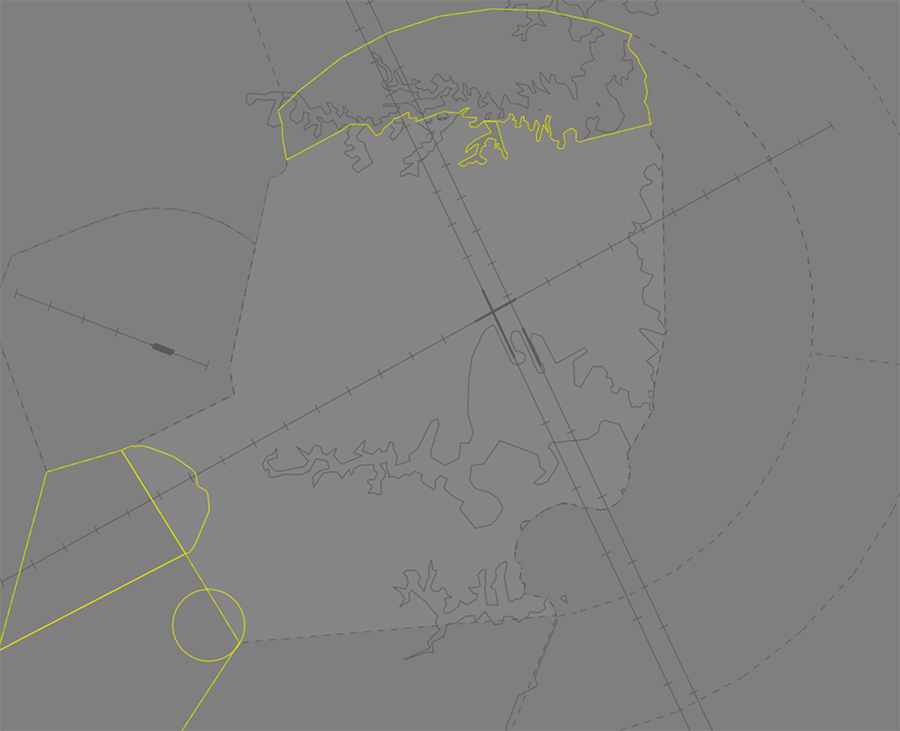
SY ADC is responsible for the Class C airspace in the SY CTR SFC to A005 as shown below.
Manoeuvring Area
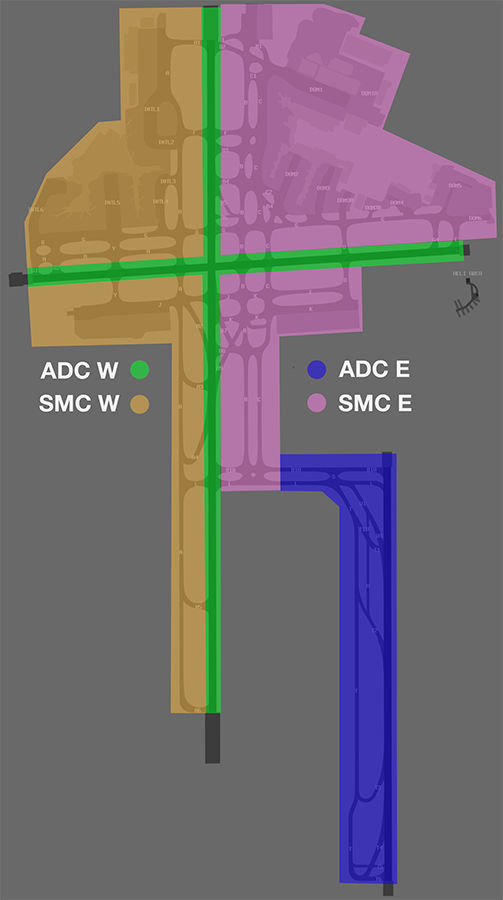
Manoeuvring Area Responsibility
Note
The vatSys ground map includes new taxiways which some simulators may not include. Some pilots will be unable to accept taxi via:
- Taxiway D south of G
- Taxiway J east of Runway 16R
- Taxiway K east of C
Heliport Responsibility
When runway 07 or 25 is in use for either arrivals or departures, the responsibility for management of the helicopter area and associated arriving and departing helicopters falls to ADC West. During all other runway modes, ADC East (if online) takes responsibility for the heliport.
Standard Taxi Routes
Standard taxi routes establish an implied set of taxi instructions which pilots are expected to comply with in the absence of other instructions. All runway crossings require an explicit crossing instruction.
Controllers do not need to explicitly say each taxiway provided it is covered by a standard taxi route in the tables below.
Important
Not all pilots are aware of the existence of standard taxi routes. When in doubt, provide full taxi instructions detailing the full desired route.
Standard taxi routes are published in Pilot Procedures and on the STANDARD DOMESTIC TAXI ROUTES charts.
Note
Controllers may choose to provide instructions which contradict a published standard taxi route to expedite traffic flow.
General Flow
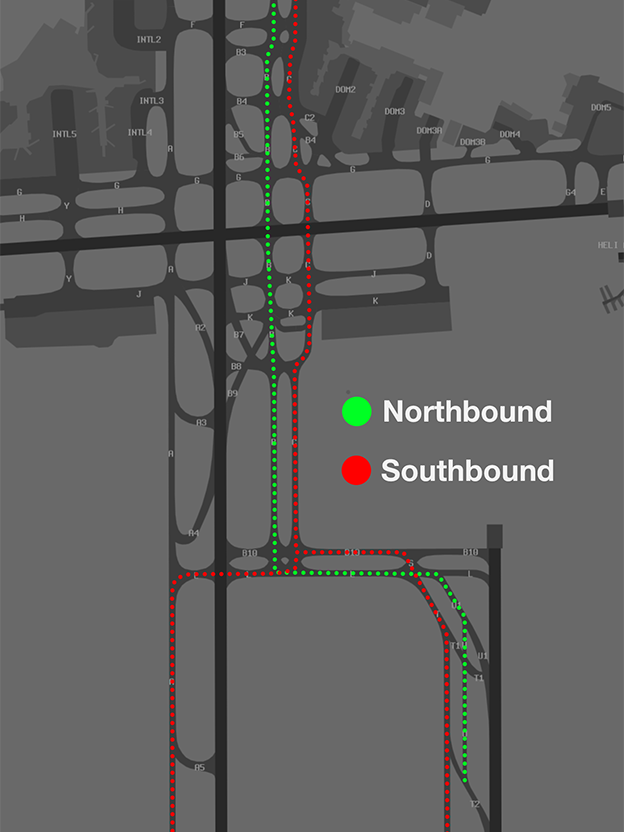
Except when the traffic situation warrants, taxi clearances shall conform to the following:
| Taxiway | Direction of Travel |
|---|---|
| B | Northbound |
| C | Southbound |
| B10 | Eastbound (except holding point for 34L) |
| L | Westbound |
Tip
For aircraft taxiing northbound on B, consider instructing them to hold short of taxiway B8 when 34L or 16R are in use for arrivals, in order to separate from aircraft using the B7 & B9 rapid exits.
Domestic Aprons
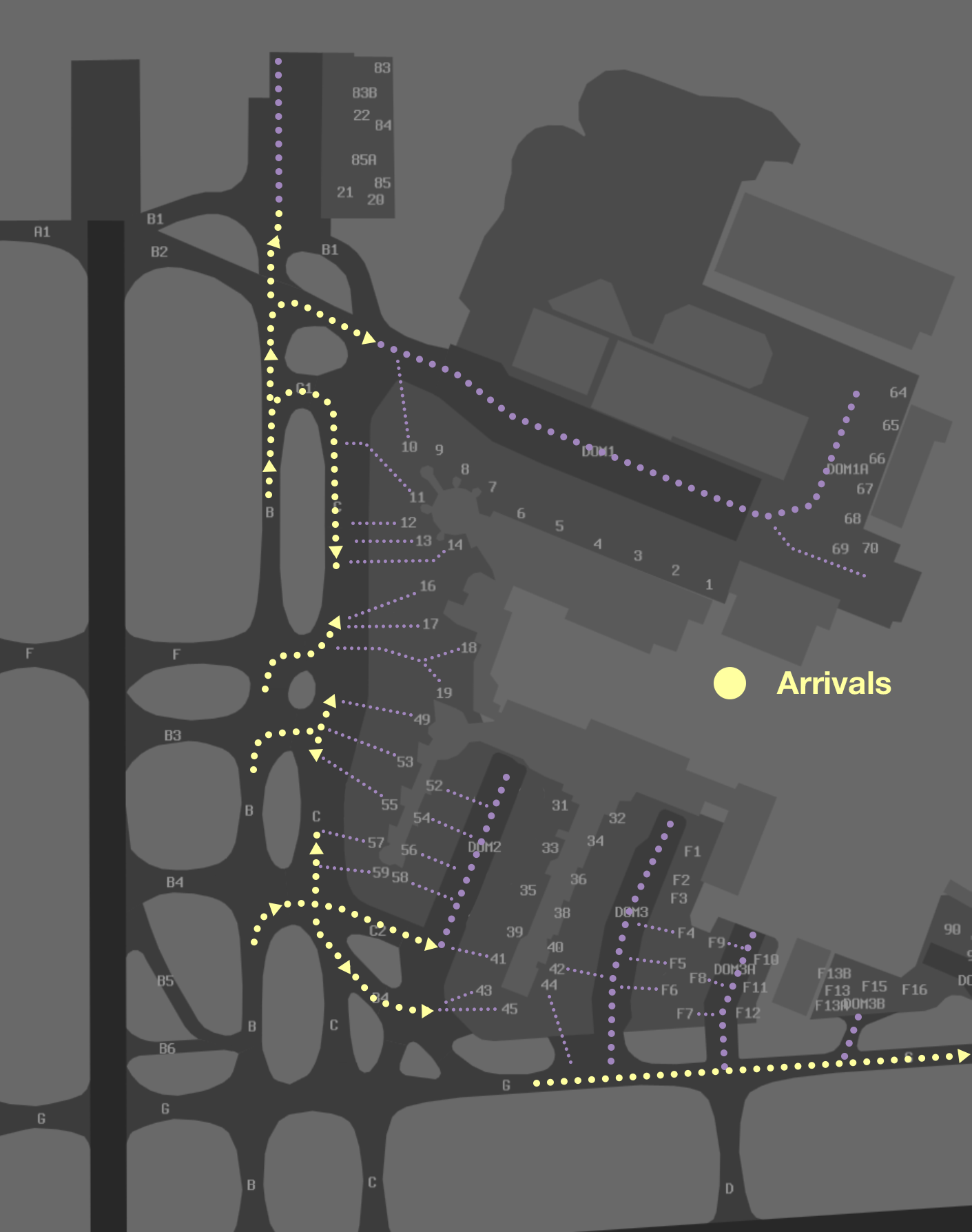
Additional standard taxi routes exist into and out of the domestic aprons.
| Parking Position | Route |
|---|---|
| B1 Apron | B |
| DOM1 & DOM1A | B, B2 |
| Taxiway C (Bays 11-14) | B, C1 |
| Taxiway C (Bays 16-19) | B, F |
| Taxiway C (Bays 49, 53, 55) | B, B3 |
| Taxiway C (Bays 57, 59) | B, B4 |
| DOM2 (All bays except below) | B, B4, C2 |
| DOM2 (Bays 43, 45A) | B, B4 |
| DOM2 - A330 aircraft (Bays 39, 45) not pictured | B, G, DOM2 |
| DOM3, DOM3A, DOM3B, DOM4, DOM5 & DOM6 | B, G |
Example
If an aircraft vacates runway 34L for bay 52 and is instructed to 'cross runway 25, taxi to the bay', they would be expected to taxi via B, B4, and C2.
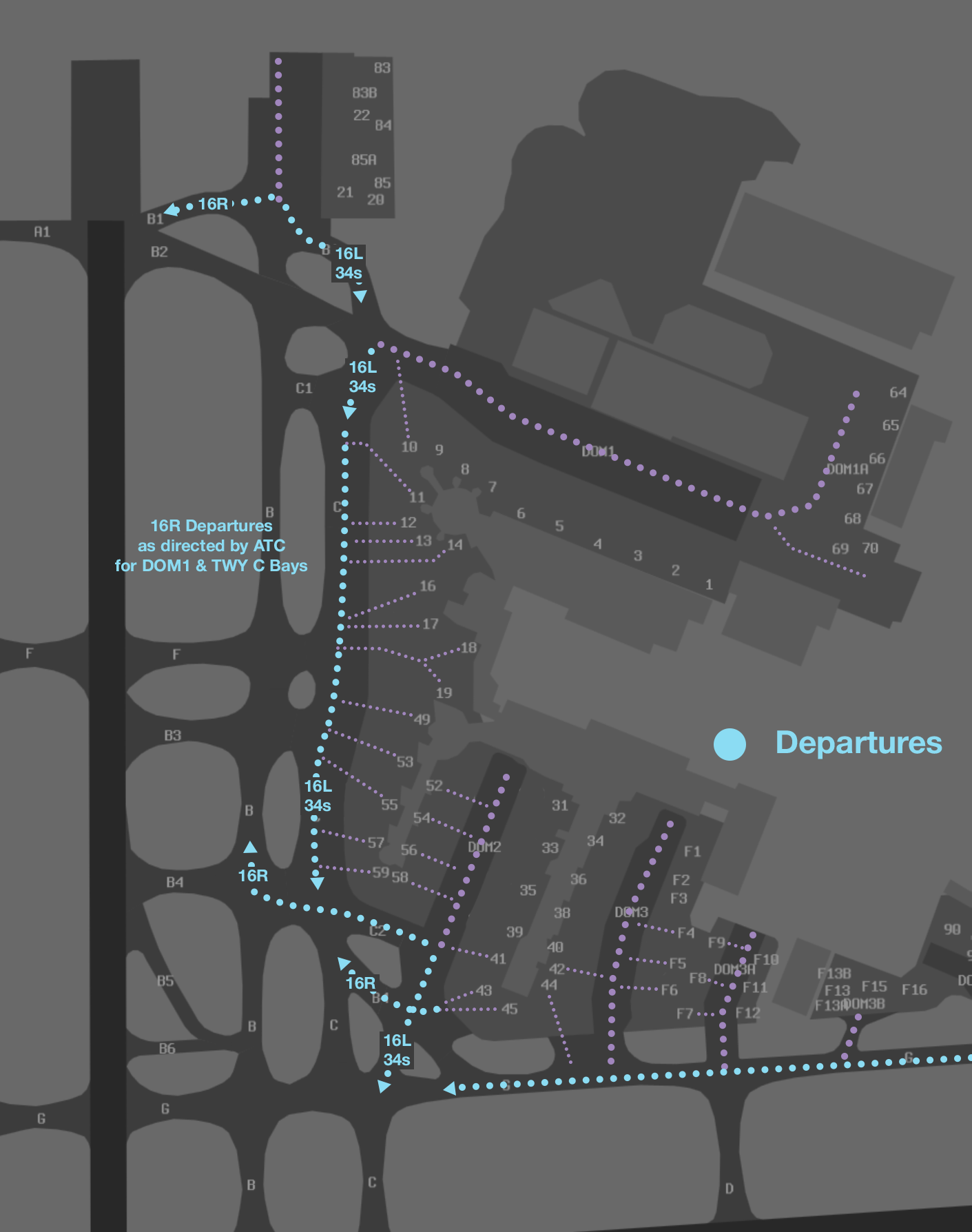
| Parking Position | Departure Runway | Route |
|---|---|---|
| B1 Apron | 16R 16L 34L - Prop 34L - Jet 34R |
B1 B1, C, B10 B1, C, B10 B1, C, L, A, A6 B1, C, B10, S, T, T6 |
| DOM1, DOM1A & Taxiway C Bays | 16R 16L 34L - Prop 34L - Jet 34R |
As Directed by ATC C, B10 C, B10 C, L, A, A6 C, B10, S, T, T6 |
| DOM2 (All bays except below) | 16R 16L 34L - Prop 34L - Jet 34R |
C2, B4 DOM2, C, B10 DOM2, C, B10 DOM2, C, L, A, A6 DOM2, C, B10, S, T, T6 |
| DOM2 (Bays 43, 45A) | 16R 16L 34L - Prop 34L - Jet 34R |
B4 DOM2, C, B10 DOM2, C, B10 DOM2, C, L, A, A6 DOM2, C, B10, S, T, T6 |
| DOM2 - A330 aircraft (Bays 39, 45) | 16R 16L 34L 34R |
DOM2, G, B DOM2, C, B10 DOM2, C, L, A, A6 DOM2, C, B10, S, T, T6 |
| DOM3, DOM3A, DOM3B, DOM4, DOM5 & DOM6 | 16R 16L 34L - Prop 34L - Jet 34R |
G G, C, B10 G, C, B10 G, C, L, A, A6 G, C, B10, S, T, T6 |
Example
If a jet aircraft from bay 6 for departure from runway 34L is instructed to 'cross runway 25, hold short runway 34L', they would be expected to taxi via C and L.
ERSA FAC YSSY noise abatement procedures require jet aircraft to depart runway 34L from full length only. This should be simulated where practical but intersection departures should be offered to jet aircraft on request where available.
Runway 16L/34R
When both ADC and SMC are online, SMC shall issue aircraft departing on runway 16L/34R with a taxi limit in accordance with the table below. When runway 34R is in use, ADC shall issue further taxi to the holding point, considering any conflict with arriving aircraft taxiing via U1 and L.
| Departure Runway | Taxi Limit |
|---|---|
| Runway 16L | Holding point B10 |
| Runway 34R | Taxiway S |
Phraseology
SY SMC: "VOZ853, taxi via Charlie, cross runway 25, hold short Sierra"
VOZ853: "Taxi via Charlie, cross runway 25, hold short Sierra, VOZ853"
VOZ853: "Sydney Tower, VOZ853, holding short Sierra, ready"
SY ADC: "VOZ853, Sydney Tower, give way to the inbound Jetstar A320, taxi to holding point Tango Six, runway 34R"
Aircraft landing on runway 16L/34R are expected to vacate the runway and taxi via the standard taxi routes to join taxiway Lima. If pilots are unfamiliar with local procedures, they should be instructed by ADC to taxi accordingly. Where possible, outbound aircraft should give way to inbound aircraft to avoid creating congestion at the runway exits.
Phraseology
SY ADC: "JAL52, taxi via Tango, Lima, on Lima contact Ground 121.7"
The standard arrival taxi routes are:
| Landing Runway | Route |
|---|---|
| RWY 16L | T, L |
| RWY 34R | T2, U, U1, L, or U1, L |
Transferring Between SMCs
When both SMC positions are online and an aircraft is to be passed from one to the other (e.g. an aircraft taxis from the domestic terminal for runway 34L), they should be instructed to hold short of runway 16R/34L and to contact the next SMC frequency.
The aircraft's strip shall be placed in the receiving controller's bay prior to frequency transfer. The receiving controller is responsible for coordinating the runway crossing with ADC.
Phraseology
SMC East: "JST412, cross runway 25, taxi via Lima, hold short runway 34L, on Lima contact ground 126.5"
JST412: "Cross runway 25, taxi via Lima, hold short runway 34L, contact ground 126.5, JST412"
SMC West -> ADC: "On L, JST412 to cross runway 34L"
ADC -> SMC West: "JST412 cross runway 34L"
JST412: "Sydney Ground, JST412, holding short runway 34L"
SMC West: "JST412, cross runway 34L, taxi to holding point Alpha Six"
JST412: "Cross runway 34L, taxi to holding point Alpha Six, JST412"
Generally, aircraft shall cross runway 16R/34L in the following directions at the following locations:
| Location | Direction of Taxi |
|---|---|
| Taxiway Golf | Eastbound |
| Runway 25 | Westbound |
| Taxiway Lima | As required |
Separation
Reduced Runway Separation
When conditions permit, the 2400m separation standard for landing aircraft may be applied to aircraft arriving Runway 16R/34L.
SODPROPS
When using the SODPROPS mode, pass traffic information to aircraft that are departing and landing at the same time.
Phraseology
SY ADC: "JST521, traffic is a 737 on a 3nm final for the opposite direction parallel runway, runway 16L, cleared for takeoff"
JST521: "Runway 16L, cleared for takeoff, JST521"
SY ADC: "VOZ954, traffic is an A320 departing from the opposite direction parallel runway to the southeast, runway 34L, cleared to land"
VOZ954: "Runway 34L, cleared to land, VOZ954"
Ensure the ATIS is updated to reflect the SODPROPS runway mode.
Parallel Runway Operations
Refer to Parallel Runway Separation Standards for more information
Go-arounds / Missed Approaches
When operating under PROPS, go around headings shall diverge from the extended centreline of the parallel runway by at least 30°. Aircraft cleared the ILS or IVA may follow the published missed approach in order to meet this requirement.
Go arounds / missed approaches shall be coordinated with the SY TCU as per the standard procedure. Following a go around, coordination is required prior to the next departure from that runway.
Workload Management
Sydney Coordinator
Sydney Coordinator is activated to reduce frequency congestion on SMC and ensure compliance with pre-determined slot times. The position is only beneficial with large amounts of traffic and when performed carefully and deliberately. When Coordinator is online, all departures are first directed to them prior to the SMC frequency, thus reducing one radio call per aircraft on the SMC frequency.
Important
Sydney Coordinator is a non-standard position which may only be used in accordance with VATPAC Air Traffic Services Policy.
Tip
The responsibilities of Sydney Coordinator may be delegated to ACD when there is high SMC workload but no seperate Coordinator controller available. This should be reflected in the ATIS accordingly.
Refer to Pushback Requests on ACD for detailed procedures.
Helicopter Operations
VFR helicopters are generally processed via one of Sydney's Helicopter Routes. There are both inbound and outbound routes. Each procedure is delivered as a coded clearance designed to separate helicopters from fixed-wing aircraft.
Inbound coded clearances contain tracking, altitudes, a clearance limit and at which waypoint to self-transfer to tower.
Outbound coded clearances contain tracking and altitude to be flown. Outbound routes typically end at the CTA boundary.
You can find each Helicopter Route below, and full details are in the ERSA FAC YSSY.
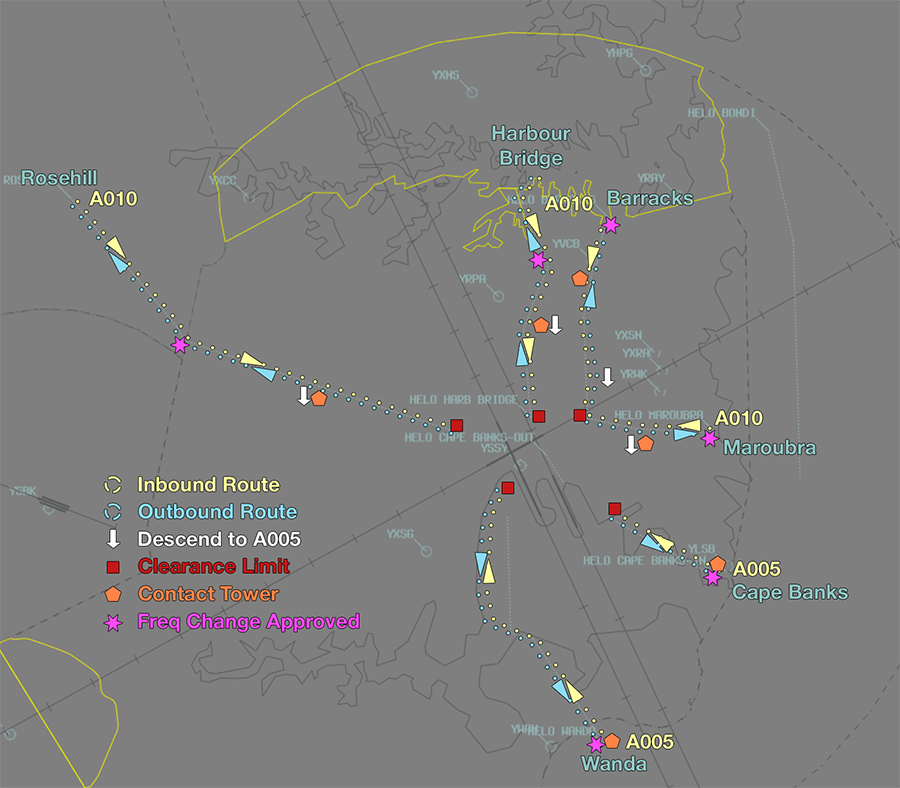
Refer to Heliport Responsibility to determine which ADC position (when both are online) is responsible for managing helicopter arrivals and departures.
Departures
VFR helicopters are generally processed via an outbound helicopter route (see above). IFR helicopters should conform to fixed wing ops and be processed via the SY (RADAR) SID from an appropriate runway, unless a visual departure is acceptable.
SY ACD will issue airways clearance for all helicopters, including those on a helicopter route. The helicopter route title should be recorded in the global ops field and the route waypoints should be added to the FDR route, as below.
| Route | Waypoints |
|---|---|
| ROSEHILL 5 OUTBOUND | CBY RKWC RSH |
| HARBOUR BRIDGE 5 OUTBOUND | ERSK REDF DHH HBB |
| BARRACKS 5 OUTBOUND | MPSC RCB |
| MAROUBRA 5 OUTBOUND | MRBR |
| CAPE BANKS 5 OUTBOUND | CAPS |
| WANDA 5 OUTBOUND | DLPT YWAN |
Phraseology
YOE: "Sydney Delivery, helicopter YOE, for the Harbour Bridge 5 outbound, request clearance"
SY ACD: "YOE, Delivery, cleared Harbour Bridge 5 outbound, squawk 0215, departure frequency 123.0"
YOE: "Cleared Harbour Bridge 5 outbound, squawk 0215, departure frequency 123.0, YOE"
Most helicopters will be capable of departing from their company helipad. If reposition is required to Helipad 1 (the primary helipad), this must be approved by SY ADC.
Phraseology
YOE: "Sydney Tower, helicopter YOE, Hotel 7, request reposition Hotel 1"
SY ADC: "YOE, reposition approved"
YOE: "Reposition approved, YOE"
Helipad 1 is controlled by SY ADC and treated like a runway (takeoff clearances required). All other pads are outside Tower's jurisdiction and do not require a takeoff/landing clearance, however, approval must still be sought for helicopters to become airborne in the SY CTR. This approval is communicated in the form of a requirement to 'report airborne'.
Phraseology
HWD: "Sydney Tower, helicopter HWD, Hotel 7, for the Harbour Bridge 5 outbound, ready"
SY ADC: "HWD, Sydney Tower, report airborne"
HWD: "HWD"
HWD: "HWD, airborne"
SY ADC: "HWD, contact departures"
HWD: "Departures, HWD"
Helicopter operations should be accommodated without unduly delaying fixed wing traffic to/from the aerodrome. Where possible, visually separate helicopters and fixed wing aircraft, and when necessary, delegate responsibility for separation to the helicopter.
Phraseology
SY ADC: "HSZ, traffic is a 737 shortly rolling on runway 34R, report in sight"
HSZ: "Traffic sighted, HSZ"
SY ADC: "HSZ, maintain own separation, caution wake turbulence, report airborne"
HSZ: "Maintain own separation, wilco, HSZ"
Arrivals
VFR helicopters are generally processed via by one of Sydney's Helicopter Routes (see above). IFR helicopters should conform to fixed wing ops and be processed via an appropriate runway.
SY TCU will clear helicopters for all inbound Helicopter Routes, with the exception of the CAPE BANKS 5 INBOUND and WANDA 5 INBOUND. Tower controllers should assess the current traffic situation and issue clearances for these aircraft when available.
Phraseology
YZD: "Sydney Tower, helicopter YZD, JIBN, A005, received Tango, request Cape Banks 5 Inbound"
SY ADC: "YZD, Sydney Tower, cleared Cape Banks 5 Inbound, report at the Container Terminal"
YZD: "Cleared Cape Banks 5 Inbound, YZD"
YZD: "YZD, Container Terminal"
SY ADC: "YZD, cleared visual approach, report on the ground"
YZD: "Cleared visual approach, wilco, YZD"
During times of peak fixed wing traffic, instruct helicopters to hold at their designated clearance limit on their Helicopter Route and maintain own separation on approach to the heliport.
Phraseology
SY ADC: "YOE, hold at the clearance limit, traffic is a 717 on a 4nm final to runway 25, report in sight"
YOE: "Hold at the clearance limit, traffic sighted, YOE"
SY ADC: "YOE, pass behind that aircraft, maintain own separation, caution wake turbulence, cleared visual approach, report on the ground"
YOE: "Pass behind the 717, maintain own separation, cleared visual approach, YOE"
Remember to pass traffic information to both aircraft.
SY ADC: "QJE1745, traffic is a helicopter, currently 3nm north of the field, they'll maintain own separation and pass behind you on approach to the heliport, runway 25, cleared to land"
QJE1745: "Runway 25, cleared to land, QJE1745"
YOE: "YOE, on the pad"
SY ADC: "YOE"
Helipad 1 is controlled by SY ADC and treated like a runway (landing clearances required). All other pads are outside Tower's jurisdiction and do not require a takeoff/landing clearance. Helicopters should be instructed to 'report on the ground' so the controller knows when they are no longer active in their airspace.
Hospital Helipads
The Sydney CTR contains a several of hospital helipads: Sydney Childrens Hospital (YXSN) and Randwick Medical (YXRA) to the east; Royal Prince Alfred Hospital (YRPA) to the north; and St George Hospital (YXSG) to the west. These pads sit outside the manoeuvring area, so no takeoff or landing clearances should be issued. Instead, helicopters should be instructed to report airborne or report on the ground.
Arriving helicopters will be cleared for a visual approach by SY TCU and transferred to SY ADC. ADC should instruct these aircraft to report on the ground. During times of poor weather, helicopters may be cleared for the ILS approach to the closest runway with an expectation of breaking off the approach and tracking to the hospital when they become visual. In these situations, SY TCU will coordinate any approach expectations to ADC.
Phraseology
RSCU201 is a VFR AW139 helicopter inbound from the southwest for St George Hospital (YXSG).
RSCU201: "Sydney Tower, helicopter RSCU201"
SY ADC: "RSCU201, Sydney Tower, report on the ground"
Phraseology
RSCU207 is an IFR AW139 helicopter cleared the RWY 16L ILS with intentions to track for Royal Prince Alfred Hsopital (YRPA).
RSCU207: "Sydney Tower, helicopter RSCU207"
SY ADC: "RSCU207, Sydney Tower, report visual"
RSCU207: "Wilco, RSCU207"
RSCU207: "RSCU207, visual"
SY ADC: "RSCU207, track direct to RPA, cleared visual approach, report on the ground"
RSCU207: "Track direct RPA, cleared visual approach, RSCU207"
Departing helicopters require an airways clearance to either transit the CTR into the adjacent Class G airspace, or to enter the overlying CTA as per their filed route. It may be necessary to instruct departing helicopters to maintain own separation with other aircraft in the CTR if a suitable gap is not available for their departure.
Phraseology
LIFE21 is a VFR BK117 helicopter outbound from Sydney Childrens Hospital (YXSN), intending to track via Victor 1 to YLSB.
LIFE21: "Sydney Tower, helicopter LIFE21, Sydney Childrens Hospital, for transit to Victor 1, ready"
SY ADC: "LIFE21, traffic is a Boeing 737 on a 5nm final to runway 25, report sighting and able to maintain own separation"
LIFE21: "Traffic sighted and able to maintain own separation, LIFE21"
SY ADC: "LIFE21, maintain own separation with the 737, cleared to transit to Victor 1, not above A005, report airborne"
LIFE21: "Maintain own separation with the 737, cleared to transit to Victor 1, not above A005, LIFE21"
Remember to pass traffic information to both aircraft.
SY ADC: "QFA843, traffic is a helicopter becoming airborne at a hospital approximately 3nm east of the field, maintaining own separation with you, runway 25, cleared to land"
Helicopters intending to enter SY TCU CTA must be first coordinated with SY TCU. Once the aircraft reports airborne and is clear of any conflicts in ADC's airspace, they should be transferred to the TCU.
Phraseology
RSCU209 is an IFR AW139 helicopter outbound from St George Hospital (YXSG) for Orange (YORG) at A045.
RSCU209: "Sydney Tower, helicopter RSCU209, St George Hospital, for Orange, ready, request clearance"
SY ADC: "RSCU209, standby"
SY ADC -> SY TCU: "Next, helicopter RSCU209, outbound from St George Hospital for the west"
SY TCU -> SY ADC: "RSCU209, A030"
SY ADC -> SY TCU: "A030, RSCU209"
SY ADC: "RSCU209, cleared to YORG via KADOM, flight planned route, climb to A030, squawk 0545, report airborne"
RSCU209: "Cleared to YORG via KADOM, flight planned route, climb to A030, squawk 0545, RSCU209"
Runway Modes
Preferred Runway Modes
Winds must always be considered for Runway modes (Crosswind <20kts, Tailwind <5kts), however the order of preference is as follows:
| Priority - Mode | Arrivals | Departures |
|---|---|---|
| 1 - SODPROPS | 34L | 16L (& 34L if operationally required) |
| 2 - 34 PROPS | 34L & 34R | 34L & 34R |
| 2 - 16 PROPS | 16L & 16R | 16L & 16R |
| 3 - 16D/07A | 07 | 16L & 16R |
| 3 - 25D/34A | 34L & 34R | 25 |
| 4 - 16D/25A | 25 | 16L & 16R |
| 5 - 07 | 07 | 07 |
| 5 - 25 | 25 | 25 |
| *Curfew | 34L | 16R |
*Permitted between the hours of 2300 and 0600 Local. If the pilot does not want to participate in curfew mode operations, the controller must accommodate this request.
Note
In general, the SODPROPS, 16D/07A, and 25D/34A modes are most suitable for noise abatement. The PROPS modes are most suitable for higher capacity. Since for the most part, neither of these are a factor on VATSIM, it is up to you which runway mode you would like to operate, subject to winds. Consider favouring the higher capacity PROPS modes during busy times, such as events like Milk Run Monday or Panic Stations.
Tip
Take in to account an aircraft's weight when runways 16L/34R or 07/25 are in use. Heavier aircraft may operationally require the longer Runway 16R/34L, or pilots may prefer a departure from 16R instead of 16L so they have a shorter taxi. If in doubt, ask the pilot and try to be accommodating of these requests.
Runway Selection
Unless operationally required, aircraft shall be assigned the following runways for departure when PROPS are in progress:
| Aircraft tracking | Runway |
|---|---|
| via KADOM | 16R/34L |
| Jets via WOL | 16R/34R |
| Non-Jets via WOL | 16R/34L |
| via STUIE | 16R/34L |
| via OLSEM | 16L/34R |
| Other aircraft: | |
| To the NORTH and EAST | 16L/34R |
| To the SOUTH and WEST | 16R/34L |
SODPROPS
During SODPROPS, all departures shall be assigned RWY 16L, except:
- aircraft who operationally require RWY 34L (generally heavy jets)
- non-jet aircraft departing to the west or south
SID Selection
Tip
A radar SID (e.g. SY (RADAR) SID) is distinct from a procedural SID with a RADAR transition (eg, GROOK SID, RADAR transition). A radar SID can be identified in the DAPs as having a "(RADAR)" at the end of the name.
| Type | Via | SID |
|---|---|---|
| Jet | KADOM OLSEM STUIE WOL |
FISHA SID, Relevant Transition |
| Jet | All others | FISHA SID, RADAR Transition |
| Non-Jet | BENBU KADOM |
ANKUB SID, Relevant Transition |
| Non-Jet | All others | RADAR SID |
| Type | Via | SID |
|---|---|---|
| Jet | OLSEM NOBAR DIPSO EVONN CAWLY OPTIC |
KEVIN SID, Relevant Transition |
| Jet | WOL (during SODPROPS only) | ABBEY SID |
| Jet | All others | KEVIN SID, RADAR Transition |
| Non-Jet | BENBU KADOM |
ANKUB SID, Relevant Transition |
| Non-Jet | All others | RADAR SID |
| Type | Via | SID |
|---|---|---|
| Jet | KADOM STUIE WOL |
GROOK SID, Relevant Transition |
| Jet | All others | GROOK SID, RADAR Transition |
| Non-Jet | BENBU KADOM |
ANKUB SID, Relevant Transition |
| Non-Jet | All others | RADAR SID |
| Type | Via | SID |
|---|---|---|
| Jet | CAWLY DIPSO EVONN NOBAR OLSEM OPTIC |
AVMOV SID, Relevant Transition |
| Jet | KADOM | KADOM SID |
| Jet | STUIE | STUIE SID |
| Jet | All others | RADAR SID |
| Non-Jet | BENBU KADOM |
ANKUB SID, Relevant Transition |
| Non-Jet | All others | RADAR SID |
| Type | Via | SID |
|---|---|---|
| Jet | NWA LEECE WOL |
TONTO SID, Relevant Transition |
| Jet | CAWLY DIPSO EVONN NOBAR OLSEM OPTIC |
AVMOV SID, Relevant Transition |
| Jet | KADOM | KADOM SID |
| Jet | STUIE | STUIE SID |
| Jet | All others | RADAR SID |
| Non-Jet | BENBU KADOM |
ANKUB SID, Relevant Transition |
| Non-Jet | All others | RADAR SID |
| Type | Via | SID |
|---|---|---|
| Jet | OLSEM | OLSEM SID |
| Jet | WOL | MARUB SID, WOL Transition |
| Jet | All others | MARUB SID, RADAR Transition |
| Non-Jet | BENBU KADOM |
ANKUB SID, Relevant Transition |
| Non-Jet | All others | RADAR SID |
Important
Some jet aircraft may require the use of the RADAR SID and will communicate this requirement when requesting airways clearance (see Climb Gradient Requirements).
Climb Gradient Requirements
Climb gradient requirements apply to all Procedural SIDs. It is the pilot's responsibility to advise if they are unable to meet these requirements. Pilots that advise this shall be assigned the RADAR SID instead, regardless of aircraft type.
ANKUB Non-Jet SID
The ANKUB SID is a unique departure that is assigned to non-jets planned via KADOM or BENBU. On this SID, non-jets fly an assigned heading before being vectored by SY TCU to a waypoint to rejoin the procedure.
SY ADC must give aicraft on this SID an assigned heading with their line up or takeoff clearance, in the same way as aircraft assigned the RADAR SID.
ATIS
Approach Types
| Cloud Base | Visibility | Approach |
|---|---|---|
| >3000FT | >5000M | EXP INDEP VISUAL APCH, DO NOT PASS THRU ASSIGNED RWY CL |
| Between 2000FT & 3000FT | >5000M | EXP INSTR APCH THEN INDEP VISUAL APCH WHEN VISUAL, DO NOT PASS THRU ASSIGNED RWY CL |
| Below 2000FT or | <5000M | EXP INSTR APCH |
Important
Independent Visual Approaches (IVAs) may only be run during Parallel Runway Operations (PROPS). During single runway operations, regular visual approaches (blank ATIS 'APCH' field) should be used instead.
Runway Mode
| Mode | ATIS Runway information |
|---|---|
| 16 PROPS | 16L AND R FOR ARRS AND DEPS |
| 34 PROPS | 34L AND R FOR ARRS AND DEPS |
| SODPROPS | 34L FOR ARRS, RWY 16L FOR DEPS, RWY 34L AVBL FOR DEPARTURE IF OPERATIONALLY REQD OR AS DIRECTED BY ATC |
Operational Info
The Operational Information field should be updated based on the runway mode and approach type in use, as per the table below:
| Condition | OPR INFO Field |
|---|---|
EXP INDEP VISUAL APCH |
INDEP PARL APPROACHES AND DEPS IN PROG |
EXP INSTR APCH, orEXP INSTR APCH THEN INDEP VISUAL APCH WHEN VISUAL |
INDEP PARL DEPS IN PROG |
| SODROPS | SIMUL OPP DIR PARL RWY OPS IN PROG |
| Curfew Mode Operations | AEST: CURFEW RWY NOMINATION. CURFEW IN OPERATION UNTIL TIME 2000. AEDT: CURFEW RWY NOMINATION. CURFEW IN OPERATION UNTIL TIME 1900. |
Note
INDEP PARL DEPS IN PROG permits independent departures (two simultaneous departures on parallel runways) but NOT independent approaches (two simultaneous arrivals on parallel runways without perscribed separation minima).
Coordinator
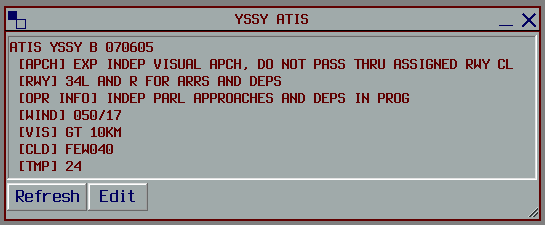
When Coordinator is online, the ATIS OPR INFO shall include WHEN READY FOR PUSH BACK OR TAXI CTC COORDINATOR 127.6.
When Coordinator is online and start approval is required, the ATIS OPR INFO shall include START APPROVAL RQ. WHEN READY FOR PUSH BACK OR ENGINE START, CTC SYDNEY COORDINATOR ON FREQ 127.6, FOR START TIME.
Example
Coordination
Auto Release
Important
YSSY utilises auto release for all Procedural SIDs, and the SY (RADAR) SID provided aircraft are assigned the standard assignable level and a Standard Assignable Heading.
Next coordination is not required for aircraft that are:
- Departing from a runway nominated on the ATIS; and
- Assigned the Standard assignable level; and
- Assigned a Procedural SID, or the Radar SID/ANKUB SID with a Standard Assignable Heading; or
- A helicopter cleared via an outbound helicopter route.
All other aircraft require a 'Next' call to SY TCU.
'Next' coordination is additionally required for:
- After a go around, the next departure from that runway
- All aircraft during the Curfew Runway Mode
The Standard Assignable level from SY ADC to SY TCU is:
| Aircraft | Level |
|---|---|
| Jets | A050 |
| Non-Jets | The lower of A030 and RFL |
Departures Controller
When a TCU controller is online, aircraft shall be issued with a departure frequency during their airways clearance in accordance with the table below. If no TCU controllers are online, the most appropriate cnroute controller or advisory frequency shall be issued.
| Runway | Via | Departure Frequency |
|---|---|---|
| 07 | ANKUB SID Tracking N, or NE |
123.0 (SDN) |
| 07 | FISHA SID, OLSEM Transition Tracking N, or NE |
123.0 (SDN) |
| 07 | FISHA SID, WOL Transition Tracking S, W, or SW |
129.7 (SDS) |
| Runway | Via | Departure Frequency |
|---|---|---|
| 16L | ABBEY SID Tracking S or SW |
129.7 (SDS) |
| 16L | KEVIN SID Tracking SE, E, NE, or N |
123.0 (SDN) |
| 16R | All | 129.7 (SDS) |
| Runway | Via | Departure Frequency |
|---|---|---|
| 25 | AVMOV SID KADOM SID Tracking N, or NE |
123.0 (SDN) |
| 25 | Tracking S, W, or SW | 129.7 (SDS) |
| Runway | Via | Departure Frequency |
|---|---|---|
| 34L | AVMOV SID Tracking N, or NE |
123.0 (SDN) |
| 34L | KADOM SID STUIE SID TONTO SID Tracking S, W, or SW |
118.4 (SDS) |
| 34R | MARUB SID OLSEM SID Tracking N, or NE |
123.0 (SDN) |
| 34R | MARUB SID, WOL Transition Tracking S, W, or SW |
129.7 (SDS) |
Standard Assignable Departure Headings
Aircraft that have been cleared the SY (RADAR) SID or ANKUB SID must receive an assigned heading with their line up or takeoff clearance. 'Next' coordination is not required to the SY TCU controller when the departing aircraft has been assigned the standard assignable level and assigned one of the headings listed below:
| Runway | Jet | Non-Jet |
|---|---|---|
| RWY 07 | H070 | H020, H110 |
| RWY 16L | H125 | H090 (RWY 25 not in use) H125 (RWY 25 in use) |
| RWY 16R | H170 | H210 |
| RWY 25 | H300, H240 | H020, H210, H240 |
| RWY 34L | H290 | H230 |
| RWY 34R | H030, H070 | H350 |
Note
Where multiple standard assignable headings are available, assign the heading most suitable for the aircraft's direction of flight.
Tip
If strong winds are present at altitude, ADC/DEP should discuss slight changes to these headings (+/- 5 degrees) to compensate for large crosswind components.
Between ADC and SMC
Inactive Runway Releases
SY ADC has responsibility of all runways, requiring SY SMC to coordinate with SY ADC to allow aircraft to cross runways whilst taxiing. SY SMC may request, or SY ADC may elect, to release certain runways to the SY SMC controller, so they may let aircraft cross the runway without coordination (for example, releasing runway 07/25 to SY SMC whilst PROPS are in progress.) This release may also be cancelled at the controller's discretion.
ACD to SY TCU
The controller assuming responsibility of SY ACD shall give heads-up coordination to the relevant SY TCU controller prior to the issue of the following clearances:
- VFR departures, other than helicopters assigned a helicopter route coded clearance
- Aircraft using a runway not on the ATIS