Ground Delay Management
Overview
Managing the flow of traffic is not just limited to sequencing in the air! Flow Management techniques can be applied to aircraft on the ground to minimise delays in the air and reduce congestion.
In real life, pilots, airlines and controllers rely on Airport Collaborative Decision Making (A-CDM) to coordinate and plan aircraft movements across the country, and there are multiple dedicated flow controllers and operations analysts to ensure efficiency on a daily basis. On VATSIM we can apply several techniques to implement better management of ground delay at an aerodrome, reduce knock-on airborne delays, reduce aerodrome congestion, and keep pilots better in the loop.
These techniques include utilising A-CDM procedures, pushback management, and ad-hoc ground stops.
Airport Collaborative Decision Making
The OzStrips plugin has been expanded to include an A-CDM mode, that can be used when traffic levels warrant. This feature imitates real life A-CDM processes to a degree, but on the network allow controllers to more easily visualise and manage overall aerodrome traffic levels, provide TSAT and CTOT information to pilots, and achieve planned departure rates at an aerodrome. It can be used without, and in conjunction with some of the other flow management techniques below.
Note
It is beneficial to have an understanding of how CDM works, before utilising it as a controller. Further information can be found on the CDM section within Tower Strips.
Implementing the Procedure
Activating A-CDM mode can be done by toggling it active, from the Settings drop down list, within the OzStrips plugin. You can tell the mode has been activated successfully when you see the Departure Monitor appear in the Runway Bay.

Coordination should be affected with other aerodrome controllers, and the FMP controller if present.
Phraseology
SY SMC -> SY ADC: "There are a few aircraft awaiting pushback, should we enable A-CDM?"
SY ADC -> SY SMC: "Affirm, let's set a departure rate of 30."
SY SMC -> SY ADC: "Roger, I'll send it within the Controller Messages chat as well."
Later, the set departure rate may need to be varied based on traffic flow conditions within the network.
Phraseology
ML FMP -> SY FMP: "Due to the amount of arrivals into ML, departures are backing up. Can we reduce the SY departure rate?"
SY FMP -> ML FMP: "Affirm, with your concurrence, we'll move from a departure rate of 30 to 24. I'll tell Coordinator."
ML FMP -> SY FMP: "Concur 24, thanks."
Processing each Aircraft
To effectively operate with A-CDM procedures:
-
When an aircraft requests pushback, they should be placed into the Cleared Bay below the default OzStrips queue bar.
A TSAT and CTOT will be generated for them, which can be provided to the pilot. This will be presented within the strip
Time Field, and will appear with a grey background.
A queued strip, with a TSAT of 03:52z. -
When the current time is within 1 minute of the TSAT, the
Time Fieldwithin the strip will go green. The SMC controller should approve pushback when able.If, due to apron congestion or similiar, the aircraft first in line can't be pushed, or is AFK, the SMC controller may push another aircraft, taking into account relative priority.
After moving the strip into the Pushback Bay, the
Time Fieldwill go yellow.
Note
It is not necessary to wait until the exact TSAT is achieved. Pushback (or taxi, if no pushback is required) may be issued provided the Time Field is green.
-
ADC should allow aircraft to depart, such that the overall departure rate is maintained.
After each aircraft becomes airborne, their departure is logged, and the Departure Monitor is incremented.
The Departure Monitor. The ADC controller should endeavour to ensure that they monitor actual vs planned departure rates, to avoid saturating down the line approach and enroute sectors. A technique to maintain the departure rate can include using the OzStrips Take-Off Timer, and waiting until
60 minutes / Departure Rateminutes have elapsed.Example
The Departure Rate is 20. There should be
60 / 20minutes between departures, or 3 minutes.
Website
When CDM is enabled at an aerodrome, pilots and controllers can view the Departure Queue online. This may be beneficial for Enroute and Approach controllers not using the OzStrips plugin, or with visibility centres not close to the aerodrome of interest.
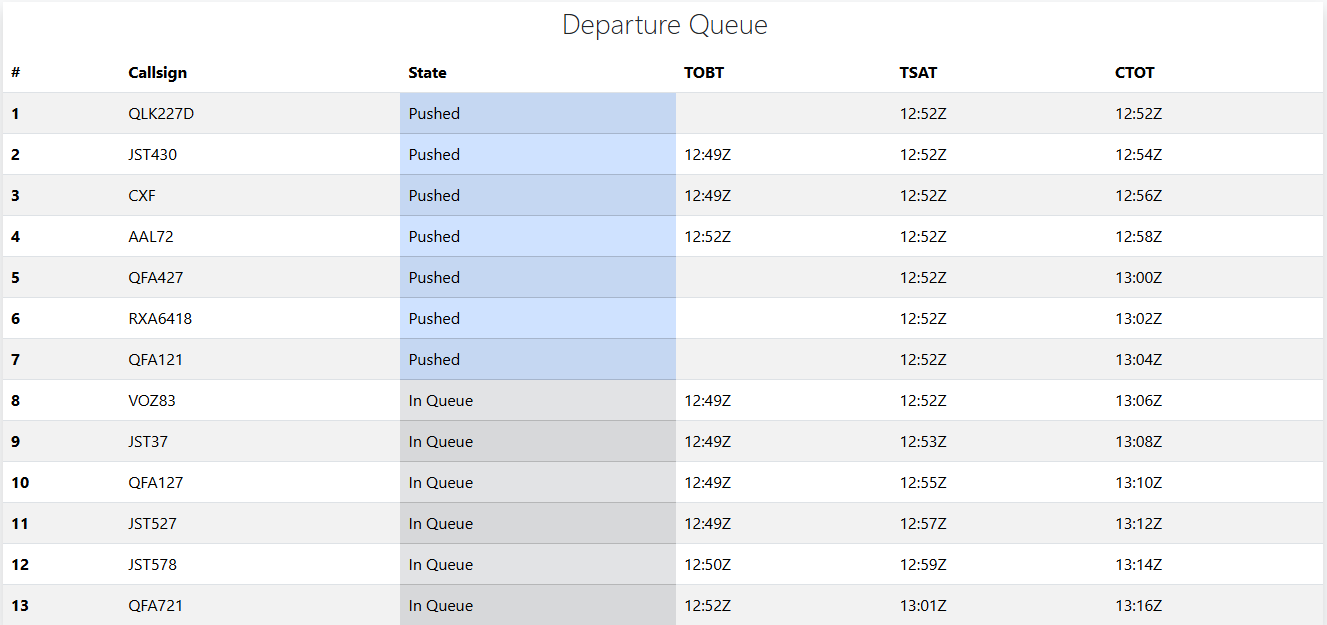
Changes to the departure rate may be made by logging in to the website. It is also possible to set destination-specific departure rates, allowing aircraft to avoid departure delays when planned to quieter aerodromes during busy events.
Pushback Requests on ACD
During busy events, such as Milk Run Monday, the SMC controller may end up with a much higher workload than the ACD controller. To mitigate this, some airports have local SOPs that allow for pushback requests to be done on ACD frequency, to balance the workload.
Important
The 'Pushback Requests on ACD' procedure is currently limited to Brisbane, Melbourne, Perth, Sydney, and Walton
At Sydney, the role of ACD in the procedure listed below is performed by a dedicated controller, named Sydney Coordinator. Where a separate Coordinator controller is not online, the role may be performed by ACD instead.
Implementing the Procedure
Note
This procedure is relevant to pushback requests on ACD and the use of Sydney Coordinator. When Sydney Coordinator is active, replace all references to ACD below with Coordinator.
To commence the procedure:
- SMC and ACD coordinate to implement the procedure, due to high SMC workload.
- SMC coordinates with ADC in order to have the ATIS updated (see each aerodrome's page).
- ACD enables the Monitor SMC Bay in OzStrips.
Phraseology
ML SMC -> ML ACD: "It's getting quite busy. Happy to implement Pushback requests on your frequency?"
ML ACD -> ML SMC: "Understood, affirm"
ML SMC -> ML ACD: "Thanks, I'll talk to Tower"
ML SMC -> ML ADC: "Can we please get ALL DEPARTURES MUST REQUEST PUSH BACK ON 127.2 on the ATIS?"
ML ADC -> ML SMC: "Wilco"
Processing each Aircraft
To operate with pushback requests on ACD:
- When ACD has finished issuing an airways clearance, they will remind pilots to "Contact me when ready for pushback/taxi".
- When a pilot requests pushback, ACD will assess their priority based on apron congestion and number of aircraft in the queue (see Queue Management).
- ACD will either instruct them to standby for Ground (not contact), or remain on the ACD frequency if a delay is required.
- If an aircraft is instructed to 'standby for Ground', ACD will move the strip into the Monitor SMC Bay in OzStrips, to denote they are awaiting pushback approval.
- When SMC has adequate space on the aprons, taxiways, and holding points, they will issue pushback/taxi to the next aircraft in line by scanning the Cleared Bay queue.
The decision whether or not to send an aircraft to SMC or hold them on the ACD frequency should be made in accordance with the Queue Management techniques.
Note
The main function of the Coordinator role is to reduce SMC's workload. Generally, this involves reducing frequency congestion and metering the flow of departing traffic, however each situation is different and will require a unique approach.
E.g. if SMC East at YSSY is busy but SMC West is quiet and there's no upline flow requirements, it may be appropriate to process aircraft on the international aprons while temporarily delaying aircraft on the domestic aprons.
Important
If SMC needs to reduce the pushback rate due to congestion at the holding points or excessive workload, ACD should be informed without delay, and instructed to hold all departures on their frequency. This will stop aircraft being told to 'standby for ground' on the SMC frequency. Remember to cancel this requirement when congestion eases.
Phraseology
VOZ543: "Melbourne Delivery, VOZ543, PDC read back"
ML ACD: "VOZ543, Melbourne Delivery"
VOZ543: "DOSEL2 departure, squawk 1336, bay E8, VOZ543"
ML ACD: "VOZ543, contact me when ready for pushback"
VOZ543: "Wilco, VOZ543"
...
VOZ543: "Melbourne Delivery, VOZ543, bay E8, request pushback"
ML ACD: "VOZ543, standby for ground 121.7"
VOZ543: "Standby for ground 121.7, VOZ543"
...
ML SMC: "VOZ543, Melbourne Ground, pushback approved."
When a separate Sydney Coordinator controller is online, pilots should be instructed to contact that controller after reading their airways clearance back.
Tip
If an aircraft is instructed to standby for ground but there is still a small delay expected on SMC (i.e. busy event or taxiway congestion), it may be beneficial to inform the pilot to prevent them from contacting SMC.
E.g. "VOZ543, it's quite busy at the moment, standby for ground 121.7, they'll get to you when they can"
If a delay is required prior to transferring an aircraft to SMC, provide an estimated delay value to the pilot or advise them of their position in the queue.
Phraseology
VOZ543: "Melbourne Delivery, VOZ543, bay E8, request pushback"
ML ACD: "VOZ543, estimated delay 10 minutes, remain this frequency."
Tip
Remember that the bottom aircraft represents the front of the queue.
Queue Management
To reduce SMC workload, ACD should not allow more than three aircraft to be awaiting pushback or taxi on the SMC frequency. When three aircraft are already queued on the SMC frequency, any additional aircraft should be told to remain on the ACD frequency and informed of their position in the queue or approximate delay (if known). These aircraft should be placed in the Cleared Bay Queue, above the Standby for Ground bar.
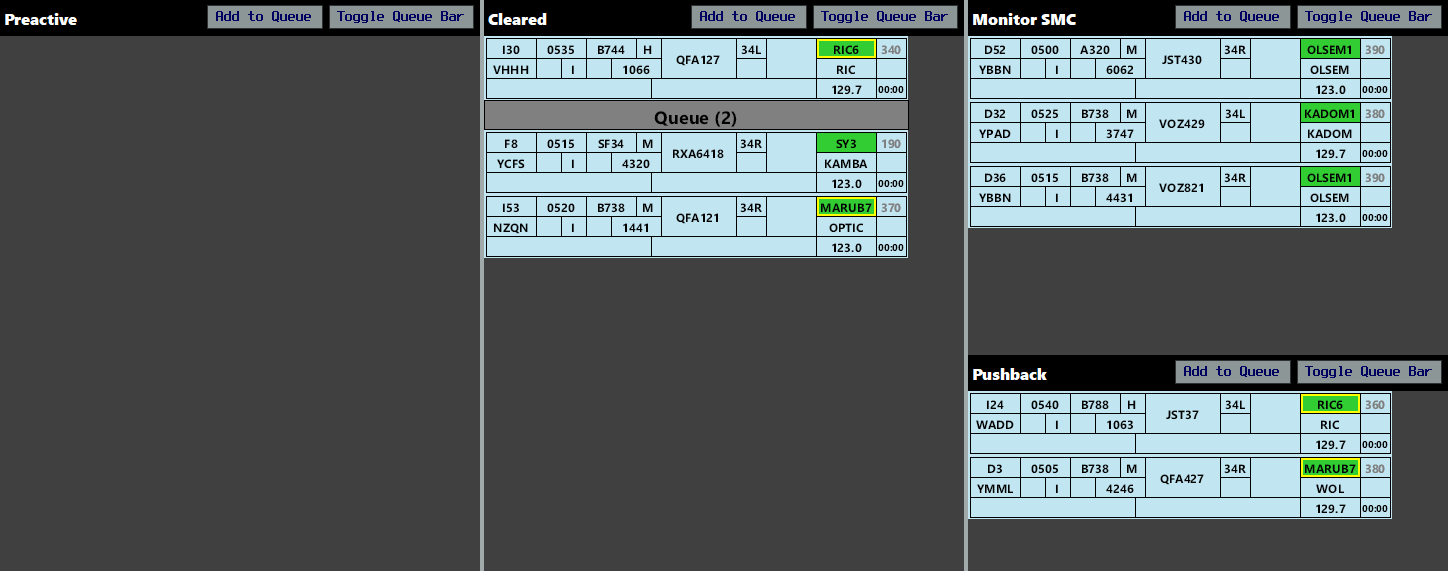
Three aircraft are waiting on the SMC frequency (in the Monitor SMC Bay), and QFA121 and RXA6418 have both requested push/taxi but are being held on the Coordinator frequency. QFA121 is closer to the bottom, so will be next to be told to standby for SMC.
When SMC moves an aircraft from below the Standby for Ground bar to the Pushback Bay, ACD should instruct the next aircraft in line to standby for ground on the SMC frequency (and move the strip appropriately).
Important
Strips must remain in the strip bay of their current state, even if they are in a queue. For example, if they have received an airways clearance and are in the queue for pushback, they must remain in the Cleared Bay, not the Pushback Bay.
Start Approval
When delays for taxi are excessive (e.g. 15–30 minutes), it may be necessary to include the following ATIS OPR INFO: START APPROVAL RQ. WHEN READY FOR PUSH BACK OR ENGINE START, CTC [POSITION] ON FREQ [FREQUENCY], FOR START TIME.
Tip
Start approvals work best in conjunction with a Coordinator position (or with pushback requests on ACD). The [POSITION] and [FREQUENCY] mentioned above should generally be Sydney Coordinator or ACD.
This will ensure aircraft don't end up burning considerable amounts of fuel and potentially disrupting the latter parts of the flight (with insufficient fuel for lengthy en-route sequencing or holds).
With start approvals in operation, aircraft who do not require pushback will contact Coordinator prior to starting. Coordinator should issue an estimated start time to the aircraft, and contact them when they reach the front of the queue to provide start approval. Aircraft are still expected to report ready to taxi to Coordinator, who will follow the procedure above and tell them to standby for ground the SMC frequency.