Kennedy (KEN)
Positions
| Name | ID | Callsign | Frequency | Login ID |
|---|---|---|---|---|
| Kennedy | KEN | Brisbane Centre | 120.150 | BN-KEN_CTR |
| Barra | BAR | Brisbane Centre | 123.800 | BN-BAR_CTR |
| Tabletop | TBP | Brisbane Centre | 120.550 | BN-TBP_CTR |
| Willis | WIL | Brisbane Centre | 127.600 | BN-WIL_CTR |
Non-Standard Positions
Non-standard positions may only be used in accordance with VATPAC Air Traffic Services Policy.
Approval must be sought from the bolded parent position prior to opening a Non-Standard Position, unless NOTAMs indicate otherwise (eg, for events).
Airspace
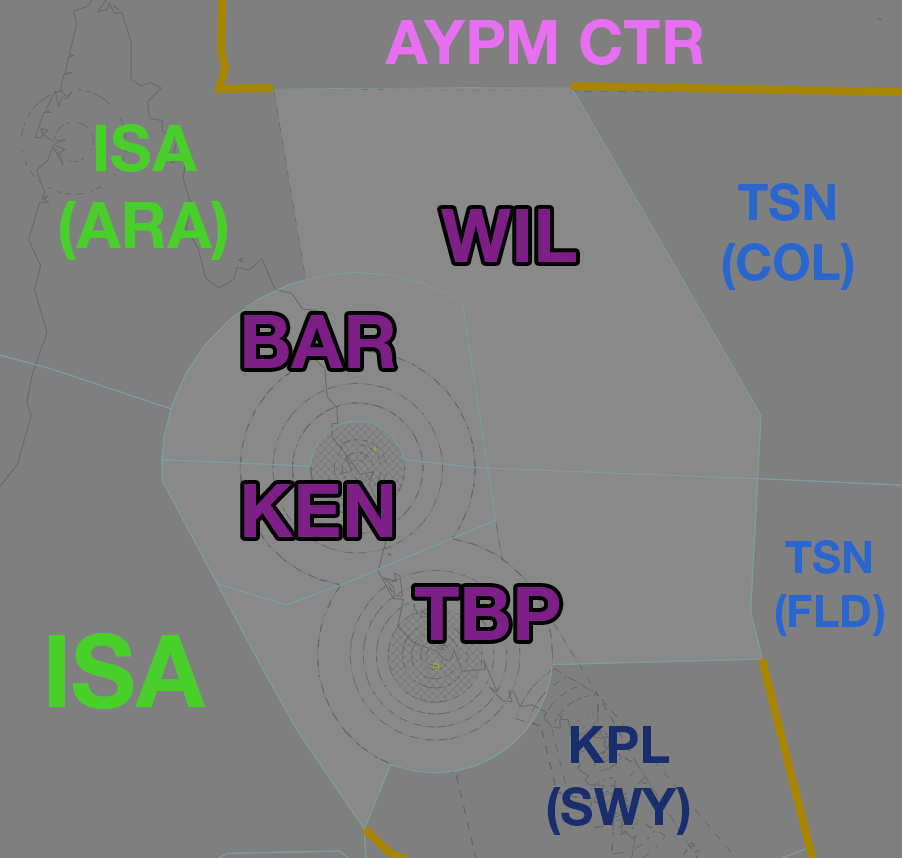
KEN is responsible for BAR, TBP, and WIL when they are offline.
BAR is responsible for the CS TCU when CS TCU is offline.
Reclassifications
When TL TCU is offline, TL CTR (Class C SFC to A085) reverts to Class G, and is administered by TBP. Alternatively, TBP may provide a top-down approach service if they wish.
Tip
If choosing not to provide a top down service, consider publishing a pre-formatted ATIS Zulu for the aerodrome, to inform pilots about the airspace reclassification.
Departure and Arrival Procedures
YBCS
STAR Assignment
YBCS has specific visual approach procedures for use when VMC exists below A030 in the terminal area. As such, light & medium category aircraft (B737/A320 and below) shall be issued the relevant Victor STAR.
Heavy aircraft must be issued the Instrument STAR.
Note
Due to the complex nature of the visual procedures, it may be helpful to ask inexperienced pilots if they are familiar with the Creek Corridor (runway 15) or are able to accept a visual circuit (runway 33), and otherwise issue the Instrument STAR.
The following subsectors are responsible for issuing STAR clearance.
| Subsector | STAR | Type | Notes |
|---|---|---|---|
| BAR | CODIE KASPI |
All | INST APCH VISUAL APCH |
| KEN | NONUM | All | |
| TBP | NONUM UPOLO |
All | Descent not below F190 |
| Subsector | STAR | Type | Notes |
|---|---|---|---|
| BAR | HENDO KEEWI TOTTY |
All | INST APCH VISUAL APCH RNP-W |
| KEN | HENDO TOTTY |
All | INST APCH RNP-W |
| TBP | HENDO TOTTY |
All | Descent not below F190 |
Arrivals from the south shall be given initial descent to not below F190. KEN will issue final descent.
Adjacent Feeder Fixes
Aircraft assigned the same runway inbound via:
- ANDOP and PUNIT
- OVLET, AVDAN and LOCKA
Must be considered to be on the same STAR for sequencing purposes. That is, they must be at least 2 minutes apart at their respective Feeder fixes.
Sequencing
Sequencing arrivals into YBCG is a joint responsibility of the subsectors of KEN. Initial sequencing actions should be performed by all sectors, with fine tuning and any holding required issued by KEN/BAR.
YBTL
STAR Assignment
The following subsectors are responsible for issuing STAR clearance.
| Subsector | STAR | Type | Notes |
|---|---|---|---|
| KEN | IBUXI IGIKI |
All | Descent not below F190 |
Arrivals from the north shall be given initial descent to not below F190. TBP will issue final descent.
Sequencing
KEN and TBP share responsbility for initial sequencing for aircraft arriving from the north, east, and west. KPL(SWY) is responsible for initial sequencing for aircraft arriving from the south. Final sequencing actions are performed by TBP.
Coordination with KPL(SWY) should be conducted to ensure that aircraft from each sector are sequenced appropriately with each other.
Local Procedures
Special Use Airspace
There are multiple volumes of SUA within KEN airspace, mostly associated with military operations in and out of YBTL.
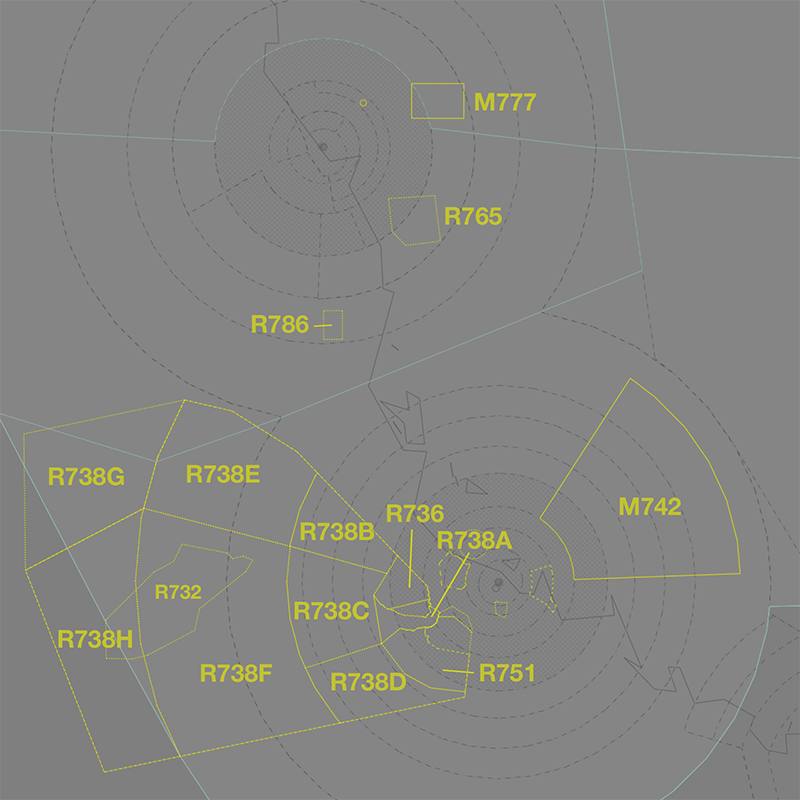
TL TCU must give heads up coordination with the relevant enroute controllers prior to any departures intending to operate in a currently inactive SUA.
Phraseology
TLA -> TBP: "On the groud YBTL, PSSM31, requests activation of M742 A040-F240, from 0300 until 0500.”
TBP -> TLA: "PSSM31, expect activation of M742 A040-F240 at 0300 until 0500."
TLA -> TBP: "PSSM31."
Non-participating aircraft intending to transit an activated SUA should be rerouted, where possible, subject to the VATSIM Code of Conduct.
M742 Tiger
The M742 Tiger MOA is located off the coast, A040-F240, spanning both TL TCU and KEN(TBP) airspace. Activation of the M742 MOA is a shared responsibility, and both TLA and KEN(TBP) must coordinate before activation.
Aircraft will generally enter and exit the MOA via the appropriate military gate.
Affected Civil Operations
Activation of the MOA disrupts traffic on the infrequently used R213 high altitude airway. Aircraft travelling on this airway should kept above F250 to ensure separation.
R732 Greenvale Training Area
The R732 Greenvale Training Area restricted area is located west of YBTL within TBP and ISA airspace.
Affected Civil Operations
When activated the restricted area disrupts traffic on the J184, W152, W528, and Z51 low altitude airways, which connect YBTL to western Queensland.
| Planned Airway | ERSA Recommended Rerouting |
|---|---|
| J184 | ... OKODU DCT THOMO W265 ... |
| W152 | ... HUG DCT YKID DCT NONUM W152 ... |
| W528 | ... KIPPA DCT THOMO W265 ... |
| Z51 | ... W841 DOTTE DCT KADMU ... |
Note
Aircraft tracking via a recommended rerouting must still be separated from the SUA laterally and vertically. After amending flight plans for the purposes of rerouting around SUA, controllers should ensure the route is displayed visually and the BRL is used to measure for >2.5nm clearance with all parts of the SUA.
R736 & R739 Townsville (Star)
The R736 and R739 Townsville (Star) restricted areas straddle the border of the TL TCU and KEN(TBP) airspace.
It is predominantly used for military training operations, including operations at the Star Landing Area ALA (YSTD).
Aircraft will generally enter and exit the MOA via the appropriate military gate.
Affected Civil Operations
When activated, the restricted areas disrupt traffic on the J184, W265, W528, and W637 low altitude airways, which connect YBTL to Western Queensland. Aircraft travelling on these airways should be manually rerouted around the SUA.
R738A-H Townsville (Land)
The R738A-H Townsville (Land) restricted areas, also known collectively as the Townsville Field Training Area, is a series of defined airspace volumes west of YBTL, A070-NOTAM. R738A and R738B are in both TL TCU and TBP airspace, while R738C-H is wholly located in TBP.
The area is used for a wide array of military training operations, including supersonic flight, air-to-air combat training, and live fire exercises. The extent of activation required will vary according to each operation, but will generally include R738A or R738B, along with an additional larger subsection.
Affected Civil Operations
When activated, the restricted areas significantly disrupts traffic on the west of YBTL.
Aircraft should be rerouted via either the recommended northern or southern diversion.
| Diversion | Planned Airways | ERSA Recommended Rerouting |
|---|---|---|
| Northern | J138 W841 Z51 |
CARMN DCT KIBOP |
| Southern | J184 W265 W469 W528 W637 |
ANDUB Q71 DOBGO |
STAR Clearance Expectation
Handoff
Aircraft being transferred to the following sectors shall be told to Expect STAR Clearance on handoff:
| Transferring Sector | Receiving Sector | ADES | Notes |
|---|---|---|---|
| TBP | KPL(SWY) | YBRK, YBMK | |
| BAR | KEN | YBTL | |
| WIL | BAR | YBCS |
Terminal Handover Frequencies
Aircraft being transferred from enroute to a TCU with multiple frequencies shall be given the frequency for the revelant TCU position.
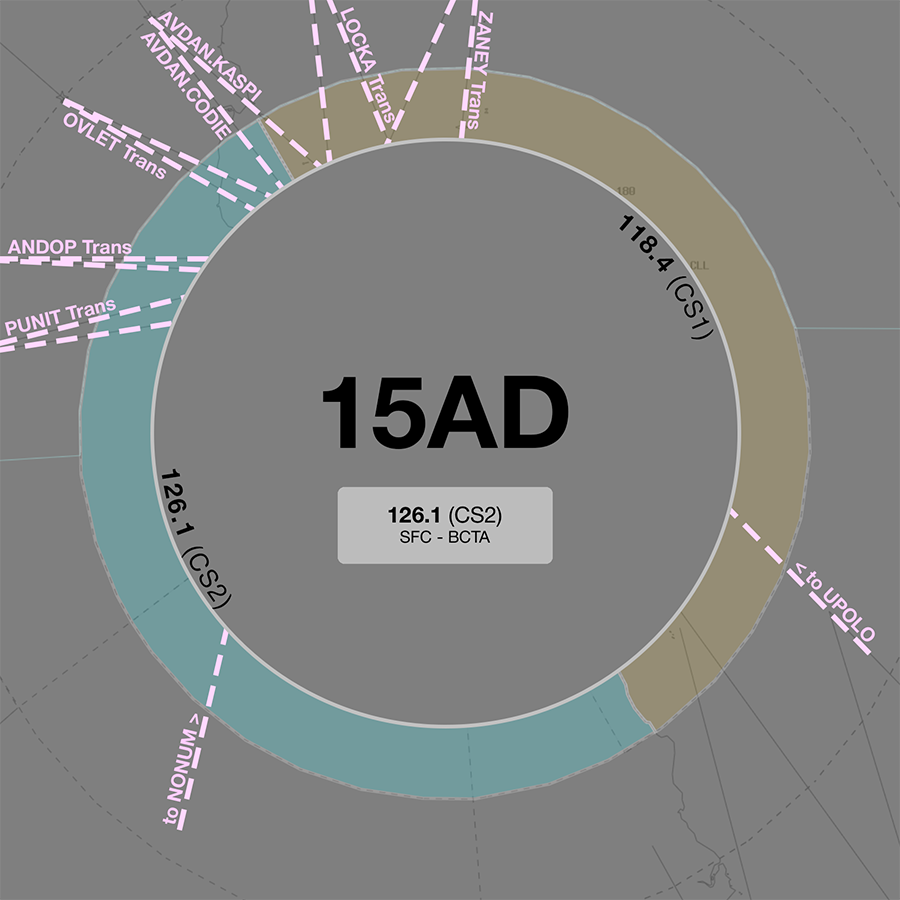
| ADES | STAR | Transition | Frequency (Controller) |
|---|---|---|---|
| YBCS | CODIE | ANDOP AVDAN OVLET PUNIT |
126.100 (CS2) |
| LOCKA ZANEY |
118.400 (CS1) | ||
| YBCS | KASPI | ANDOP OVLET PUNIT |
126.100 (CS2) |
| AVDAN LOCKA ZANEY |
118.400 (CS1) | ||
| YBCS | NONUM | 126.100 (CS2) | |
| YBCS | UPOLO | 118.400 (CS1) |
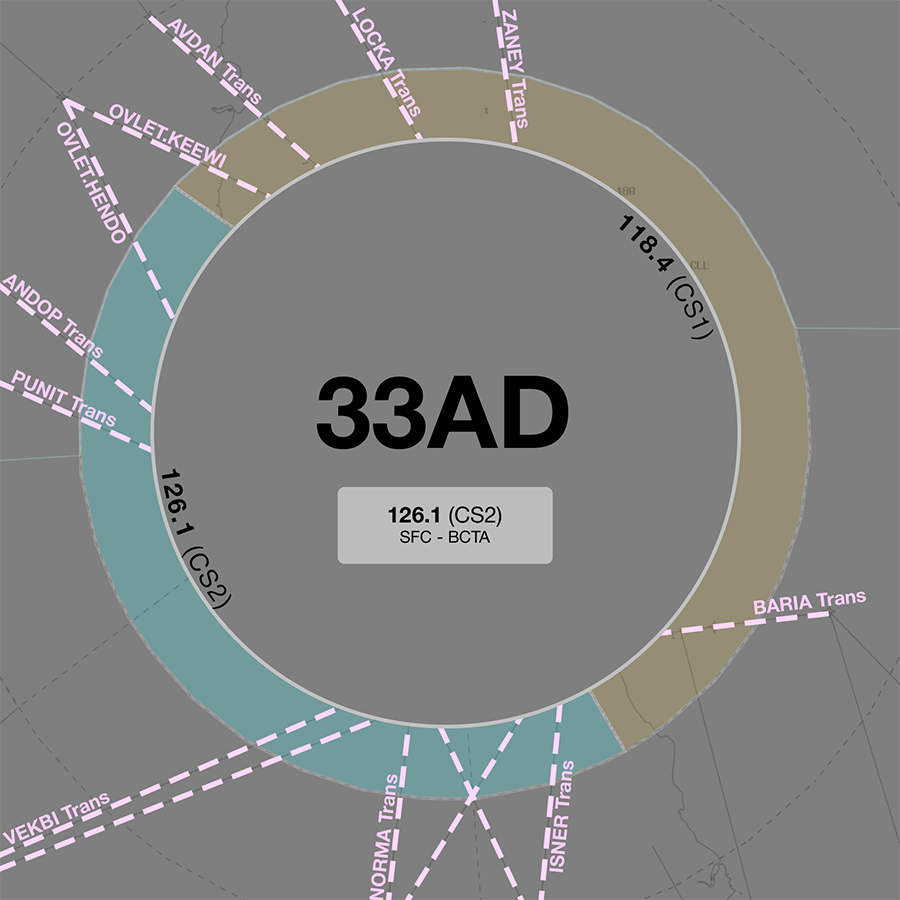
| ADES | STAR | Transition | Frequency (Controller) |
|---|---|---|---|
| YBCS | HENDO | ANDOP ISNER NORMA OVLET PUNIT VEKBI |
126.100 (CS2) |
| BARIA | 118.400 (CS1) | ||
| YBCS | KEEWI | ANDOP PUNIT VEKBI ISNER |
126.100 (CS2) |
| AVDAN LOCKA OVLET ZANEY |
118.400 (CS1) | ||
| YBCS | TOTTY | All | 126.100 (CS2) |
Tip
The quick reference tables above only include scenarios for which there is voiceless coordination. Refer to the diagram for the appropriate position/frequency for coordination and handoff for all other situations.
Coordination
CS TCU
Airspace
The vertical limits of the CS TCU are SFC to F180.
Refer to Cairns TCU Airspace Division for information on airspace divisions when CS2 is online.
Arrivals/Overfliers
Voiceless for all aircraft:
- With ADES YBCS; and
- Assigned a STAR; and
- Assigned the standard assignable level of:
- Radials 055° clockwise through to 355°:
A070 - Radials 355° clockwise to 055°:
A090
- Radials 055° clockwise through to 355°:
All other aircraft coming from KEN CTA must be Heads-up Coordinated to CS TCU prior to 20nm from the boundary.
Departures
Voiceless for all aircraft:
- Tracking via a Procedural SID terminus; and
- Assigned the lower of
F180or theRFL
All other aircraft going to KEN CTA will be Heads-up Coordinated by CS TCU.
TL TCU
Airspace
TL TCU owns the Class C and G airspace within 36 DME TL from SFC to F180.
Refer to Reclassifications for operations when TL TCU is offline.
Arrivals/Overfliers
Voiceless for all aircraft:
- With ADES YBTL; and
- Assigned a STAR; and
- Assigned
A090
All other aircraft coming from TBP CTA must be Heads-up Coordinated to TL TCU prior to 20nm from the boundary.
Departures
Voiceless for all aircraft:
- Tracking via a Procedural SID terminus; and
- Assigned the lower of
F180or theRFL
All other aircraft going to TBP CTA will be Heads-up Coordinated by TL TCU.
Enroute
As per Standard coordination procedures, Voiceless, no changes to route or CFL within 50nm to boundary.
KEN Internal
As per Standard coordination procedures, Voiceless, no changes to route or CFL within 50nm to boundary.
TBP may make changes to CFL up to the boundary with KEN for the purposes of issuing descent for YBCS.
TSN(FLD/COL) (Oceanic)
As per Standard coordination procedures, Voiceless, no changes to route or CFL within 15 mins to boundary.
Aircraft must have their identification terminated and be instructed to make a position report on first contact with the next (procedural) sector.
Phraseology
ISA: "QFA121, identification terminated, report position to Brisbane Radio, 126.45"
International (AYPM)
As per Standard coordination procedures, Voiceless, no changes to route or CFL within 50nm to boundary.