Pearce TCU
Positions
| Name | ID | Callsign | Frequency | Login ID |
|---|---|---|---|---|
| Pearce Approach | PEA | Pearce Approach | 130.200 | PE_APP |
Note
Pearce TCU is a military TCU and procedures can differ significantly to those in a civil TCU. Ensure you are familiar with the military controller skills necessary to provide a quality service.
Airspace
The vertical limits of the Pearce TCU is SFC to F160.
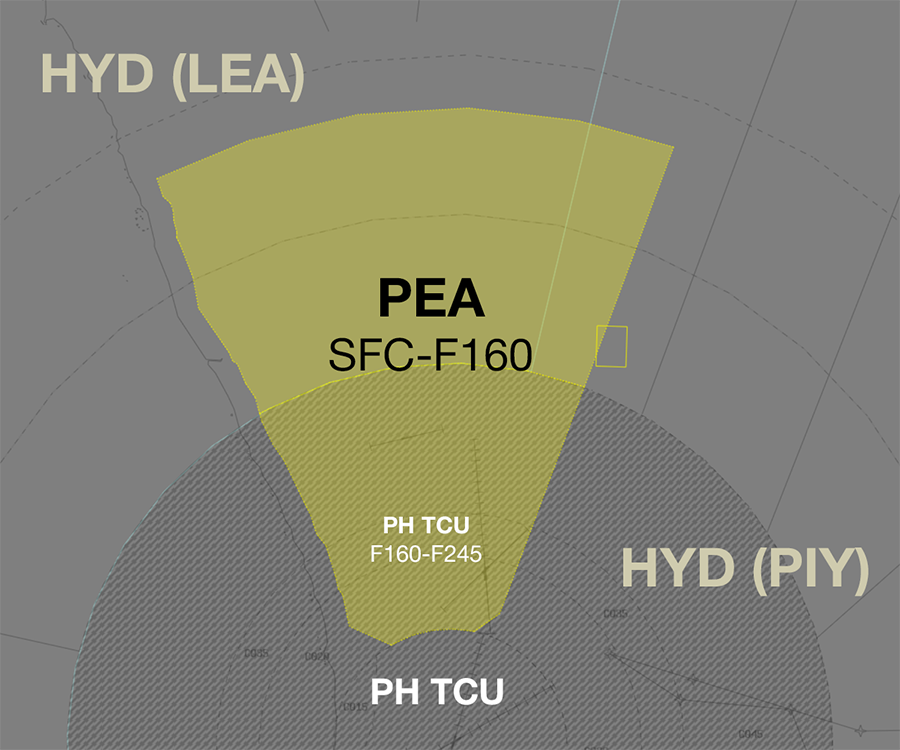
PE ADC
PE ADC owns the airspace within the Pearce CIRA (5nm Radius of YPEA ARP, located entirely within R155A), SFC to A035.
GIG ADC
GIG ADC owns the airspace within the Gingin CIRA (5nm of the YGIG ARP, excluding the area south of 12 TACAN PEA), SFC to A035.
Reclassification
When GIG ADC is offline the aerodrome is uncontrolled, but PEA remains responsibile for controlled airspace down to SFC.
Tip
Consider publishing a pre-formatted ATIS Zulu for the aerodrome, to inform pilots about the airspace reclassification.
Restricted Area Activations
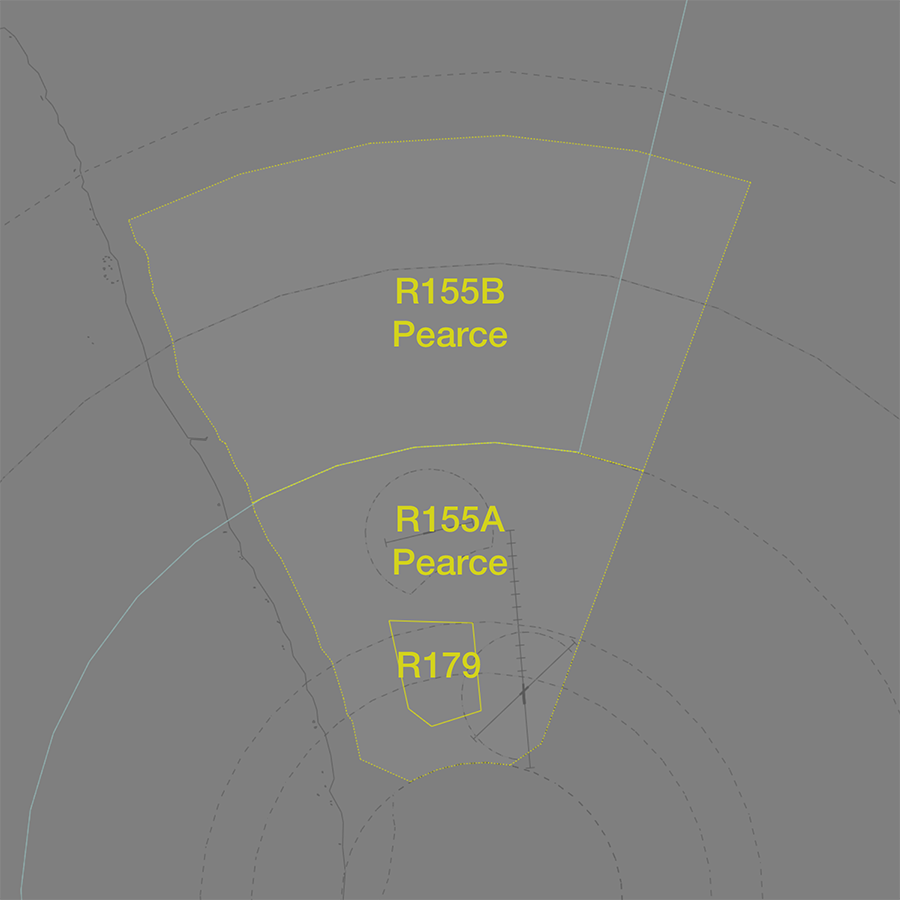
When PEA is online, the following restricted areas are activated by default, and reclassified as Class C airspace.
- R155A Pearce
SFC-F160 - R155B Pearce
SFC-F160
SUA in Enroute Airspace
Military operations taking place in SUA in enroute airspace are outside the jurisdiction of PE TCU.
Upon receiving airways clearance coordination from ACD of an aircraft intending to operate in a currently inactive SUA in enroute airspace, PE TCU must give heads up coordination to relevant enroute controllers.
This gives the enroute controller sufficient time to assess the request, make necessary adjustments to any aircraft in the area currently, and activate the SUA; or alternately to refuse the activation request before the aircraft is in the air.
Phraseology
DUGT19 is requesting clearance to operate in the M166 restricted area.
PE ACD -> PEA: "DUGT19 requests clearance to M166”
PEA -> PE ACD: "Standby, call you back."
PEA -> LEA: "On the groud YPEA, DUGT19, requests activation of M166 A020-F160, from 0300 until 0500.”
LEA -> PEA: "DUGT19, expect activation of M166 A020-F160 at 0300 until 0500."
PEA -> LEA: "DUGT19."
PEA -> PE ACD: "DUGT19, clearance approved."
PE ACD -> PEA: "Clearance approved, DUGT19"
Note
The requirement to coordinate activation of an SUA is in addition to existing coordination requirements. Heads-up coordination is still required for these aircraft if they do not meet the voiceless coordination criteria.
Local Procedures
Initial and Pitch
The initial points changes according to both runway, and direction.
| RWY | Initial Point | Altitude |
|---|---|---|
| 18s | 4NM north at Quarry | A015 |
| 36s | 3.5NM south, at Ellenbrook Speedway | A015 (Right Initial)A010 (Left Initial) |
| 05 | 5nm west, where Warbrook Road leaves the pines | A015 |
| 23 | 4.5NM east, at Quarry | A010 |
The initial points are offset from the runway at the following locations.
| RWY | Initial Point | Altitude |
|---|---|---|
| 08 | Corner of the pine plantation | A015 |
| 26 | Paddock divided by the creek | A015 |
Military Gates
There are four military lanes established throughout the PEA TMA to facilitate entry and exit to adjoining SUA.
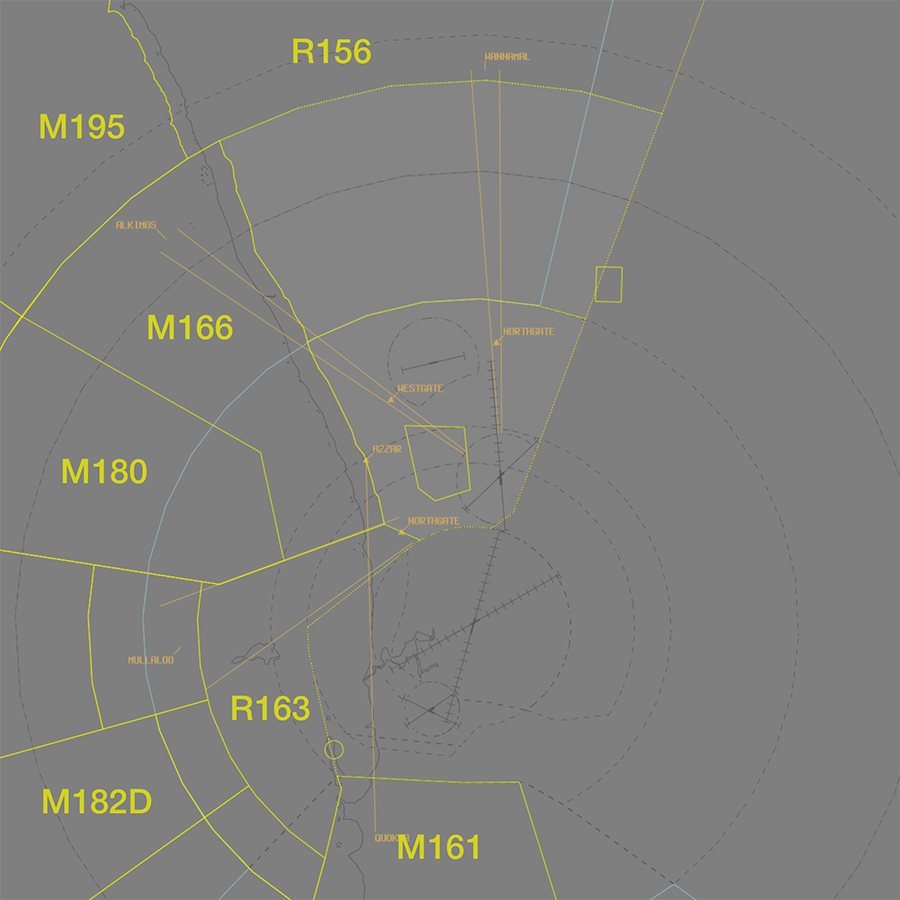
| Intended SUA | TCU Exit Lane |
|---|---|
| M161 | MULLALOO or QUOKKA |
| M166 | ALKIMOS |
| M170A-B | MULLALOO |
| M180 | MULLALOO |
| M182A-G | MULLALOO |
| M195 | ALKIMOS |
| R156 | WANNAMAL |
| R163 | MULLALOO |
Tip
Coordination requirements exist between ACD and TCU when aircraft are requesting clearance to operate in an SUA that has not been activated.
There are four Departure/Arrival Lanes established in the PE TCU to facilitate military aircraft movements between adjacent SUAs.
Alkimos Lane
The Alkimos Lane is centred on the PEA 304 radial, A050-F120. The lane facilitates transit to/from the M147 restricted areas.
Mullaloo Lane
The Mullalloo Lane is between the 248 and 233 radials, A050-F120. The lane facilitates transit to/from the R163 restricted area.
Wannamal Lane
The Wannamal Lane is centered on the PEA 356 radial, A050-F120. The lane facilitates transit to/from SUAs to the north.
Quokka Lane
The Quokka Lane is defined as the AZZAR-FENDA track in the south-west of the TCU, A090-F140. It facilitates transit to/from the M161 MOA on the southern side of the PH TCU, and offers shorter track miles for military aircraft that would otherwise transit via the Wannamal Lane.
Aircraft may be cleared to via the Quokka Lane in lieu of the Wannamal Lane following coordination with PEA.
Phraseology
PE ACD -> PEA: "VIPR21 requests clearance to M161."
PEA -> PE ACD: "VIPR21, clearance approved via Quokka Lane.
Aircraft cleared via the Quokka Lane will be issued a requirement to reach A090 by the 250° PEA TAC radial by PE ACD.
Important
Aircraft transiting on the Quokka Lane must be heads-up coordinated to PH TCU prior to the boundary.
Special Use Airspace
Muchea Air Weapons Range SUA
The Muchea Air Weapons Range is located within the PE TMA, and is used for air-surface gunnery and bombing practice. It is entirely contained within the R179 Pearce restricted area.
When the R179 Pearce restricted area is active all airspace within the SUA is managed by PEA, and the ATIS should be updated to reflect the activation.
Training Areas
The PE TMA and adjoining SUAs contain multiple segmented training areas to facilitate local training operations.
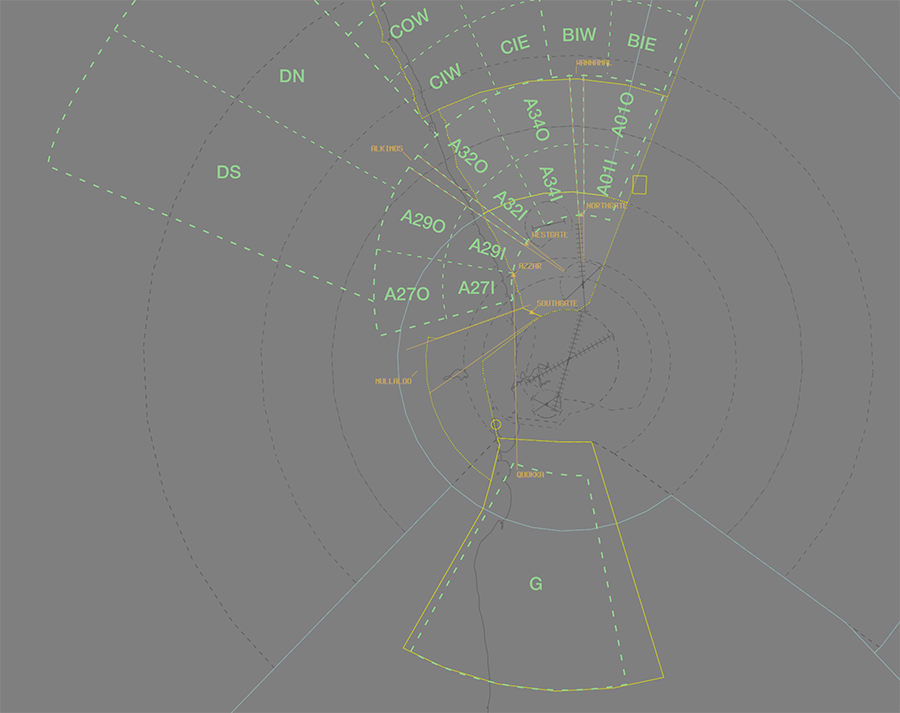
The 'A' inner training areas (with designator ending in 'I') extend from 15NM to 30NM PEA TAC, and the 'A' outer training areas (with designator ending in 'O') extend from 30NM to 45NM PEA TAC. The 'B', 'C', and 'D' training areas extend beyond 45NM PEA TAC, and the 'G' training area extends from 40NM PEA TAC to 70NM PH VOR, within the M161 MOA.
PEA is not responsible for assigning training areas, or ensuring separation between aircraft operations between areas.
When an aircraft has declared an intention to operate within a training areas, PEA may provide a traffic statement to help provide situational awareness to the departing aircraft.
Phraseology
PEA: "CYGT11, cleared operating, number 2 in A32 Outer, report ops normal time 30.
Coordination
Enroute
Departures
All aircraft from PE TCU to HYD require Heads-up coordination prior to the boundary, however, as soon as practical (when is the aircraft becomes airborne) is preferred.
Arrivals/Overfliers
All aircraft transiting from HYD to PE TCU must be Heads-up coordinated prior to 20nm from the boundary. There are no standard assignable levels; HYD and PEA controller must agree on a suitable level during coordination.
Phraseology
LEA -> PEA: "via AVNEX, EGLE9, will be assigned A090"
PEA -> LEA: "EGLE9, A090"
PE ADC
Next coordination is required from PE ADC to PE TCU for all aircraft.
The Standard Assignable Level from PE ADC to PE TCU is:
| Departure Procedure | Level |
|---|---|
| GUNOK SID | A030 |
| A Procedural SID | F130 |
| All others | The lower of F130 and RFL |
ACD to TCU
The controller assuming responsibility of ACD shall give heads-up coordination to PEA (or the enroute controller responsible for the PEA TCU) prior to the issue of a clearance to an aircraft intending to operate in an SUA that has not been activated.
Phraseology
PE ACD -> PEA: "DUGT19DUGT19 requests clearance to M166"
PEA -> PE ACD: "DUGT19, clearance approved."
GIG ADC
Next coordination is required from GIG ADC to PE TCU for all aircraft.
The Standard Assignable Level from GIG ADC to PE TCU is:
| Aircraft | Level |
|---|---|
| All | The lower of A050 and RFL |
SMC to PE TCU
The controller assuming responsibility of SMC shall give heads-up coordination to PEA (or the enroute controller responsible for the PE TCU) prior to the issue of a clearance to an aircraft intending to operate in an SUA that has not been activated.
Phraseology
GIG SMC -> PEA: "SIRA31 requests clearance to M171A"
PEA -> GIG SMC: "SIRA31, clearance approved."
PH TCU
All aircraft transiting between PE TCU and PH TCU must be heads-up coordinated prior to the boundary.
Phraseology
PEA -> PH TCU: "Airborne YPEA, PHNX11"
PH TCU -> PEA: "PHNX11, F180"
Charts
Reference
In addition to the civilian ERSA and AIP publications, the RAAF AIP website contains the necessary charts (available in the TERMA) and description of procedures (in each airports' FIHA).