Brisbane TCU Changes
Future Procedure
This page documents future procedures that are scheduled to be introduced on 09 July 2026.
Controllers are strongly encouraged to familiarise themselves with the incoming changes before launch day.
Positions
| Name | ID | Callsign | Frequency | Login ID |
|---|---|---|---|---|
| Brisbane Approach North | BAN | Brisbane Approach | 124.700 | BN_APP |
| Brisbane Approach South | BAS | Brisbane Approach | 125.600 | BN-S_APP |
| Brisbane Departures North | BDN | Brisbane Departures | 133.450 | BN_DEP |
| Brisbane Departures South | BDS | Brisbane Departures | 118.450 | BN-S_DEP |
| Brisbane Radar | SHN | Brisbane Centre | 119.500 | BN-R_DEP |
| Brisbane Flow | BFL | BN_FMP | ||
| Gold Coast Approach | BAC | Brisbane Approach | 123.500 | BN-C_APP |
| Ballina Approach | BAA | Ballina Approach | 118.350 | BA_APP |
Non-Standard Positions
Non-standard positions may only be used in accordance with VATPAC Air Traffic Services Policy.
Approval must be sought from the bolded parent position prior to opening a Non-Standard Position, unless NOTAMs indicate otherwise (eg, for events).
Airspace
The Vertical limits of the BN TCU are SFC to F180, except in BAC airspace, where it is SFC to A075 in the North West, and SFC to F125 in the South East.
Reclassifications
AF CTR reverts to Class G when AF ADC is offline, and is administered by the relevant BN TCU controller.
See also: AF ADC Offline.
BA CTR reverts to Class G below A045 when BA ADC is offline, and is administered by BAA.
See also: BA ADC Offline.
CG CTR reverts to Class G below A035 when CG ADC is offline, and is administered by the BAC. Alternatively, BAC may provide a top-down aerodrome service if they wish.
See also: CG ADC Offline.
Airspace Division
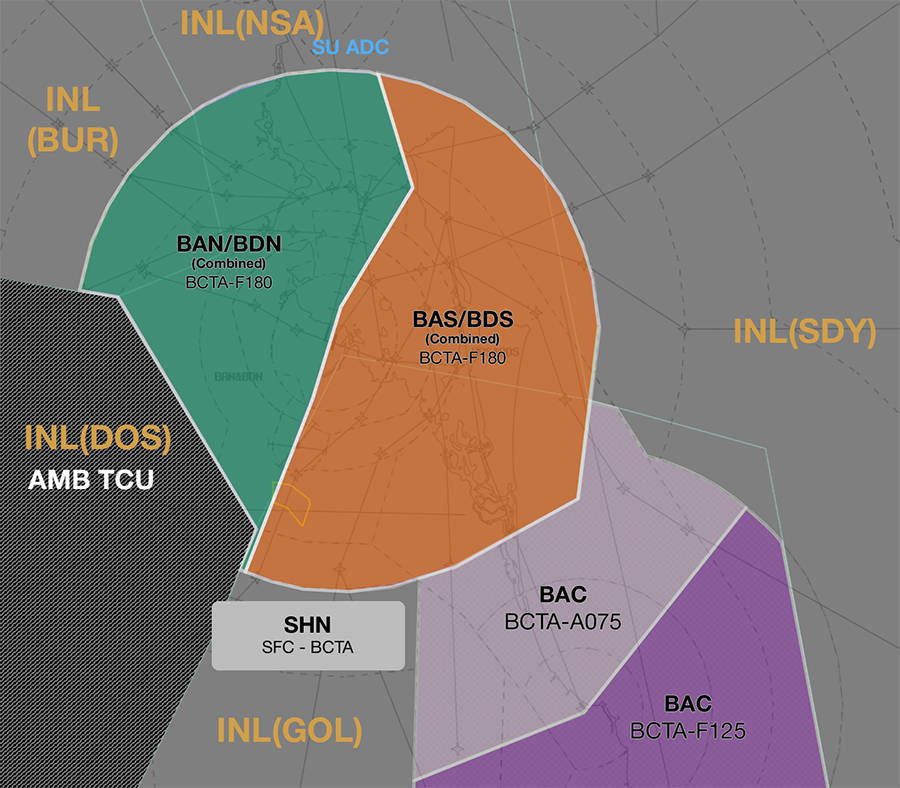
The divisions of the airspace between BAN, BAS, BDS, BDN, BAC, and BAA change based on the Runway Mode.
Note
The following diagrams do not include non BN TCU areas of responsibility such as AF CTR, CG ADC, or BA ADC.
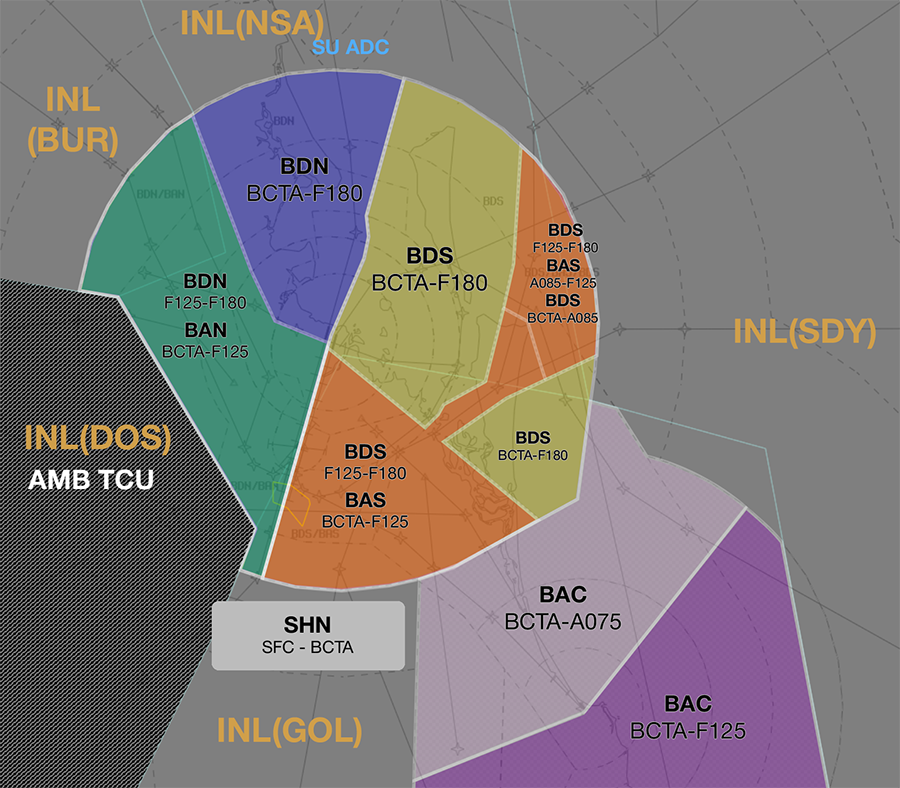
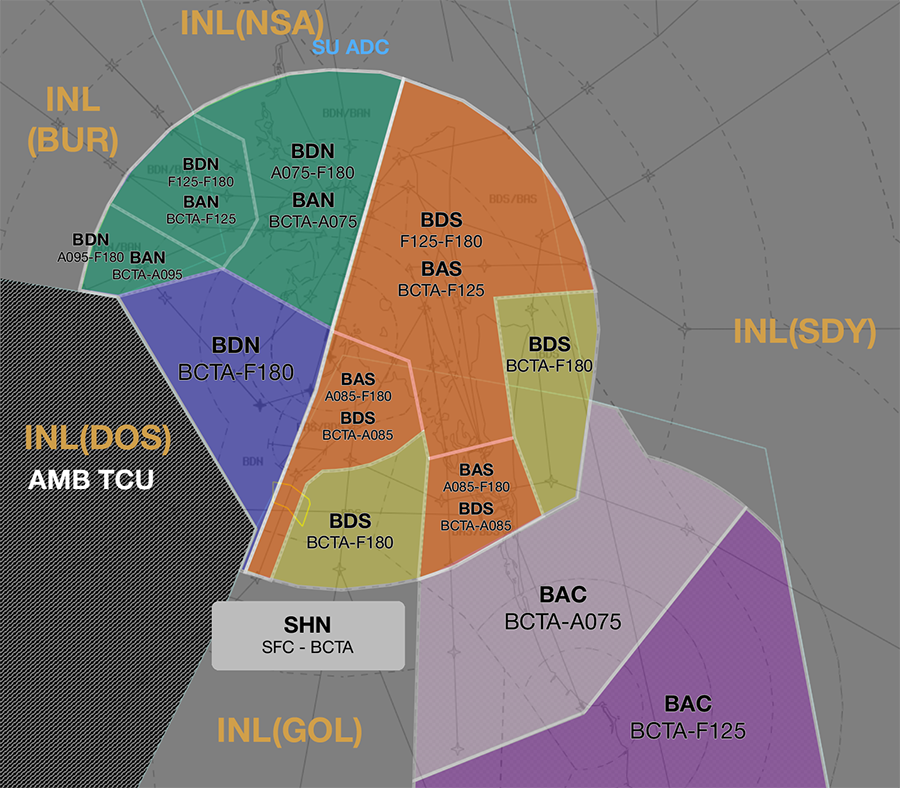
Important
During SODPROPS, approach and departure sectors are combined 'on-side'. i.e.:
- BAN and BDN are combined with each other; and
- BAS and BDS are combined with each other.
The controller may connect as either position, and assume both frequencies.
Only two TCU controllers may operate the BN TMA when running the SODPROPS runway mode (excluding an additional SHN, BAC, and BAA controller if desired).
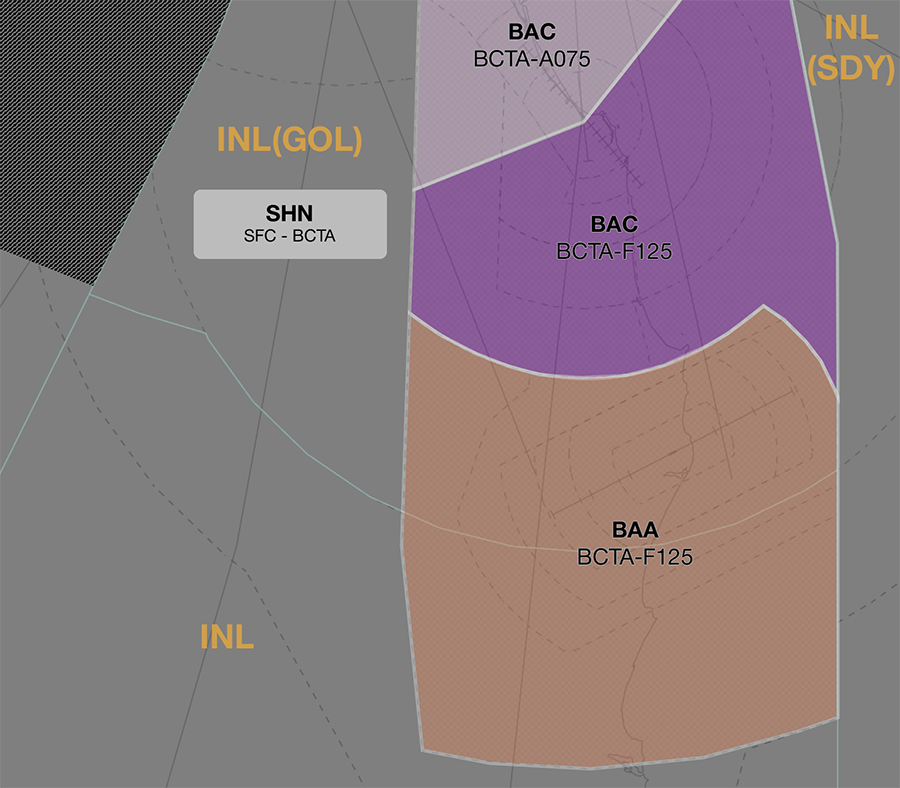
Brisbane Radar (SHN)
SHN is responsible for the provision of FIS in Class G airspace within the BN TMA. The role can be delegated to any TMA controller. The position is designed to reduce the workload of other TMA positions by obtaining a pilot's request, identifying them, performing any necessary coordination, then handing them to the relevant controller who will issue clearance if appropriate. Explicit coordation requirements exist between SHN and other TCU positions.
Example
During a busy event, BAN is experiencing a high workload and wishes to delegate the SHN role to another controller who isn't as busy. BDN has a low workload and elects to perform the role.
Airspace Structural Arrangements
There are 7 executive controller positions within the BN/CG TCUs, plus a flow controller. Due to the large variety of traffic scenarios experienced across both day-to-day operations and busy events, controllers are encouraged to split the airspace among multiple controllers in a way which best reduces their workload.
With a controller on BAN and an additional controller offering assistance, some example splits include:
- BAC
- BAS, extending BDS
Tip
When general traffic levels are high, splitting the airspace into 'approach' airspace and 'departures' airspace may introduce additional complexity. In these situations, it may be simpler to combine sectors 'on-side', i.e.:
- BAN and BDN combined; and
- BAS and BDS combined.
Extending
BN TCU may extend to BAC/BAA and vice versa; callsigns remain the same. See Controller Skills for details.
Separation
Parallel Runway Operations
Aircraft joining parallel instrument approaches must remain separated from aircraft on the adjacent approach until they are established. This usually involves keeping aircraft vertically separated and may require aircraft to intercept the localiser/final approach course/RNP AR track and maintain their assigned level, only allowing descent on the approach once they are established.
Two aircraft cleared for adjacent instrument approaches must maintain the following minimum lateral separation:
| Situation | Lateral Separation Standard |
|---|---|
| One or both aircraft not yet established | 3nm |
| Both aircraft established on final approach courses | 1.5nm |
Note
It may be necessary to use speed control on final to maintain the required separation.
Local Procedures
Special Use Airspace
Evans Head SUA
The Evans Head Air Weapons Range is located partially within BAA airspace, and is used for air-surface gunnery, bombing, and rocket firing practice. There are multiple restricted areas and MOAs associated with the range to enable flying activities based at Amberley.
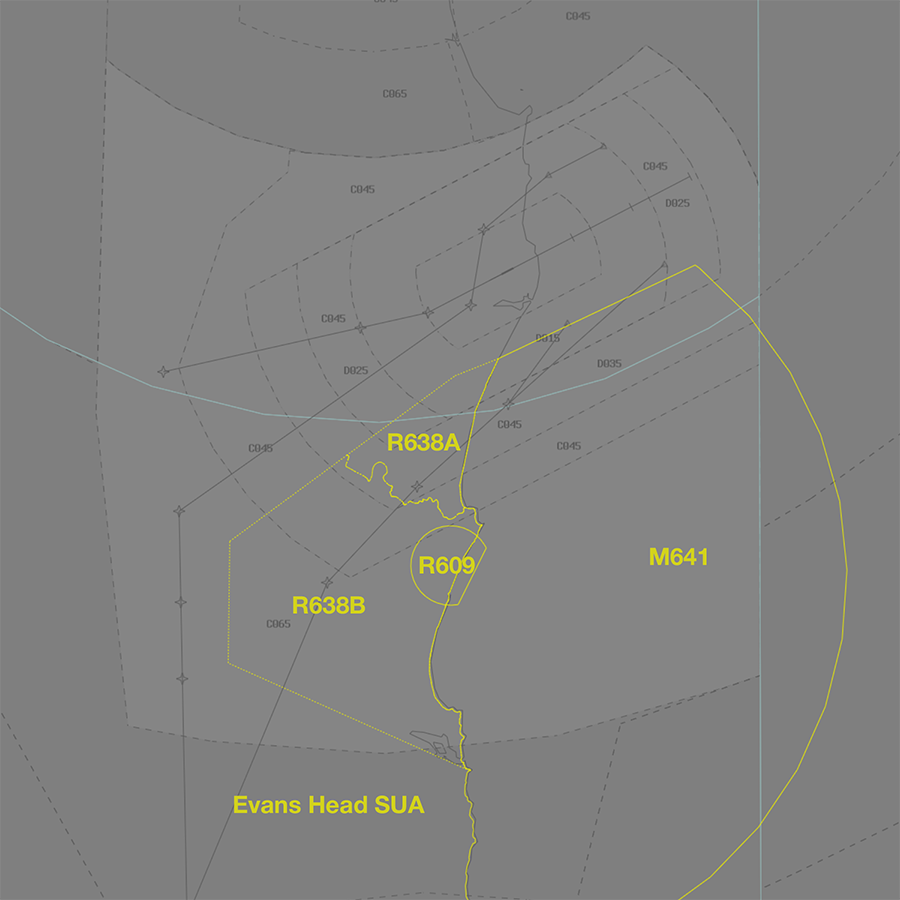
AMA (or INL on their behalf) will coordinate the activation of these SUA prior to any activity.
Departure/Arrival Procedures
STAR and Runway Assignment
Sequencing of arrivals into YBBN is the responsibility of INL, with input from BN TCU.
Aircraft from the north/west are assigned 01L/19R and aircraft from the south/east assigned 01R/19L. These standard runway assignments may be modified strategically by the BAS or BFL controller.
Example
If during an event, the vast majority of traffic is coming from BLAKA and GOMOL feeder fixes, BAS/BFL may elect to assign 19L to BLAKA arrivals and 19R to GOMOL arrivals, to keep them separated at all times.
BFL -> INL: "All arrivals via GOMOL to be assigned 19R until further notice"
INL -> BFL: "Roger, Arrivals via GOMOL to be assigned 19R"
Gold Coast Arrivals
Visual approaches are preferred into YBCG. If due to operational requirements, an aircraft is unable to accept a visual approach, coordination with CG ADC may be required.
There is no STAR available to facilitate aircraft arriving from the north west. INL(BUR/NSA) will instruct these aircraft BN Y177 IDRIL NOPAS GOMOL prior to handoff to BN TCU, who will then facilitate further descent. Aircraft will then be given further instructions by BAC according to the runway in use.
| Runway | Routing |
|---|---|
| 14 | Not below A050 until established over water, and then instructed to join final/track to an instrument IAF. |
| 32 | Radar vectors to join 10NM/instrument IAF. |
Note
Aircraft tracking via the above routing does not constitute a voiceless coordination route between BAN/BDS and BAC. Aircraft should still be heads-up coordinated to BAC prior to 5 minutes to the boundary, unless coordinated otherwise.
BERNI Arrivals
YBCG arrivals from the south will transit BAA airspace as they descend. INL will provide these aircraft with their STAR clearance and initial descent according to the voiceless coordination criteria
BAA is then responsible for facilitating descent to these aircraft to A090 (or an otherwise coordinated level), before handing the aircraft to BAC.
Alternately, BAA may coordinate A090 and "no frequency requirements" with INL, if traffic levels allow. This permits INL to provide the aircraft with continuous descent as they transit the TMA. BAA is responsible for onwards coordination to BAC, if an altitude other than A090 is assigned.
Phraseology
BAA -> INL: "JST458, A080 and no frequency requirements. My onwards with BAC."
INL -> BAA: "JST458, A080, yours with BAC."
INL will put BAA C080 NFR in the label data, and hand the aircraft directly off to BAC.
Tower Offline
AF ADC Offline
Due to the low level of CTA (A015) in the AF CTR when AF ADC is offline, it is best practice to give airways clearance to aircraft at the holding point, to ensure departing aircraft can have uninterrupted climb.
Phraseology
ABC: "Brisbane Approach, ABC, PC12, POB 8, IFR, Taxiing YBAF for YBSU, Runway 28R"
BN TCU: "ABC, Brisbane Approach, Squawk 3601, No Reported IFR Traffic, Report Ready at the Holding Point for Airways Clearance"
ABC: "Squawk 3601, Wilco, ABC"
ABC: "ABC, Ready Runway 28R, Request clearance"
BN TCU: "ABC, Cleared to YBSU via BN, Flight Planned Route. Make Visual right turn DCT BN, Climb to A030"
ABC: "Cleared to YBSU via BN, Flight Planned Route. Make Visual right turn DCT BN, Climb to A030, ABC"
BA ADC Offline
Due to the low level of CTA (A045) in the BA CTR when BA ADC is offline, it is best practice to give airways clearance to aircraft at the holding point, to ensure departing aircraft can have uninterrupted climb.
Phraseology
JST459: "Ballina Approach, JST459, A320 IFR, Taxiing YBNA for YSSY, Runway 06"
BN TCU: "JST459, Ballina Approach, Squawk 3601, no reported IFR traffic, report ready at the holding point for airways clearance"
JST459: "Squawk 3601, wilco, JST459"
JST459: "JST459, ready Runway 06, request clearance"
BN TCU: "JST459, cleared to YSSY via IDNER, flight planned route. climb to A040"
JST459: "Cleared to YSSY via IDNER, flight planned route, climb to A040, JST459"
CG ADC Offline
Due to the low level of CTA (A035) in the CG CTR when CG ADC is offline, it is best practice to give airways clearance to aircraft at the holding point, to ensure departing aircraft can have uninterrupted climb.
Phraseology
JST446: "Brisbane Approach, JST446, A320, IFR, taxiing YBCG for YSSY, runway 14"
BN TCU: "JST446, Brisbane Approach, squawk 3601, no reported IFR traffic, report ready at the holding point for airways clearance"
JST446: "Squawk 3601, wilco, JST446"
JST446: "JST446, ready runway 14, request clearance"
BN TCU: "JST446, cleared to YSSY via APAGI, flight planned route, climb to A060"
JST446: "Cleared to YSSY via APAGI, flight planned route, climb to A060, JST446"
Runway Modes
Parallel Runway Operations
Unless operationally required, aircraft arriving YBBN shall be assigned the following runways for arrival when PROPS are in progress:
| Aircraft tracking | Runway |
|---|---|
| via BLAKA | 01R/19L |
| via GOMOL | 01R/19L |
| via UGTUG | 01R/19L |
| via TEBOT | 01R/19R |
| via MORBI | 01L/19R |
| via SMOKA | 01L/19R |
| via WOODY | 01L/19R |
| via ENLIP | 01L/19L |
| Other aircraft: | |
| From the NORTH and WEST | 01L/19R |
| From the SOUTH and EAST | 01R/19L |
SODPROPS
Arriving aircraft must be established on final and transferred to the tower frequency no later than 10NM from touchdown.
Note
Arrivals from the south and east shall be assigned the ISPON STAR to RWY 19R by Enroute. Aircraft not assigned this procedure should be closely monitored for conflict with aircraft departing RWY 01R.
Helicopter Operations
In VMC, helicopters inbound to or outbound from YBBN shall be processed via two visual waypoints (outlined below) positioned north and south of the field. Where VMC does not exist, IFR helicopters will conform to fixed wing ops.
| Direction of Flight | Inbound/Outbound Tracking Point |
|---|---|
| North | BLHS |
| South | MBHM |
| East | MBHM |
| West | BLHS |
Departures
BN ADC will clear outbound helicopters via the appropriate waypoint and transfer the aircraft to TCU. Where VMC does not exist, IFR helicopters will be assigned the BN (RADAR) SID and processed as per fixed wing ops.
Arrivals
Helicopters arriving to YBBN during VMC shall be cleared by BN TCU via the appropriate inbound waypoint, with that waypoint issued as the clearance limit. TCU shall coordinate the arrival with ADC and transfer the aircraft approaching the clearance limit.
Phraseology
X6G: "Brisbane Approach, helicopter X6G, 14nm north of Brisbane, A010, inbound, received Bravo, request clearance"
BN TCU: "X6G, Brisbane Approach, remain outside Class C airspace, squawk 0445"
X6G: "Remain OCTA, squawk 0445, X6G"
TCU -> ADC: "North, helicopter X6G, inbound at A010, clearance limit BLHS"
ADC -> TCU: "X6G"
BN TCU: "X6G, identified, cleared to YBBN via BLHS, maintain A010, clearance limit BLHS"
X6G: "Cleared to YBBN via BLHS, maintain A010, clearance limit BLHS, X6G"
BN TCU: "X6G, contact Brisbane Tower, 120.5"
BN ADC will assess the traffic situation and clear the aircraft for a visual approach to their nominated landing site.
City Scenic Flights
Helicopters conducting scenic flights around the city require access to the Brisbane CTA to operate. These flights typically involve low-level operations inside controlled airspace and in proximity to landmarks within the city area.
Aircraft must track via Class G airspace to UQLD and contact BN TCU prior to reaching UQLD requesting airways clearance. Attempt to identify the aircraft, and if a clearance cannot be given immediately, instruct the pilot to remain clear of Class C airspace.
Phraseology
FHK: "Departures, helicopter FHK, 2 miles south UQLD A010, for city scenic, request airways clearance"
BN TCU: "FHK, Departures, squawk 1562, remain outside Class C airspace"
FHK: "Squawk 1562, remain OCTA, FHK"
BN TCU: "FHK, identified, cleared to enter controlled airspace remaining west of SBD, not above A010, Brisbane QNH 1026"
FHK: "Cleared to enter controlled airspace remaining west of SBD, not above A010, QNH 1026, FHK"
Due to the close proximity to YBBN, it may be necessary to instruct helicopters to maintain visual separation with arriving or departing aircraft.
Phraseology
BN TCU: "FHK, report sighting an Embraer E190 departing runway 19R, through A008 on climb."
FHK: Traffic in sight, FHK"
BN TCU: "FHK, maintain own seperation with the E190"
FHK: "Maintain own seperation, FHK"
BN TCU: "QFA1864, traffic is a helicopter operating over the CBD not above A010, maintaining own separation with you"
QFA1864: "QFA1864"
Once the aircraft exits the CTA, cancel their identification and control services.
Phraseology
FHK: "FHK, excited the zone"
BN TCU: "FHK, identification and control service terminated, frequency change approved"
FHK: "Frequency change approved, FHK"
Flow
Local Knowledge
- Aircraft inbound to YBBN from the south may be split between the GOMOL/BLAKA and ENLIP STARs, and assigned different runways, to reduce overall delay (most effective during 01 PROPS)
- Aircraft inbound to YBBN may be issued the appropriate Xray or Victor STAR to reduce track miles
- Aircraft inbound to YBBN from the north for RWY 01R may be issued the SMOKA M STAR to reduce track miles
- Aircraft inbound to YBCG may be assigned the Yankee or Victor STAR to reduce track miles
Flow Tables
YBBN
The tables below give an estimated time in minutes from the Feeder Fix to the Threshold.
| STAR | RWY 01L | RWY 01R | RWY 19L | RWY 19R |
|---|---|---|---|---|
| BLAKA A | 13 | 13 | 19 | 21 |
| BLAKA X | - | 12 | 16 | - |
| ENLIP A | 11^ | 11^ | 20 | 18 |
| ENLIP X | - | - | 16 | 16 |
| GOMOL A | 14 | 14 | 18 | 20 |
| GOMOL V | - | 13 | 15 | - |
| GOMOL X | - | 12 | 16 | - |
| ISPON ENLIP transition BLAKA transition GOMOL transition UGTUG transition |
- - - - |
- - - - |
- - - - |
20 19 19 14 |
| MORBI A | 16 | 15 | 13 | 12 |
| MORBI V | 13 | - | - | 11^ |
| SMOKA A | 15 | 14 | 13 | 13 |
| SMOKA M | - | 12^ | - | - |
| SMOKA X | 13 | - | - | 11^ |
| TEBOT A | 18 | 18 | 11^ | 11^ |
| TEBOT X | - | 15 | - | - |
| UGTUG A | 15 | 15 | 13 | 14 |
| UGTUG X | - | 13 | 12^ | - |
| WOODY A | 14 | 13 | 15 | 15 |
| WOODY V | 11^ | - | - | 12^ |
| STAR | RWY 01L | RWY 01R | RWY 19L | RWY 19R |
|---|---|---|---|---|
| BLAKA A | 15 | 15 | 22 | 24 |
| BLAKA X | - | 14 | 18 | - |
| ENLIP A | 13^ | 13^ | 23 | 20 |
| ENLIP X | - | - | 19 | 18 |
| GOMOL A | 16 | 15 | 21 | 23 |
| GOMOL V | - | 14 | 17 | - |
| GOMOL X | - | 14 | 18 | - |
| ISPON ENLIP transition BLAKA transition GOMOL transition UGTUG transition |
- - - - |
- - - - |
- - - - |
23 22 21 15 |
| MORBI A | 18 | 17 | 14 | 14 |
| MORBI V | 14 | - | - | 12^ |
| SMOKA A | 17 | 16 | 15 | 15 |
| SMOKA M | - | 13^ | - | - |
| SMOKA X | 14 | - | - | 13^ |
| TEBOT A | 20 | 21 | 12^ | 13^ |
| TEBOT X | - | 17 | - | - |
| UGTUG A | 17 | 17 | 15 | 16 |
| UGTUG X | - | 14 | 13^ | - |
| WOODY A | 16 | 15 | 17 | 16 |
| WOODY V | 13^ | - | - | 14^ |
YBCG
The tables below give an estimated time in minutes from the Feeder Fix to the Threshold.
| Arrival | RWY 14 | RWY 32 |
|---|---|---|
| BERNI A STAR | 15 | 11^ |
| BERNI V STAR | 14 | 12^ |
| BERNI Y STAR | 14 | - |
| LAMSI A STAR | 13 | 11^ |
| LAMSI Y STAR | 12^ | 10^ |
| BN Y177 IDRIL CG2SA | - | 16 |
| BN Y177 IDRIL CG2NC | 12^ | - |
| Arrival | RWY 14 | RWY 32 |
|---|---|---|
| BERNI A STAR | 17 | 13^ |
| BERNI V STAR | 16 | 13^ |
| BERNI Y STAR | 16 | - |
| LAMSI A STAR | 15 | 13^ |
| LAMSI Y STAR | 14^ | 12^ |
| BN Y177 IDRIL CG2SA | - | 18 |
| BN Y177 IDRIL CG2NC | 13^ | - |
Corrections
| Situation | Correction |
|---|---|
| Assigned a reduced speed | +1 min, except ^ |
| Over 40kt of head/tailwind component | +1 min for headwind -1 min for tailwind |
Assumptions
- Nil wind
- The feeder fix for all STARs is the assigned STAR transition waypoint (if applicable), otherwise the waypoint coinciding with the STAR title
- Aircraft inbound to YBCG from the north will track from IDRIL to the IAF for their assigned approach
- Aircraft inbound to YBCG on a STAR ending at FIKUL or KEGAN will conduct the RNP Z approach
YBBN Calculator
The following calculator will generate a landing time from a feeder fix ETA, or the reverse.
YBCG Calculator
The following calculator will generate a landing time from a feeder fix ETA, or the reverse.
Coordination
Enroute
Departures
Voiceless for aircraft:
- With ADEP YBBN
- Tracking via a Procedural SID terminus^; and
- Assigned the lower of
F180or theRFL
- With ADEP YBCG
- Tracking via APAGI and assigned the lower of
F120or theRFL; or - Tracking via BN and assigned the lower of
F180or theRFL
- Tracking via APAGI and assigned the lower of
- With ADEP YBNA
- Tracking via IDNER or BUVAM; an
- Assigned the lower of
F120of theRFL
- With ADES YBSU
- Assigned the ITIDE STAR; and
- Assigned
F130
Note
^Aircraft are not required to be tracking via the SID procedure, simply tracking via any of the terminus waypoints (regardless of assigned SID) is sufficient to meet the criteria for voiceless coordination.
All other aircraft going to INL CTA will be Heads-up coordinated by BN TCU/BAC/BAA.
Phraseology
BAC -> GOL: "Departing YBCG, X4C, do you have any Restrictions or Requirements?"
GOL -> BAC: "X4C, No Restrictions or Requirements"
Arrivals
Voiceless for all aircraft:
- With ADES YBBN:
- Assigned a STAR; and
- Assigned
A090.
- With ADES YBCG:
- Assigned a STAR, and assigned
F130; or - Tracking via
BN Y177 IDRIL NOPAS GOMOL, and assignedF190.
- Assigned a STAR, and assigned
- With ADES YBNA:
- Assigned a STAR; and
- Assigned
F120
All other aircraft coming from INL CTA must be Heads-up coordinated to BN TCU/BAC/BAA prior to 20nm from the boundary.
BN ADC
Auto Release
Next coordination is not required to BN TCU for aircraft that are:
- Departing from a runway nominated on the ATIS (except during SODPROPS^); and
- Assigned the standard assignable level; and
- Assigned a Procedural SID; or
- Assigned the Radar SID with a Standard Assignable Heading
^Auto Release is not available during SODPROPS runway mode. All aircraft must be coordinated from BN ADC to BN TCU.
All other aircraft require a 'Next' call to BN TCU.
The Standard Assignable level from BN ADC to BN TCU is:
| Aircraft | Level |
|---|---|
| Jets | A060 |
| Non-Jets | The lower of A040 and RFL |
Standard Assignable Departure Headings
Aircraft that have been cleared the BN (RADAR) SID will receive an assigned heading with their line up or takeoff clearance. 'Next' coordination is not required (excluding during SODPROPS) from the BN ADC controller when the departing aircraft has been assigned the standard assignable level and assigned one of the headings listed below:
| Runway | Assigned Heading |
|---|---|
| 01L | H340 |
| 01R | H120 |
| 19L | H110 |
| 19R | H270 |
Tip
If strong winds are present at altitude, ADC/DEP should discuss slight changes to these headings (+/- 5 degrees) to compensate for large crosswind components.
BN TCU Internal
APP / DEP
Voiceless Coordination is in place for aircraft transiting between BN APP/DEP positions, provided the aircraft is:
- With ADEP YBBN
- Assigned a SID; and
-
Climbing via SID to
A100or higher -
With ADES YBBN
- Assigned a STAR; and
- Descending via STAR to
A080
All other aircraft, including aircraft that transit between internal BN TCU boundaries, must be heads-up coordinated.
Phraseology
BDS -> BAS: "via MAKRU, QFA904"
BAS -> BDS: "QFA904, A050"
Between BAC and APP/DEP
YBCG arrivals and departures do not meet the voiceless criteria between APP/DEP and BAC, and must be heads-up coordinated.
Phraseology
BDS -> BAC: "via NOPAS, A2B"
BAC -> BDS: "A2B, A070"
Between BAC and BAA
Voiceless coordination is in place for aircraft transiting between BAA and BAC positions, provided the aircraft is:
- With ADES YBCG
- Assigned a STAR; and
- Descending via STAR to to
A090.
All other aircraft must be heads-up coordinated.
Phraseology
BAA -> BAC: "via IPNOS, XYZ"
BAC -> BAA: "XYZ, A070"
Between SHN and TCU
Standard Radar to TCU coordination for each aircraft transiting between Class G and CTA (or vice versa).
AF ADC
Airspace
AF ADC is responsible for the Class D Airspace within the AF CTR SFC to A015.
Refer to Reclassifications for operations when AF ADC is offline.
Departures
Next coordination is required from AF ADC to BN TCU for all aircraft entering BN TCU CTA.
The Standard Assignable level from AF ADC to BN TCU is:
| Aircraft | Level |
|---|---|
| All | The lower of A040 and RFL |
Arrivals/Overfliers
BN TCU will heads-up coordinate arrivals/overfliers from Class C to AF ADC prior to 5 mins from the boundary.
IFR aircraft will be cleared for the coordinated approach (Instrument or Visual) prior to handoff to AF ADC, unless AF ADC nominates a restriction.
VFR aircraft require a level readback.
Phraseology
BN TCU -> AF ADC: "via TVT for the visual approach, UJE"
AF ADC -> BN TCU: "UJE, visual approach"
BA ADC
Airspace
BA ADC is responsible for the Class D airspace within the BA CTR SFC to A015.
Refer to Reclassifications for operations when BA ADC is offline.
Auto Release
Next coordination is not required to BN TCU for aircraft that are:
- Departing from a runway nominated on the ATIS; and
- Assigned the standard assignable level; and
- Assigned a Procedural SID
All other aircraft require a 'Next' call to BA TCU.
The Standard Assignable level from BA ADC to BA TCU is:
| Aircraft | Level |
|---|---|
| All | The lower of A050 and RFL |
Arrivals/Overfliers
BAA will heads-up coordinate arrivals/overfliers from Class C to BA ADC prior to 5 mins from the boundary.
IFR aircraft will be cleared for the coordinated approach (Instrument or Visual) prior to handoff to BA ADC, unless BA ADC nominates a restriction.
VFR aircraft require a level readback.
Phraseology
BAA -> BA ADC: "via AVBAK for RNP-Y, QLK2035"
BA ADC -> BAA: "QLK2035, RNP-Y"
CG ADC
Airspace
CG ADC is responsible for the Class C Airspace within the CG CTR SFC to A015.
Refer to Reclassifications for operations when CGF ADC is offline.
Auto Release
Next coordination is not required to BN TCU for aircraft that are:
- Departing from a runway nominated on the ATIS; and
- Assigned the standard assignable level; and
- Assigned a Procedural SID
All other aircraft require a 'Next' call to CG TCU.
The Standard Assignable level from CG ADC to BN TCU is:
| Aircraft | Level |
|---|---|
| Jets | A060 |
| Non-Jets | The lower of A060 and RFL |
AMB TCU
All aircraft transiting from BN TCU to AMB TCU and vice versa must be Heads-up coordinated prior to the boundary.
Phraseology
AMA -> BDN: "via BN, DRGN02"
BDN -> AMA: "DRGN02, F140"
For aircraft arriving into AMB TCU there is no standard assignable level.
Phraseology
BDN -> AMA: "via WACKO, STAL13, what level can I assign?"
AMA -> BDN: "STAL13, A100"
BDN -> AMA: "A100, STAL13"
SU ADC
BN TCU Class G shares a tiny border with SU ADC, however there are no SIDs, STARs, or airways through this gap. The only possible way for an aircraft to directly enter SU ADC airspace from BN TCU's jurisdiction, is from Class G, and as such, no coordination is required to SU ADC. However, ensure the aircraft is transferred to the ADC at least 10nm prior to the boundary, to facilitate their airways clearance.
SU ADC coordination for arrivals and departures via the SID/STAR is handled by INL(NSA).