Adelaide (YPAD)
Positions
| Name | Callsign | Frequency | Login ID |
|---|---|---|---|
| Adelaide ADC | Adelaide Tower | 120.500 | AD_TWR |
| Adelaide SMC | Adelaide Ground | 121.700 | AD_GND |
| Adelaide ACD | Adelaide Delivery | 126.100 | AD_DEL |
| Adelaide ATIS | 134.500 | YPAD_ATIS |
Airspace
AD ADC is not responsible for any airspace by default.
Manoeuvring Area
Manoeuvring Area Responsibility
ADC is responsible for the E2 and D2 taxiways

Note
Where an aircraft will be taxiing via multiple taxiways of the same lettering (e.g. A6, then A5, then A4, etc), refer to the taxiway by only the letter.
E.g. an aircraft taxiing from the terminal to runway 05 could be instructed to taxi "via Alpha, cross runway 30, Foxtrot, to holding point Foxtrot Six runway 05".
Local Procedures
Scenic Coastal Flights
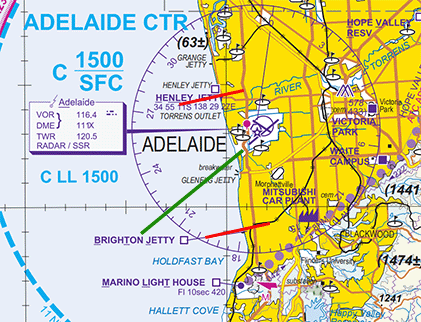
VFR aircraft may transit the control zone tracking coastal north or southbound, generally at A005. AD TCU is responsible for ensuring these aircraft remain separated from aircraft arriving/departing at YPAD and will likely delegate this responsibility to ADC, who may employ visual separation or other tools to ensure separation is maintained.
The TCU controller will coordinate these aircraft with ADC prior to issuing airways clearance, including the intended clearance limit. On receipt of this coordination, ADC should consider any possible conflict from arriving or departing aircraft at YPAD (including the missed approach to runway 23). The clearance limits in the table below will ensure that coastal aircraft remain clear of the runway 05 approach path and runway 23 departure/missed approach path.
| Direction of Travel | Clearance Limit |
|---|---|
| Northbound | BTJ |
| Southbound | HNLY |
Phraseology
CNY is a VFR Cessna 172 tracking coastal northbound, approaching PNL. They have contacted AD TCU for clearance.
TCU -> ADC: "South of PNL, CNY, for coastal northbound, 500ft, clearance limit BTJ"
ADC -> TCU: "CNY"
If a delay is expected at the clearance limit, instruct the aircraft to hold there.
Phraseology
CNY: "Adelaide Tower, CNY, maintaining not above 500ft"
AD ADC: "CNY, Adelaide Tower, hold at the clearance limit, expect onwards clearance in 5 minutes due inbound traffic"
CNY: "Hold at the clearance limit, CNY"
Once the conflict is no longer a threat (or if no holding was required in the first place), cancel the clearance limit and issue onwards clearance tracking coastal north/southbound at the desired level.
Phraseology
AD ADC: "CNY, cancel clearance limit, track coastal offshore northbound, not above 500ft"
CNY: "Cancel clearance limit, track coastal offshore northbound, not above 500ft, CNY"
Once the aircraft is clear of potential conflict with YPAD (i.e. north of HNLY or south of BTJ), transfer them back to AD TCU.
Runway Modes
Preferred Runway Modes
Winds must always be considered for Runway modes (Crosswind <20kts, Tailwind <5kts), however the order of preference is as follows:
| Priority - Mode | Arrivals | Departures |
|---|---|---|
| 1 - 2312A23D | 23 & 12 | 23 |
| 2 - 0512A05D | 05 & 12 | 05 |
| 3 - 23 Only | 23 | 23 |
| 4 - 05 Only | 05 | 05 |
| 5 - 12 Only | 12 | 12 |
| 6 - 30 Only | 30 | 30 |
| *Curfew (RRO) | 05 | 23 |
*Permitted between the hours of 2300 and 0600 Local (1330-2030 UTC/1230-1930 UTC HDS). If the pilot does not want to participate in curfew mode operations, the controller must accommodate this request.
SID Selection
Jet Aircraft planned via AVDEN, BENDO, GILES, AREPA, ORBUN. or UPROT, shall be assigned the Procedural SID that terminates at the appropriate waypoint. Jet Aircraft not planned via any of these waypoints shall receive amended routing via the most appropriate SID terminus, unless the pilot indicates they are unable to accept a Procedural SID.
a) Non-Jet Aircraft; or
b) Aircraft using Runway 12/30; or
c) Aircraft that cannot accept a Procedural SID
Shall be assigned the Radar SID.
Example
Non-Jet Aircraft planned via EEMUE, assigned runway 05, shall be given the AD (RADAR) SID.
ATIS
Approach Types
Normal methods apply to determine the most appropriate approach type.
Additionally, with Runway 23 in use for arrivals, the APCH field shall include the following when the cloud base is between A024 and A042:
ACFT FM THE EAST AND JET ACFT FM THE WEST EXP INST APCH
Note
This allows aircraft on the Victor STAR from the west to join a visual right base without the need to conduct an instrument approach, while keeping aircraft from the east clear of the higher terrain near the Adelaide Hills.
Operational Info
The Operational Information field should be updated based on the runway mode in use, as per the table below:
| Runway Mode | OPR INFO Field |
|---|---|
| Curfew (RRO) | ACST: CURFEW IN OPERATION UNTIL TIME 2030. ACDT: CURFEW IN OPERATION UNTIL TIME 1930. |
Coordination
Auto Release
Next coordination is not required to AD TCU for aircraft that are:
- Departing from a runway nominated on the ATIS; and
- Assigned the standard assignable level; and
- Assigned a Procedural SID
All other aircraft require a Next call to AD TCU.
The Standard Assignable level from AD ADC to AD TCU is:
| Aircraft | Level |
|---|---|
| Jets | A050 |
| Non-Jets | The lower of A040 and RFL |
Departures Controller
When a TCU controller is online, aircraft shall be issued with a departure frequency during their airways clearance in accordance with the table below. If no TCU controllers are online, the most appropriate Enroute controller or Advisory frequency shall be issued.
| Runway | Via | Departure Frequency |
|---|---|---|
| 05 | AREPA GILES ORBUN West |
124.2 (AAW) |
| 05 | AVDEN BENDO UPROT East |
118.2 (AAE) |
| Runway | Via | Departure Frequency |
|---|---|---|
| 12 | All | 118.2 (AAE) |
| Runway | Via | Departure Frequency |
|---|---|---|
| 23 | AREPA GILES ORBUN West |
124.2 (AAW) |
| 23 | AVDEN BENDO UPROT East |
118.2 (AAE) |
| Runway | Via | Departure Frequency |
|---|---|---|
| 30 | All | 124.2 (AAW) |