Alice Springs (ASP)
Positions
| Name | ID | Callsign | Frequency | Login ID |
|---|---|---|---|---|
| Alice Springs | ASP | Melbourne Centre | 128.850 | ML-ASP_CTR |
| Alice Springs West | ASW | Melbourne Centre | 131.800 | ML-ASW_CTR |
| Bourke | BKE | Melbourne Centre | 128.200 | ML-BKE_CTR |
| Esperance | ESP | Melbourne Centre | 123.950 | ML-ESP_CTR |
| Forrest | FOR | Melbourne Centre | 132.700 | ML-FOR_CTR |
| Warburton | WAR | Melbourne Centre | 124.900 | ML-WAR_CTR |
| Woomera | WRA | Melbourne Centre | 132.900 | ML-WRA_CTR |
Non-Standard Positions
Non-standard positions may only be used in accordance with VATPAC Air Traffic Services Policy.
Approval must be sought from the bolded parent position prior to opening a Non-Standard Position, unless NOTAMs indicate otherwise (eg, for events).
Airspace
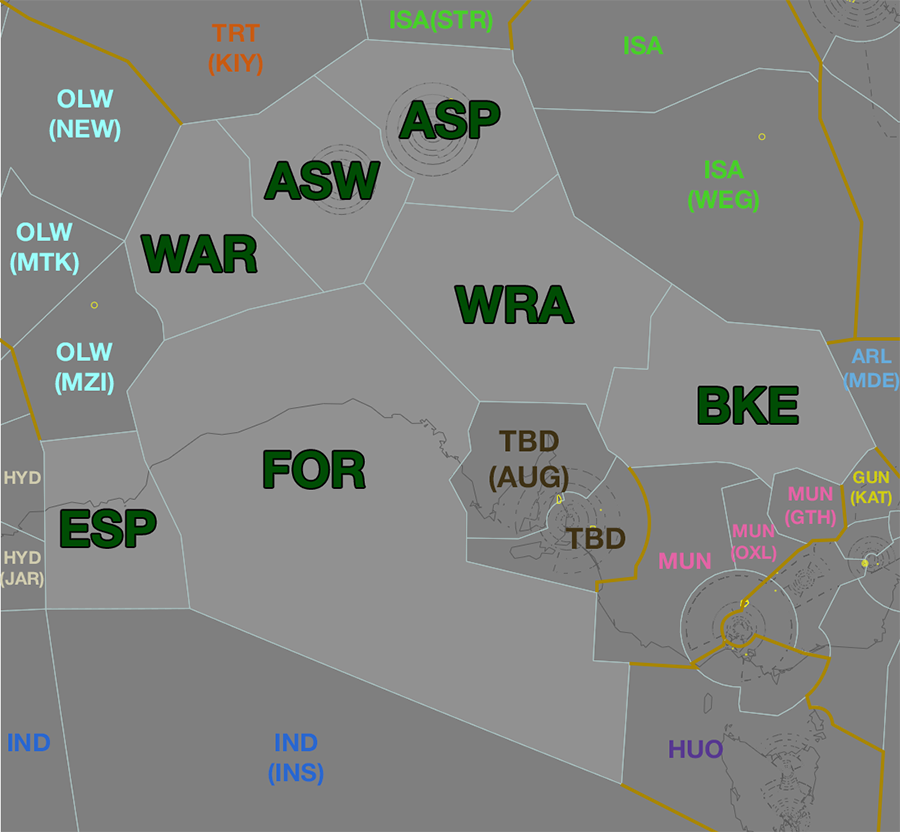
AS ADC is responsible for the Class D airspace SFC to A045, as well as the Class C airspace A045 to A065, within the AS CTR.
Extending
Important
Due to the large geographical area covered by this sector and it's neighbours, controllers are reminded of their obligations under the ATS Policy when extending. Ensure that you have sufficiently placed visibility points to cover your primary sector and any secondary, extended sectors in their entirety.
Reclassifications
When AS ADC is offline, AS CTR (Class D and C SFC to F125) within 80 DME AS reverts to Class G, and AS CTA (Class C F125 to F245) within 80 DME AS reverts to Class E, and both are administered by ASP. Alternatively, ASP may provide a top-down procedural service if they wish.
Tip
If choosing not to provide a top down service, consider publishing a pre-formatted ATIS Zulu for the aerodrome, to inform pilots about the airspace reclassification.
The restricted airspace around YPWR is classified as Class G by default, and is only reclassified as controlled airspace when WR ADC is online. When WR ADC is offline, the area remains Class G, and is administered by WRA.
Surveillance Coverage
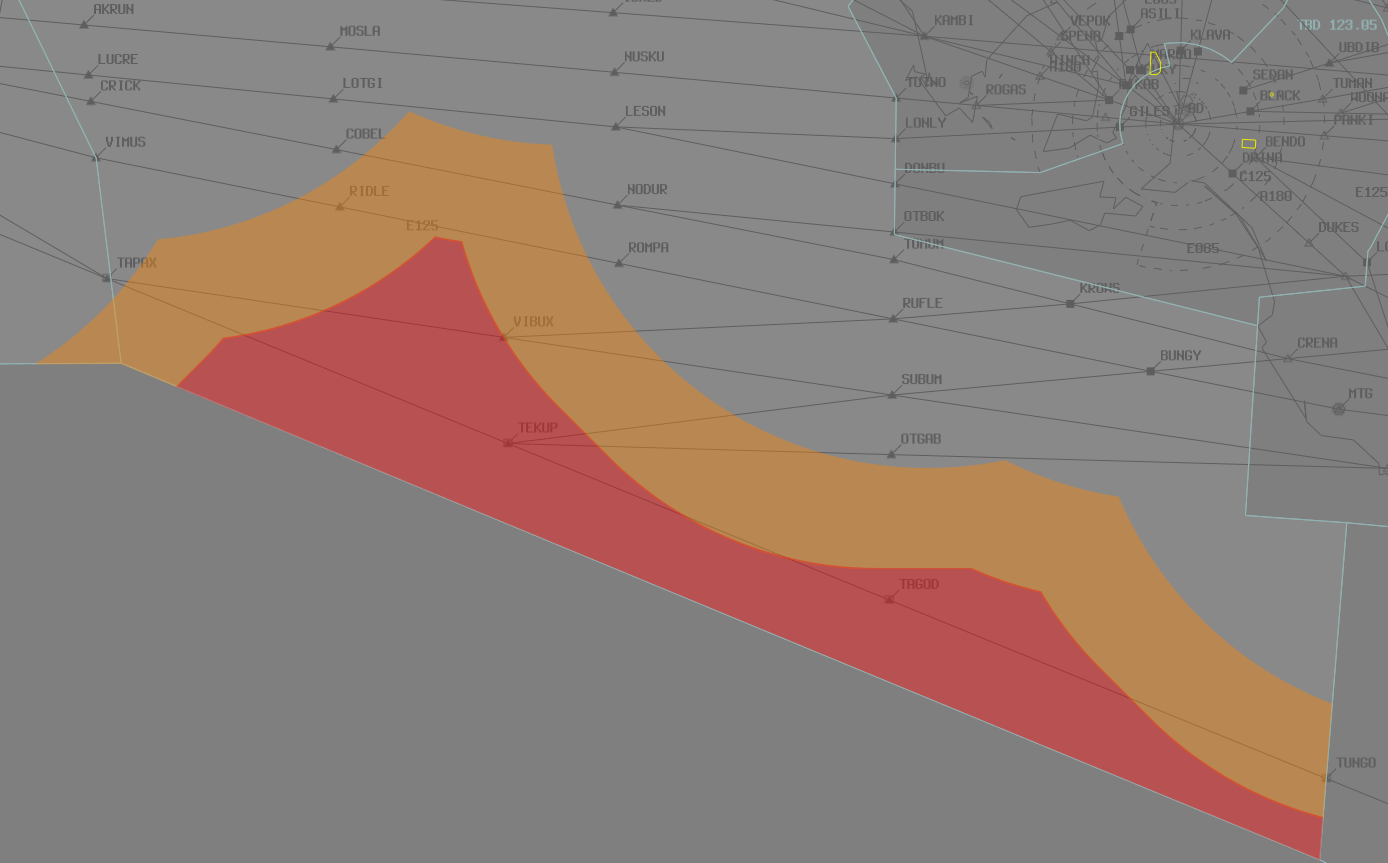
Limited surveillance coverage exists in the FOR sector greater than 250nm from ADSB stations. Procedural Standards must be implemented prior to losing surveillance coverage
The Orange shaded areas will have limited surveillance coverage Below F330.
The Red shaded areas will have limited surveillance coverage at All Levels.
Departure and Arrival Procedures
YBAS
Sequencing
All sequencing is performed by ASP.
YPWR
WRA is responsibile for facilitating operations in and out of YPWR.
Local Procedures
Special Use Airspace
There are multiple volumes of SUA within ASP airspace, mostly associated with military operations in and out of YPWR.
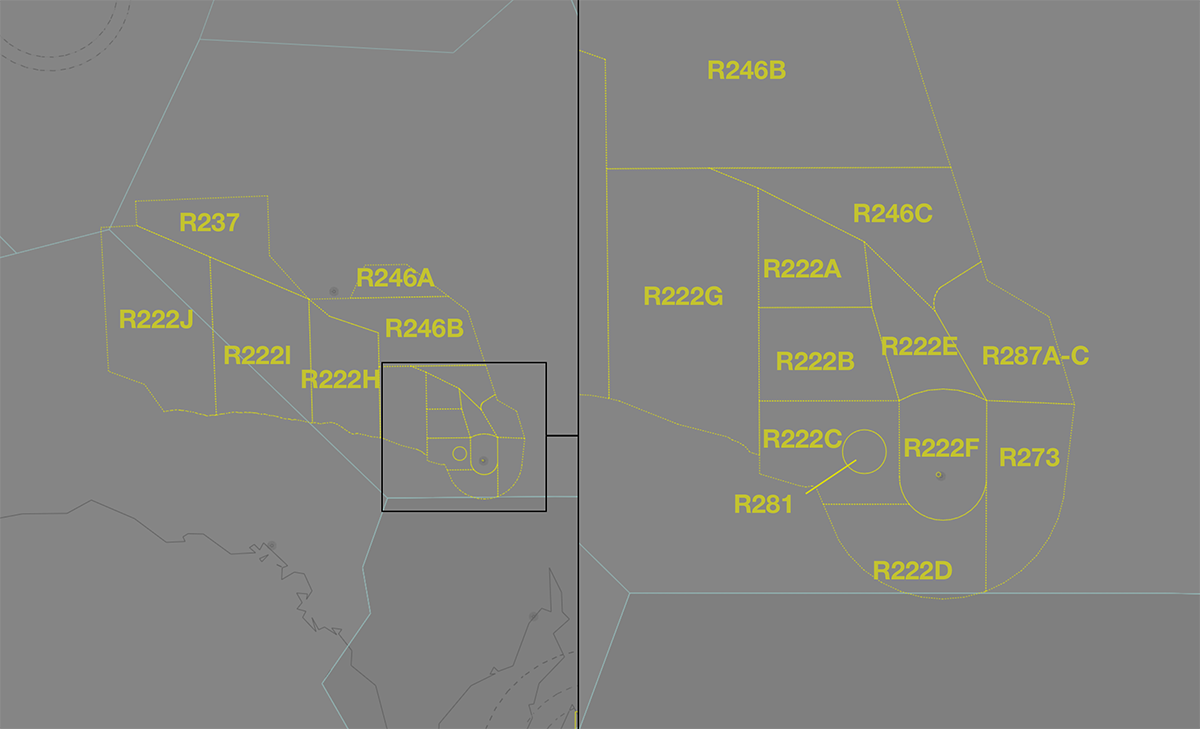
When WR ADC is online, R222F Restricted Area is activated SFC to F120 by default. WR ADC must give heads up coordination with the relevant enroute controllers prior to any departures intending to operate in a currently inactive SUA.
Phraseology
WR ADC -> WRA: "On the ground YPWR, BFLO11, requests activation of R222C SFC-F290, from 0100 until 0300."
WRA -> WR ADC: "BFLO11, expect activation of R222C SFC-F290 at 0100 until 0300."
WR ADC -> WRA: "BFLO11.
Non-participating aircraft intenting to transit an activated SUA should be rerouted, where possible, subject to the VATSIM Code of Conduct.
Woomera SUA
There are multiple restricted areas associated with military operations at YPWR: R222A-L, R237, R246A-C, R273, R281, and R287A-C. All restricted areas are located with the WRA subsector; R222I and R222J extend into FOR airspace, and R222K and R222L extend across ASP, ASW, WAR, and OLW(MZI, LEO).
These restricted areas directly adjoin the jurisdiction of WR ADC, and when WR ADC is online aircraft will be transferred directly to/from the MOAs.
Affected Civil Operations
When activated these restricted areas disrupt traffic on the J141, J251, T20, T21 and T29 high airways, which connect YPAD to the Northern Territory and are often used by transcontinental flights to and from the east coast. Activation also significantly distrupts traffic on the W238, W274, W617, W764 low airways and traffic around YCBP and YOLD.
Aircraft transiting the area should be rerouted via the Z90, Z91, Z92, and Z93 as required.
Note
Aircraft tracking via a recommended rerouting must still be separated from the SUA laterally and vertically. After amending flight plans for the purposes of rerouting around SUA, controllers should ensure the route is displayed visually and the BRL is used to measure for >2.5nm clearance with all parts of the SUA.
STAR Clearance Expectation
Handoff
Aircraft being transferred to the following sectors shall be told to Expect STAR Clearance on handoff:
| Transferring Sector | Receiving Sector | ADES | Notes |
|---|---|---|---|
| FOR, WRA, BKE | TBD(AUG) | YPAD, YPED | Jets only |
| BKE | TBD | YPAD, YPED | |
| BKE | GUN(KAT), MUN(GTH) | YSSY | |
| BKE | GUN(KAT) | YSWS | |
| ESP | HYD | YPPH, YPEA | Jets only |
Tip
To help facilitate sequencing, BKE should aim to handoff aircraft to KAT as soon as possible, ie, >50nm to the boundary if there are no restrictions.
Coordination
Enroute
As per Standard coordination procedures, Voiceless, no changes to route or CFL within 50nm to boundary.
ASP Internal
As per Standard coordination procedures, Voiceless, no changes to route or CFL within 50nm to boundary.
AS ADC
Airspace
AS ADC is responsible for the Class D airspace SFC to A045, as well as the Class C airspace A045 to A065, within the AS CTR.
Refer to Reclassifications for operations when AS ADC is offline.
Departures
Next coordination is required from AS ADC to ASP for all aircraft entering ASP CTA.
The standard assignable level from AS ADC to ASP is:
| Aircraft | Level |
|---|---|
| All | The lower of A070 and RFL |
Arrivals/Overfliers
YBAS arrivals and overfliers shall be heads-up coordinated to AS ADC from ASP prior to 5 mins from the boundary.
Phraseology
ASP -> AS ADC: "Via SADEL, QFA1956”
AS ADC -> ASP: "QFA1956"
The standard assignable level from ASP to AS ADC is A080, any other level must be prior coordinated.
WR ADC
Airspace
WR ADC is responsible for the Class D airspace SFC to F120 within the R222F restricted area.
Refer to Reclassifications for operations when WR ADC is offline.
Departures
Next coordination is not required from WR ADC to ASP(WRA).
Aircraft leaving WR ADC airspace both laterally and vertically will enter ASP(WRA) uncontrolled airspace. However, it is good practice for WR ADC to provide heads-up coordination for aircraft leaving WR ADC airspace vertically to help facilitate an uninterrupted climb.
Phraseology
WR ADC -> WRA: "via WR 180 bearing outbound, LYBD11.”
WRA -> WR ADC: "LYBD11, F240, no reported IFR traffic."
WR ADC -> WRA: "F240, LYBD11."
WR ADC: "LYBD11, leave and re-enter controlled airspace on climb to F240, no reported IFR traffic"
LYBD11: "Leave and re-enter controlled airspace on climb to F240, LYBD11"
Arrivals/Overfliers
As with departures, there is no inherent requirement for ASP(WRA) to coordinate arrivals or overfliers with WR ADC. However, it is good practice for ASP(WRA) to provide heads-up coordination for aircraft arriving into directly into WR ADC airspace.
Arriving aircraft shall be instructed to leave CTA descending (if appropriate) and to contact WR ADC for clearance.
IND(INS) (Oceanic)
As per Standard coordination procedures, Voiceless, no changes to route or CFL within 15 mins to boundary.
Aircraft must have their identification terminated and be instructed to make a position report on first contact with the next (procedural) sector.
Phraseology
ASP: "QFA121, identification terminated, report position to Brisbane Radio, 129.25"