Wollongong (WOL)
Positions
| Name | ID | Callsign | Frequency | Login ID |
|---|---|---|---|---|
| Wollongong | WOL | Melbourne Centre | 125.000 | ML-WOL_CTR |
| Snowy | SNO | Melbourne Centre | 124.000 | ML-SNO_CTR |
Non-Standard Positions
Non-standard positions may only be used in accordance with VATPAC Air Traffic Services Policy.
Approval must be sought from the bolded parent position prior to opening a Non-Standard Position, unless NOTAMs indicate otherwise (eg, for events).
Airspace
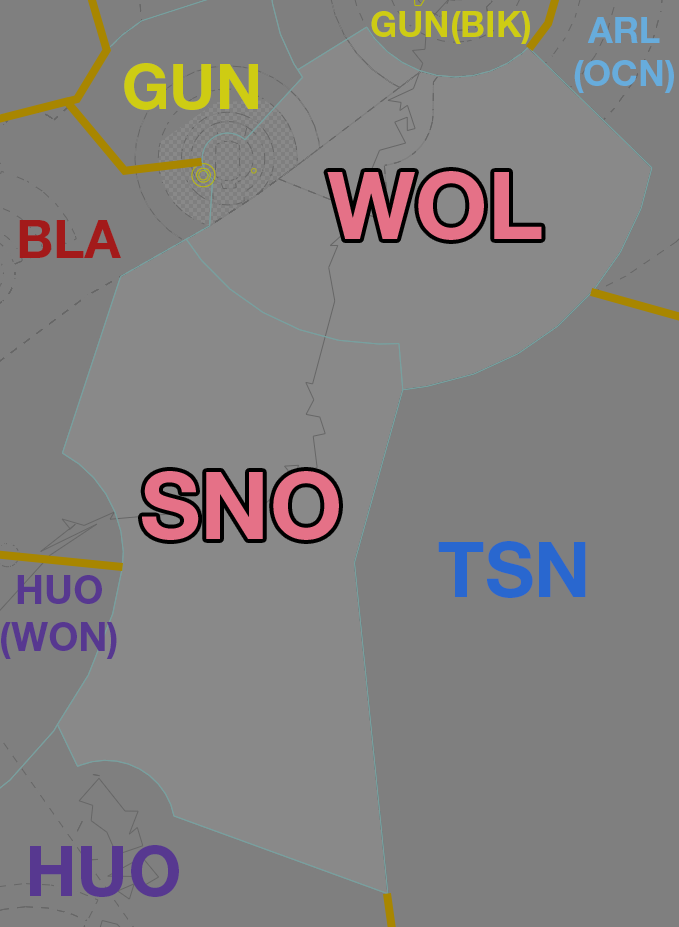
Reclassifications
When CB TCU is offline, CB TCU (Class C SFC to A085) reverts to Class G, and is administered by WOL. Alternatively, WOL may provide a top-down approach service if they wish.
Tip
If choosing not to provide a top down service, consider publishing a pre-formatted ATIS Zulu for the aerodrome, to inform pilots about the airspace reclassification.
The restricted airspace around YSNW is classified as Class G by default, and is only reclassified as controlled airspace when NWA is online. When NWA is offline, the area remains Class G, and is administered by WOL.
Departure and Arrival Procedures
YMES
STAR Assignment
The following subsectors are responsible for issuing STAR clearance.
| Subsector | STAR | Type | Notes |
|---|---|---|---|
| SNO | LAREX TREVR |
All |
Sequencing
SNO is responsible for sequencing arrivals at YMES arriving from the east.
YSCB
STAR Assignment
The following subsectors are responsible for issuing STAR clearance.
| Subsector | STAR | Type | Notes |
|---|---|---|---|
| WOL | BUNGO LEECE |
Non-Jet Jet^ |
Note
^ GUN(BIK) will issue STAR clearances to jet aircraft overflying the SY TCU en route to YSCB. WOL will issue STAR clearances to all other jet aircraft.
Sequencing
Sequencing arrivals from the east and northeast into YSCB is a responsibility of WOL.
Holding Fixes
Refer to the vatSys Enroute Holds map for details of published holds on the airways inbound to YSCB. Where delays necessitate holding, aircraft should be instructed to hold at the following positions. The listed time should be subtracted from an aircraft's assigned feeder fix time to determine when they should leave the hold.
| Feeder Fix | Holding Fix | Time from Hold to Feeder Fix |
|---|---|---|
| MANDA | NONUP | Jets: 3 min Non-Jets: 4 min |
| Others | Feeder Fix | - |
Adjacent Feeder Fixes
Aircraft assigned the same runway inbound via LEECE and BUNGO, must be considered to be on the same STAR for sequencing purposes. That is, they must be at least 2 minutes apart at their respective Feeder fixes.
YSNW
WOL is responsibile for facilitating operations in and out of YSNW.
Local Procedures
Special Use Airspace
There are multiple volumes of SUA within WOL airspace associated with military operations in and out of YSNW.
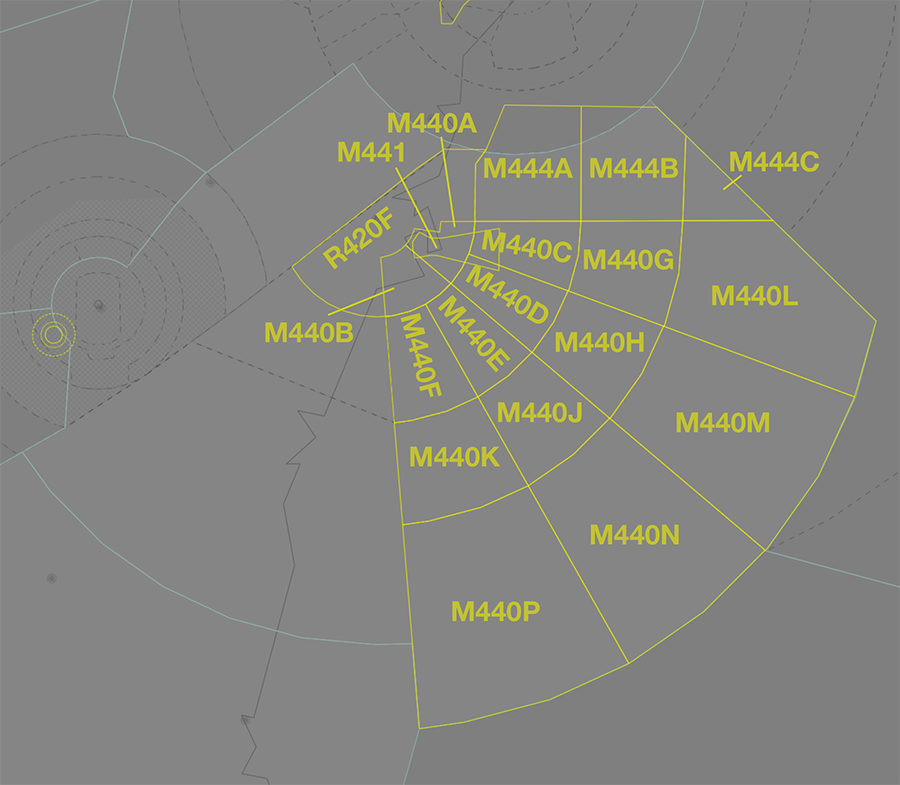
Each TCU must give heads up coordination with the relevant enroute controllers prior to any departures intending to operate in a currently inactive SUA.
Phraseology
NWA -> WOL: "On the groud YSNW, SWFH12, requests activation of R420F F125-F300, from 0300 until 0500.”
WOL -> NWA: "SWFH12, expect activation of R420F F125-F300 at 0300 until 0500."
NWA -> WOL: "SWFH12."
Non-participating aircraft intending to transit an activated SUA should be rerouted, where possible, subject to the VATSIM Code of Conduct.
R420F Nowra
The R420F Nowra restricted area is located over YSNW, F125-F300, located entirely in WOL airspace.
The resricted area sits directly above the NWA TMA and when NWA is online aircraft will be transferred directly to/from the SUA. When NWA is offline, aircraft will contact WOL for transit through the surrounding civilian airspace.
Affected Civil Operations
When activated, the restricted area disrupts traffic on a number of high and low altitude airways, including H20, H536, V501, W144, W436, and W575, used primarily by aircraft departing the Sydney Basin.
Aircraft may be given an additional requirement to climb above the vertical limits of the activation, or rerouted manually to avoid the area.
Tip
Activation of the R420F significantly increases the workload for WOL and SDS, as the airspace available for YSSY departures via WOL. During peak periods (such as Milk Run Monday), activation of the restricted area should not be approved.
M440A-P Tasman Sea
The M440A-P Tasman Sea MOAs are located east of YSNW and extend into the Tasman Sea, NOTAM-NOTAM, located entirely in WOL airspace.
The restricted areas sit directly above, and adjacent to, the NWA TMA and when NWA is online aircraft will be transferred directly to/from the SUA. When NWA is offline, aircraft will contact WOL for transit through the surrounding civilian airspace.
STAR Clearance Expectation
Handoff
Aircraft being transferred to the following sectors shall be told to Expect STAR Clearance on handoff:
| Transferring Sector | Receiving Sector | ADES | Notes |
|---|---|---|---|
| WOL | BLA | YMML, YMAV | Jets only |
| WOL | GUN | YSSY | |
| SNO | HUO(WON) | YMML | |
| SNO | HUO | YMHB |
Terminal Handover Frequencies
Aircraft being transferred from enroute to a TCU with multiple frequencies shall be given the frequency for the revelant TCU position.
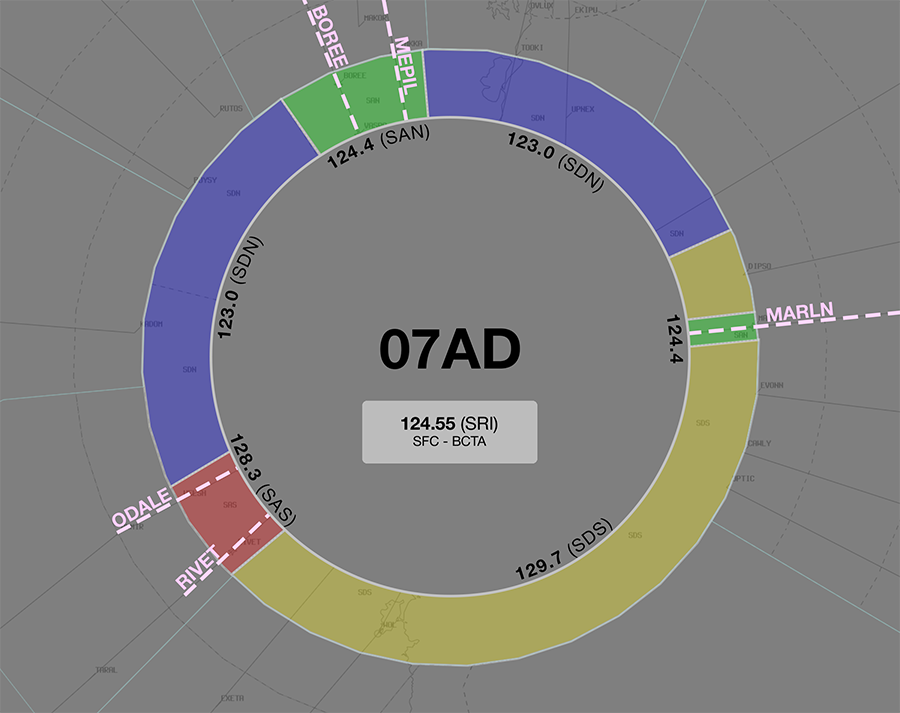
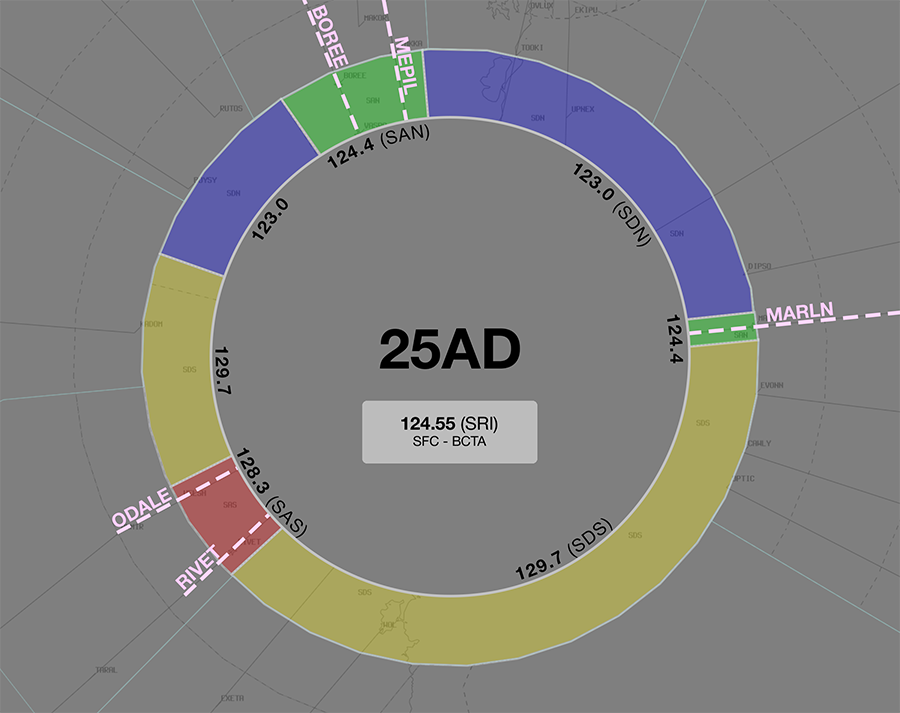
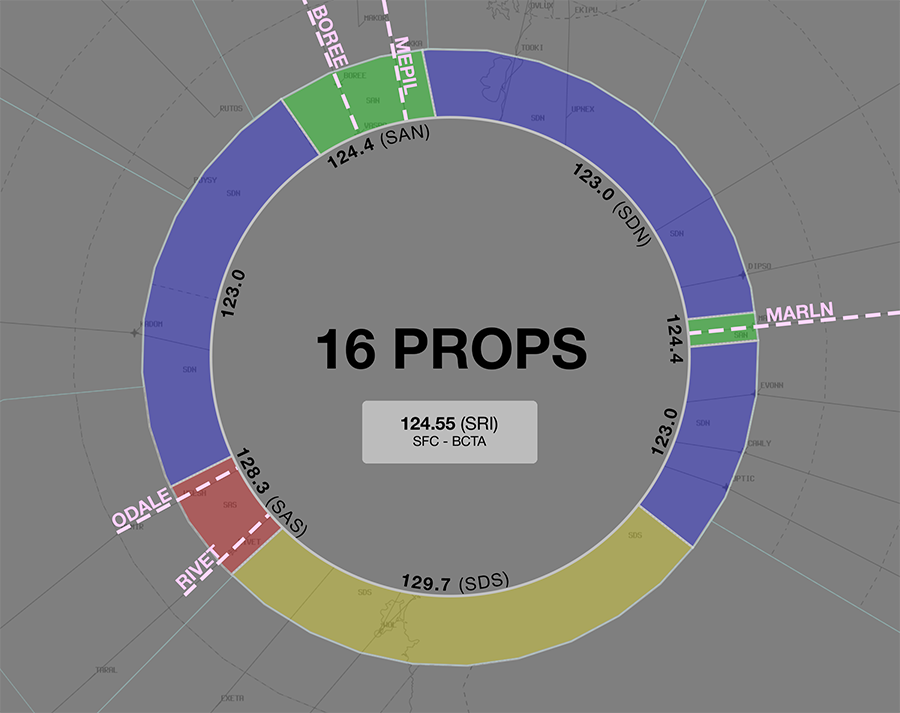
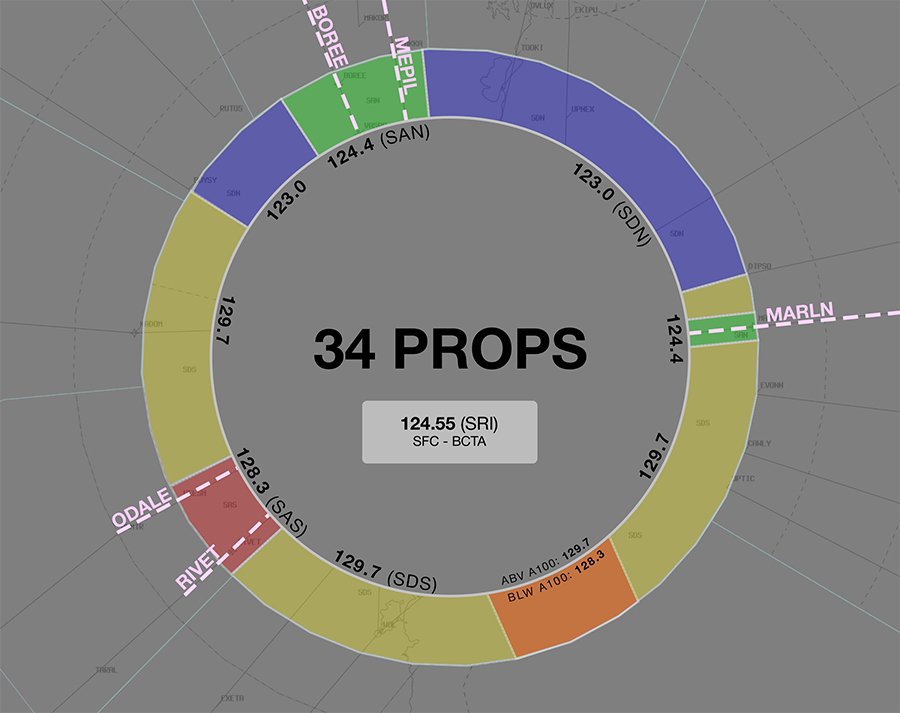
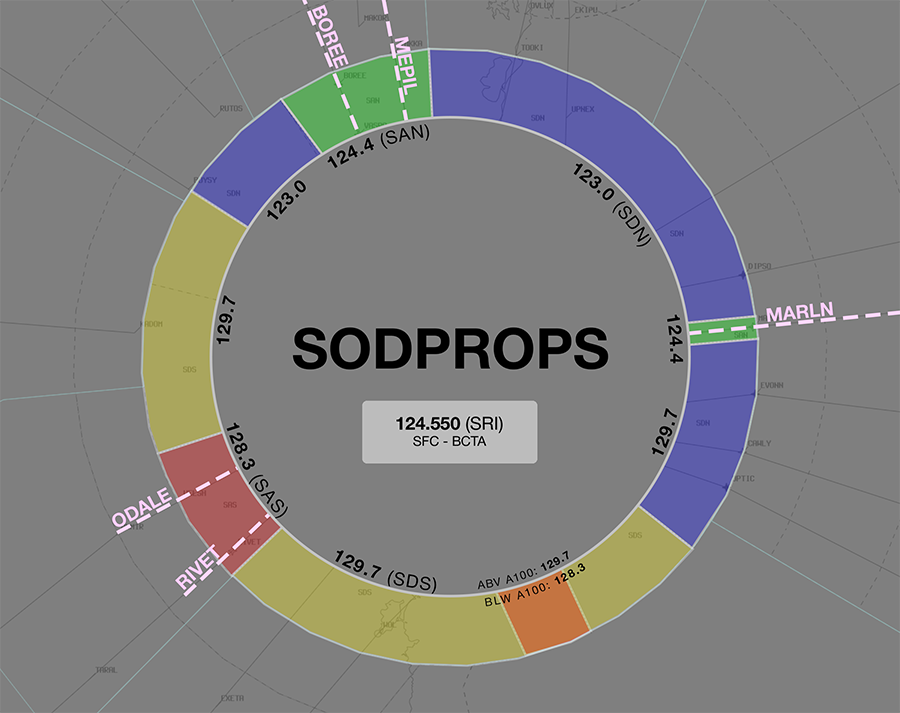
| ADES | STAR | Frequency (Controller) |
|---|---|---|
| YSSY | BOREE | 124.400 (SAN) |
| YSSY | MARLN | 124.400 (SAN) |
| YSSY | MEPIL | 124.400 (SAN) |
| YSSY | AKMIR | 128.300 (SAS) |
| YSSY | RIVET | 128.300 (SAS) |
| YSCN | PRAWN | 124.400 (SAN) |
| YSBK | WHALE | 124.400 (SAN) |
| YSRI | RITSU | 135.900 (SRA) |
| YSRI | RUPEM | 118.400 (SWA) |
| YSWS | BIKUS | 124.400 (SAN) |
| YSWS | RIKNI | 124.400 (SAN) |
| YSWS | REVKI | 118.400 (SWA) |
| YSWS | UNTAV | 135.900 (SRA) |
Tip
The quick reference tables above only include scenarios for which there is voiceless coordination. Refer to the diagram for the appropriate position/frequency for coordination and handoff for all other situations.
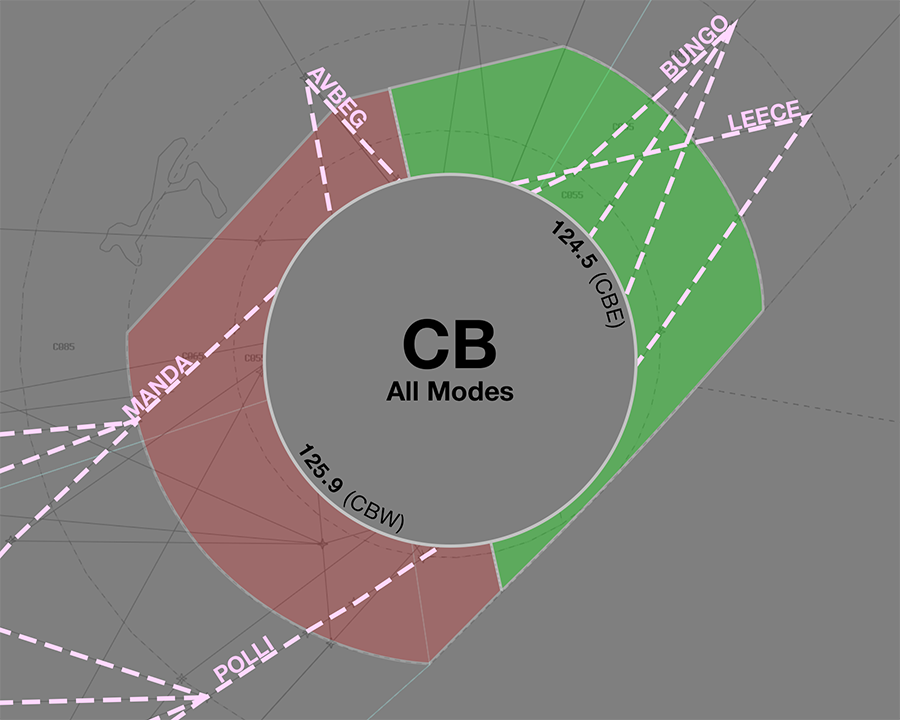
| STAR | Frequency (Controller) |
|---|---|
| AVBEG | 125.900 (CBW) |
| BUNGO | 124.500 (CBE) |
| LEECE | 124.500 (CBE) |
| MANDA | 125.900 (CBW) |
| POLLI | 125.900 (CBW) |
Tip
The quick reference tables above only include scenarios for which there is voiceless coordination. Refer to the diagram for the appropriate position/frequency for coordination and handoff for all other situations.
Coordination
SY TCU
Airspace
SY TCU is responsible for the airspace within a 45nm radius of TESAT, SFC to F285.
Refer to Sydney TCU Airspace Division for information on airspace divisions when any child position of SAS is online.
Arrivals/Overfliers
Heads-up Coordination required for all aircraft entering SY TCU from WOL CTA prior to 20nm from the boundary.
Departures
Voiceless for all aircraft:
- Assigned the lower of
F280or theRFL; and - that enter WOL airspace via any of the Green Shaded Corridors below
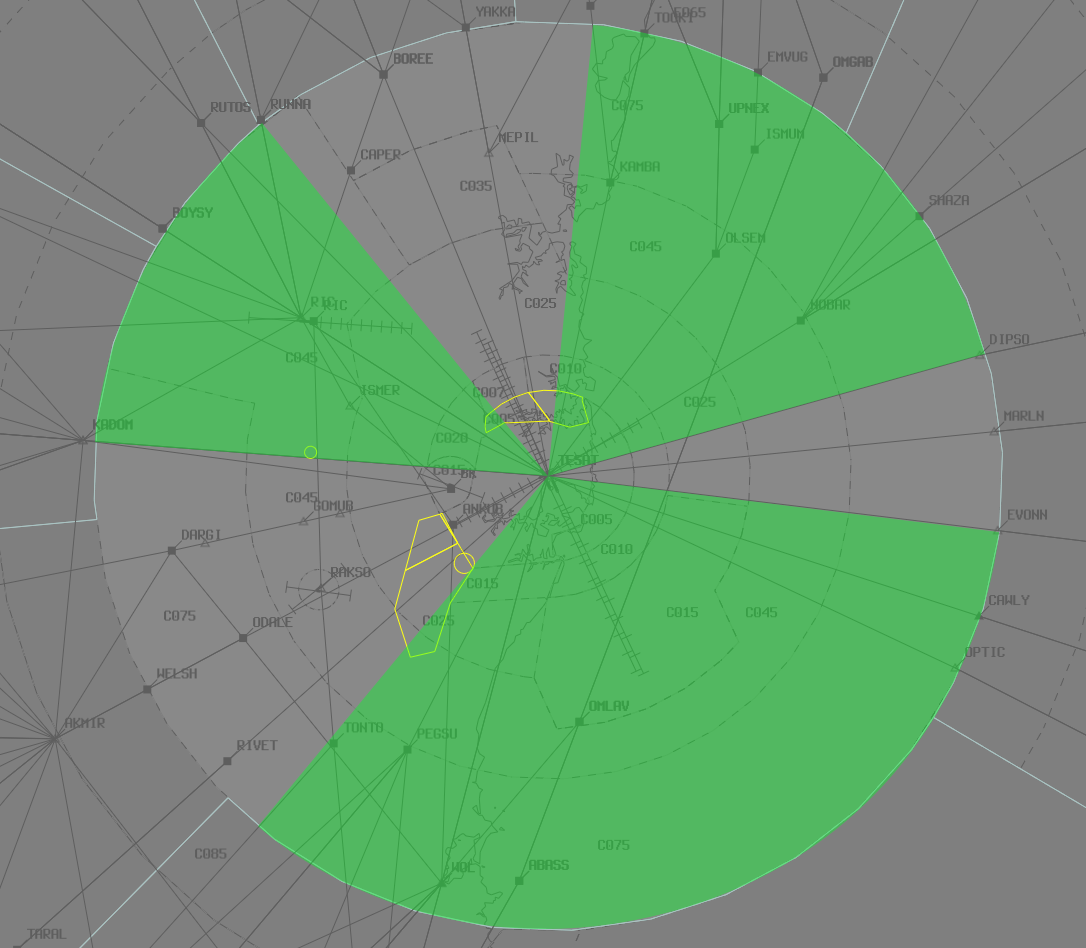
All other aircraft going to WOL CTA will be Heads-up Coordinated by SY TCU.
CB TCU
Airspace
The Vertical limits of the CB TCU are SFC to F245.
Refer to Canberra TCU Airspace Division for information on airspace divisions when CBW is online.
Refer to Reclassifications for operations when CB TCU is offline.
Arrivals/Overfliers
Voiceless for all aircraft:
- With ADES YSCB; and
- Assigned a STAR; and
- Assigned
F130
All other aircraft coming from WOL CTA must be Heads-up Coordinated to CB TCU prior to 20nm from the boundary.
Departures
Heads-up Coordination required for all aircraft entering WOL CTA prior to the boundary.
NW TCU
Airspace
NW TCU owns the Class C airspace within the R421A and R421B restricted areas SFC to F125.
Arrivals/Overfliers
Voiceless for aircraft:
- With ADES YSNW; and
- Tracking via NWA or NWR; and
- Assigned
F130
All other aircraft coming from WOL CTA will be heads-up coordinated to NW TCU.
Departures
Voiceless for aircraft:
- Tracking via a Procedural SID terminus; and
- Assigned the lower of
A100or theRFL
Note
Aircraft are not required to be tracking via the SID procedure, simply tracking via any of the terminus waypoints (regardless of departure airport or assigned SID) is sufficient to meet the criteria for voiceless coordination.
All other aircraft going to WOL CTA must be heads-up coordinated by NW TCU prior to the boundary.
Enroute
As per Standard coordination procedures, Voiceless, no changes to route or CFL within 50nm to boundary.
That being said, it is advised that WOL/SNO give Heads-up Coordination to the relevant sector, prior to 50nm from the boundary, for any aircraft not on the Q29 or V169 airways.
TSN (Oceanic)
As per Standard coordination procedures, Voiceless, no changes to route or CFL within 15 mins to boundary.
Aircraft must have their identification terminated and be instructed to make a position report on first contact with the next (procedural) sector.
Phraseology
SNO: "QFA121, identification terminated, report position to Brisbane Radio, 124.65"
WOL Internal
As per Standard coordination procedures, Voiceless, no changes to route or CFL within 50nm to boundary.