Hyden (HYD)
Positions
| Name | ID | Callsign | Frequency | Login ID |
|---|---|---|---|---|
| Hyden | HYD | Melbourne Centre | 118.200 | ML-HYD_CTR |
| Cross | SCR | Melbourne Centre | 135.800 | ML-SCR_CTR |
| Dally | DAL | Melbourne Centre | 124.800 | ML-DAL_CTR |
| Geraldton | GEL | Melbourne Centre | 134.200 | ML-GEL_CTR |
| Grove | GVE | Melbourne Centre | 133.800 | ML-GVE_CTR |
| Jarrah | JAR | Melbourne Centre | 120.300 | ML-JAR_CTR |
| Leeman | LEA | Melbourne Centre | 122.400 | ML-LEA_CTR |
| Pingelly | PIY | Melbourne Centre | 133.900 | ML-PIY_CTR |
Non-Standard Positions
Non-standard positions may only be used in accordance with VATPAC Air Traffic Services Policy.
Approval must be sought from the bolded parent position prior to opening a Non-Standard Position, unless NOTAMs indicate otherwise (eg, for events).
Airspace
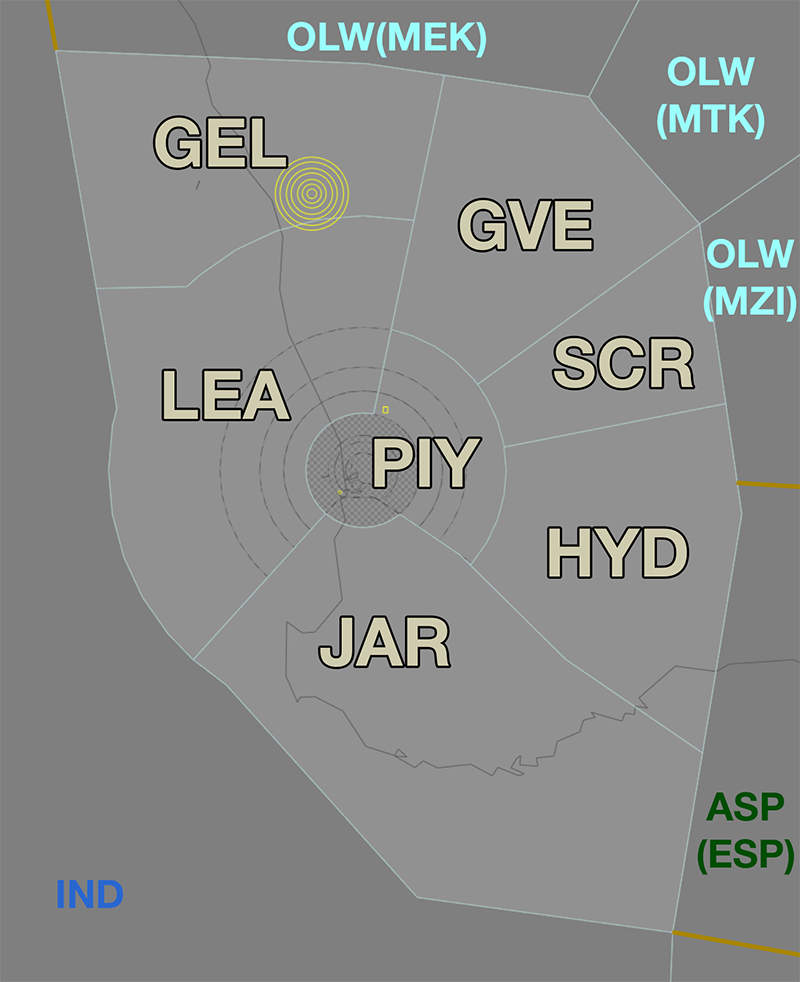
Reclassifications
When PEA is offline, the PE MIL CTR, GIG MIL CTR, and restricted airspace within R155 is deactivated and the airspace is administered by LEA, PIY and PH TCU.
Tip
Consider publishing a pre-formatted ATIS Zulu for the aerodrome, to inform pilots about the airspace reclassification.
Departure and Arrival Procedures
YGIG
LEA and PIY share responsibility for facilitating operations in and out of YGIG.
YPEA
STAR Assignment
The STARs at YPEA have different variations designed to facilitate separation with PH TCU traffic, dependant on the runway mode in use at YPPH.
The following subsectors are responsible for issuing STAR clearance.
| Subsector | STAR | Type | Notes |
|---|---|---|---|
| HYD | PEA GOLF, KABLI Trans | Jet | Descent not below F190 |
| PIY | PEA GOLF, LAVEX Trans PEA WHISKEY, MALUP Trans |
Non-Jet |
| Subsector | STAR | Type | Notes |
|---|---|---|---|
| HYD | PEA ROMEO, KABLI Trans | Jet | Descent not below F190 |
| PIY | PEA ROMEO, LAVEX Trans | Non-Jet |
Arrivals from the east and north shall be given initial descent to not below F190. PIY will issue final descent.
YPJT
STAR Assignment
The STARs at YPEA have different variations designed to facilitate separation with PH TCU traffic, dependant on the runway mode in use at YPPH.
The following subsectors are responsible for issuing STAR clearance.
| Subsector | STAR | Type | Notes |
|---|---|---|---|
| DAL | JT GOLF, WOORA Trans | Jet | Descent not below F190 |
| HYD | JT GOLF, KABLI Trans | Jet | Descent not below F190 |
| PIY | JT GOLF, LAVEX Trans JT WHISKEY, MALUP Trans JT GOLF, WOORA Trans |
Non-Jet |
| Subsector | STAR | Type | Notes |
|---|---|---|---|
| HYD | JT ROMEO, KABLI Trans | Jet | Descent not below F190 |
| PIY | JT ROMEO, LAVEX Trans | Non-Jet |
Arrivals from the east and north shall be given initial descent to not below F190. PIY will issue final descent.
Note
All STARs at YPJT terminate in radar vectors to the aerodrome and are not associated with a runway. No runway shall be issued with STAR clearance.
E.g. "FD623, cleared JT3R arrival, maintain F200"
YPPH
STAR Assignment
The following subsectors are responsible for issuing STAR clearance.
| Subsector | STAR | Type | Notes |
|---|---|---|---|
| DAL | JULIM | Jet | Descent not below F190 |
| HYD | KABLI | Jet | Descent not below F190 |
| JAR | SOLUS | All | |
| LEA | IPMOR | All | |
| PIY | DAYLR LAVEX SAPKO |
Non-Jet |
Arrivals from the east and north shall be given initial descent to not below F190. PIY will issue final descent.
Runway Assignment
When the Southwest Plan active, arrivals shall be processed to either Runway 21 or 24 based on their feeder fix (subject to any operational requirements).
| FF | Runway |
|---|---|
| JULIM | 21 |
| SAPKO | 21 |
| IPMOR | 21 |
| KABLI | 24 |
| LAVEX | 24 |
| SOLUS | 24 |
Sequencing
Sequencing arrivals into YPPH is a joint responsibility of multiple subsectors:
- DAL and HYD will perform initial sequencing actions for aircraft arriving from the north and east, with final sequencing performed by PIY.
- LEA is responsible for all sequencing actions for aircraft arriving from the west.
- JAR is responsible for all sequencing actions for aircraft arriving from the south.
Adjacent Feeder Fixes
Aircraft assigned the same runway inbound via JULIM and SAPKO, must be considered to be on the same STAR for sequencing purposes. That is, they must be at least 2 minutes apart at their respective Feeder fixes.
Predictable Sequencing Waypoints
There are ten Predictable Sequencing waypoints available for aircraft inbound YPPH via Q10, Q32, Q27, Q41 and Z38, located south of Q10 and north of Q27. There are also eight waypoints available for aircraft inbound via Q9, Q31, Q38, Q73 and Q181 located east of the Q38.
The table below contains the estimated time from the initial waypoint to the final waypoint via the CDO waypoint.
| Initial Waypoint | CDO Waypoint | Final Waypoint | Delay (in mins) |
|---|---|---|---|
| OTGOM | ELGAT | AVPAL | +2 |
| OTGOM | VEKBO | AVPAL | +4 |
| OTGOM | DUBUL | AVPAL | +5 |
| OTGOM | SOVTO | AVPAL | +6 |
| OTGOM | ASEBI | AVPAL | +8 |
| OTGOM | LEDAB | AVPAL | +11 |
| OTGOM | NURPA | AVPAL | +13 |
| OTGOM | BEPKI | AVPAL | +15 |
| OTGOM | IGOKO | AVPAL | +17 |
| Initial Waypoint | CDO Waypoint | Final Waypoint | Delay (in mins) |
|---|---|---|---|
| ELGAT | VEKBO | AVPAL | +1 |
| ELGAT | DUBUL | AVPAL | +2 |
| ELGAT | SOVTO | AVPAL | +3 |
| ELGAT | ASEBI | AVPAL | +5 |
| ELGAT | LEDAB | AVPAL | +7 |
| ELGAT | NURPA | AVPAL | +9 |
| ELGAT | BEPKI | AVPAL | +11 |
| ELGAT | IGOKO | AVPAL | +13 |
| Initial Waypoint | CDO Waypoint | Final Waypoint | Delay (in mins) |
|---|---|---|---|
| URGEX | TEKUD | MALUP | +1 |
| URGEX | BEMPI | MALUP | +2 |
| URGEX | AGTOD | MALUP | +4 |
| URGEX | DUKOR | MALUP | +6 |
| URGEX | IPGER | MALUP | +8 |
| URGEX | TODOS | MALUP | +10 |
| URGEX | IVPIL | MALUP | +13 |
| Initial Waypoint | CDO Waypoint | Final Waypoint | Delay (in mins) |
|---|---|---|---|
| IVPIL | TODOS | MALUP | +1 |
| IVPIL | IPGER | MALUP | +2 |
| IVPIL | DUKOR | MALUP | +3 |
| IVPIL | AGTOD | MALUP | +4 |
| IVPIL | BEMPI | MALUP | +5 |
| IVPIL | TEKUD | MALUP | +6 |
| IVPIL | URGEX | MALUP | +8 |
| Initial Waypoint | CDO Waypoint | Final Waypoint | Delay (in mins) |
|---|---|---|---|
| VEKBO | DUBUL | AVPAL | +1 |
| VEKBO | SOVTO | AVPAL | +2 |
| VEKBO | ASEBI | AVPAL | +4 |
| VEKBO | LEDAB | AVPAL | +6 |
| VEKBO | NURPA | AVPAL | +8 |
| VEKBO | BEPKI | AVPAL | +11 |
| VEKBO | IGOKO | AVPAL | +12 |
| Initial Waypoint | CDO Waypoint | Final Waypoint | Delay (in mins) |
|---|---|---|---|
| TEKUD | BEMPI | MALUP | +1 |
| TEKUD | AGTOD | MALUP | +3 |
| TEKUD | DUKOR | MALUP | +5 |
| TEKUD | IPGER | MALUP | +7 |
| TEKUD | TODOS | MALUP | +9 |
| Initial Waypoint | CDO Waypoint | Final Waypoint | Delay (in mins) |
|---|---|---|---|
| SOVTO | ASEBI | AVPAL | +2 |
| SOVTO | LEDAB | AVPAL | +4 |
| SOVTO | NURPA | AVPAL | +6 |
| SOVTO | BEPKI | AVPAL | +8 |
| SOVTO | IGOKO | AVPAL | +10 |
| Initial Waypoint | CDO Waypoint | Final Waypoint | Delay (in mins) |
|---|---|---|---|
| NALAR | URGEX | MALUP | +5 |
| NALAR | TEKUD | MALUP | +7 |
| NALAR | BEMPI | MALUP | +8 |
| NALAR | AGTOD | MALUP | +10 |
| NALAR | DUKOR | MALUP | +12 |
| NALAR | IPGER | MALUP | +14 |
| NALAR | TODOS | MALUP | +16 |
| NALAR | IVPIL | MALUP | +20 |
| Initial Waypoint | CDO Waypoint | Final Waypoint | Delay (in mins) |
|---|---|---|---|
| IGOKO | OTGOM | AVPAL | +12 |
| IGOKO | ELGAT | AVPAL | +9 |
| IGOKO | VEKBO | AVPAL | +7 |
| IGOKO | DUBUL | AVPAL | +6 |
| IGOKO | SOVTO | AVPAL | +5 |
| IGOKO | ASEBI | AVPAL | +3 |
| IGOKO | LEDAB | AVPAL | +2 |
| IGOKO | NURPA | AVPAL | +1 |
| Initial Waypoint | CDO Waypoint | Final Waypoint | Delay (in mins) |
|---|---|---|---|
| DUBUL | SOVTO | AVPAL | +1 |
| DUBUL | ASEBI | AVPAL | +3 |
| DUBUL | LEDAB | AVPAL | +5 |
| DUBUL | NURPA | AVPAL | +7 |
| DUBUL | BEPKI | AVPAL | +9 |
| DUBUL | IGOKO | AVPAL | +11 |
| Initial Waypoint | CDO Waypoint | Final Waypoint | Delay (in mins) |
|---|---|---|---|
| OPEGA | TUTRU | DAKPO | +4 |
| OPEGA | BEKIG | DAKPO | +2 |
| DAKPO | MIGEP | KAGMI | +2 |
| DAKPO | AVMEK | KAGMI | +4 |
| DAKPO | GOPLO | KAGMI | +6 |
| Initial Waypoint | CDO Waypoint | Final Waypoint | Delay (in mins) |
|---|---|---|---|
| BUNGL | MALUP | MALUP | +3 |
| BUNGL | IGROB | MALUP | +5 |
| BUNGL | KINAB | MALUP | +7 |
Holding Fixes
Refer to the vatSys Enroute Holds map for details of published holds on the airways inbound to YPPH. Where delays necessitate holding, aircraft should be instructed to hold at the following positions. The listed time should be subtracted from an aircraft's assigned feeder fix time to determine when they should leave the hold.
| Feeder Fix | Holding Fix | Time from Hold to Feeder Fix |
|---|---|---|
| JULIM | CALIG | Jets: 4 min Non-Jets: 6 min |
| Others | Feeder Fix | - |
Tip
Additional holding may be performed at upstream holding fixes to reduce controller workload. This is particularly useful when non-standard child sectors have been opened, allowing aircraft to absorb some of their delay in the previous sector.
Local Procedures
Special Use Airspace
There are multiple volumes of SUA within HYD airspace, mostly associated with military operations in and out of the PE TMA.
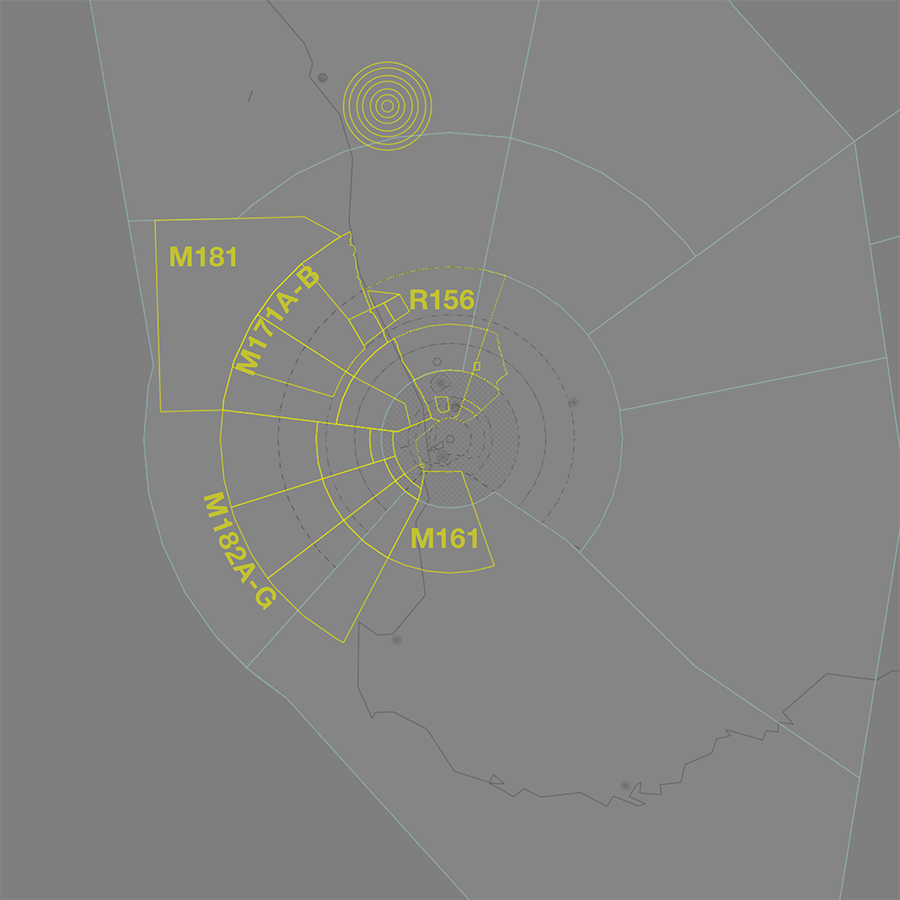
PE TCU must give heads up coordination with the relevant enroute controllers prior to any departures intending to operate in a currently inactive SUA.
Phraseology
PEA -> LEA: "On the groud YPEA, DUGT19, requests activation of M166 A020-F160, from 0300 until 0500.”
LEA -> PEA: "DUGT19, expect activation of M166 A020-F160 at 0300 until 0500."
PEA -> LEA: "DUGT19."
Non-participating aircraft intending to transit an activated SUA should be rerouted, where possible, subject to the VATSIM Code of Conduct.
M161 Pearce
The M161 Pearce MOA is south of YPPH, A060 - NOTAM, spanning both PH TCU and JAR airspace. Activation of M161 Pearce is a shared responsibility, and both PH TCU and JAR must coordinate before activation.
M170A-B and M171A-B Pearce
The M170A-B and M171A-B Pearce MOAs are located off the coast, SFC - NOTAM, spanning PEA, PH TCU and LEA airspace. Activation of M170A-B and M171A-B Pearce is a shared responsibility, and both PEA, PH TCU and LEA must coordinate before activation.
Affected Civil Operations
Activation of the MOA disrupts traffic on the infrequently used T12 high altitude airway, which connects Perth to destinations in Europe and Asia. Aircraft travelling on this airway will generally be long-haul international flights with limited fuel reserves to handle extensive delays.
Aircraft travelling on this airway should not be rerouted around the activation. Instead, aircraft operating within the SUA should be issued with a restriction to remain north of the 258° PEA TAC radial (within 30 TAC) or the 270° PEA TAC radial (between 30-45 TAC).
M181 and M182A-G Stirling
The M181 and M182A-G Stirling MOAs are located off the coast, SFC - NOTAM, spanning GEL, JAR, and LEA airspace. Activation of M181 and M182A-G Stirling is a shared responsibility, and both GEL, JAR, and LEA must coordinate before activation.
STAR Clearance Expectation
Handoff
Aircraft being transferred to the following sectors shall be told to Expect STAR Clearance on handoff:
| Transferring Sector | Receiving Sector | ADES | Notes |
|---|---|---|---|
| GVE | DAL | YPPH, YPJT | Jets only |
| DAL, CRS, HYD | PIY | YPPH, YPEA | Non-jets only |
| DAL, CRS, HYD | PIY | YPJT | Non-jets only |
| GEL | LEA | YPPH |
Terminal Handover Frequencies
Aircraft being transferred from enroute to a TCU with multiple frequencies shall be given the frequency for the revelant TCU position.
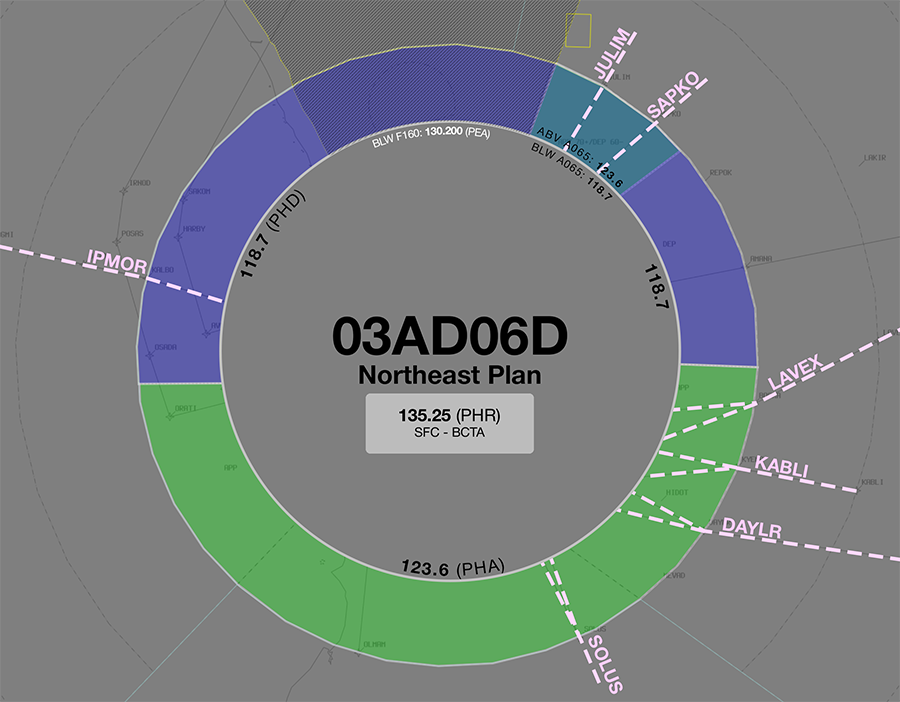
| ADES | STAR | Frequency (Controller) |
|---|---|---|
| YPPH | DAYLR | 123.600 (PHA) |
| YPPH | IPMOR | 118.700 (PHD) |
| YPPH | JULIM | ABV A065: 123.600 (PHA)BLW A065: 118.700 (PHD) |
| YPPH | KABLI | 123.600 (PHA) |
| YPPH | LAVEX | 123.600 (PHA) |
| YPPH | SAPKO | ABV A065: 123.600 (PHA)BLW A065: 118.700 (PHD) |
| YPPH | SOLUS | 135.250 (PHR) |
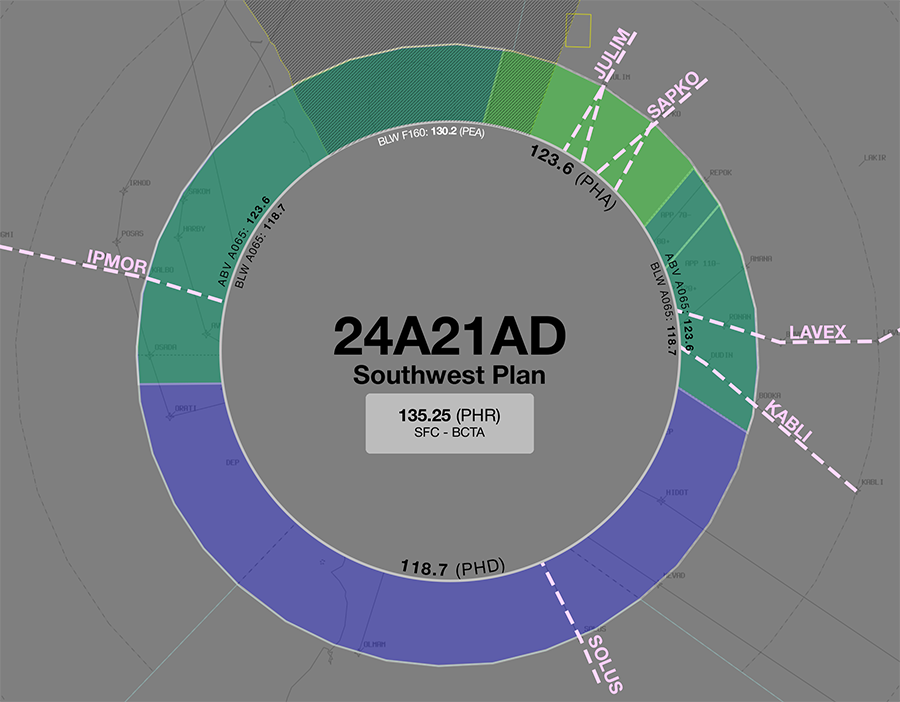
| ADES | STAR | Frequency (Controller) |
|---|---|---|
| YPPH | IPMOR | ABV A065: 123.600 (PHA)BLW A065: 118.700 (PHD) |
| YPPH | JULIM | 123.600 (PHA) |
| YPPH | KABLI | 123.600 (PHA) |
| YPPH | LAVEX | 123.600 (PHA) |
| YPPH | SAPKO | 123.600 (PHA) |
| YPPH | SOLUS | 135.250 (PHR) |
Coordination
PH TCU
Airspace
The PH TCU is responsible for the airspace within 36 DME of the PH VOR, SFC to F245.
Refer to Perth TCU Airspace Division for information on airspace divisions when PHD is online.
Note
A significant portion of the TMA airspace south of the PH VOR (roughly 20 DME onwards) is classified Class E with a lower limit of F125. Aircraft arriving from this direction from F130 and above shall be instructed to leave and re-enter controlled airspace on descent to the standard assignable level (or other appropriate altitude).
Departures
Voiceless for all aircraft:
- Tracking via a Procedural SID procedure‡; and
- Assigned the lower of
F180or theRFL
Note
‡ In contrast to many other TCUs, aircraft are required to be tracking via the SID procedure. Aircraft simply tracking via any of the terminus waypoints (including aircraft given track shortening) is not sufficient to meet the criteria for voiceless coordination.
All other aircraft going to HYD CTA will be Heads-up Coordinated by PH TCU.
Arrivals/Overfliers
Voiceless for all aircraft:
- With ADES YPPH; and
- Assigned a STAR (except the SOLUS STAR); and
- Assigned
A090
All other aircraft coming from HYD CTA must be Heads-up Coordinated to PH TCU prior to 20nm from the boundary.
Arrivals via SOLUS STAR
Due to the relatively high level of Class G in the south of the TMA, aircraft arriving via the SOLUS STAR should be cleared to leave and re-enter CTA on descent to A090. Standard Heads Up coordination should be used in this case.
Upon receiving coordination from HYD, PH TCU should provide a traffic statement to HYD.
Phraseology
JAR -> PHR: "Via SOLUS, RXA2126, will be assigned A090."
PHR -> JAR: "RXA2126, no reported IFR traffic."
JAR -> PHR: "Copy, no traffic"
JAR: "RXA2126, leave and reenter controlled airspace descending to A090, QNH 1013, no reported IFR traffic."
RXA2126: "Leave and reenter controlled airspace descending to A090, QNH 1013, copy traffic, RXA2126."
JAR: "RXA2126, contact Perth Centre on 135.25"
PE TCU
Airspace
PEA is responsible for the restricted airspace within R155A and R155B. This airspace is reclassified to Class C when PEA is online.
Departures
All aircraft from PE TCU to HYD require Heads-up coordination prior to the boundary, however, as soon as practical (when is the aircraft becomes airborne) is preferred.
Arrivals/Overfliers
All aircraft transiting from HYD to PE TCU must be Heads-up coordinated prior to 20nm from the boundary. There are no standard assignable levels; HYD and PEA controller must agree on a suitable level during coordination.
Phraseology
LEA -> PEA: "via AVNEX, EGLE9, will be assigned A090"
PEA -> LEA: "EGLE9, A090"
Enroute
As per Standard coordination procedures, Voiceless, no changes to route or CFL within 50nm to boundary.
HYD Internal
Changes to CFL are permitted up to the boundary from DAL, CRS and HYD to PIY.
All else is Voiceless, no changes to route or CFL within 20nm (reduced from 50nm) to boundary.
That being said, it is advised that HYD(All) gives Heads-up Coordination prior to 20nm in the following scenarios:
- JAR to PIY for all aircraft
- LEA to PIY for all aircraft
IND (Oceanic)
As per Standard coordination procedures, Voiceless, no changes to route or CFL within 15 mins to boundary.
Aircraft must have their identification terminated and be instructed to make a position report on first contact with the next (procedural) sector.
Phraseology
LEA: "QFA121, identification terminated, report position to Brisbane Radio, 129.25"
Note
Controllers should be aware that VHF coverage near the LEA/IND border may be limited. Controllers should strive to issue HF frequencies and transfer of communications instruction prior to 160 NM PH DME.