Territory (TRT)
Positions
| Name | ID | Callsign | Frequency | Login ID |
|---|---|---|---|---|
| Territory North | TRT | Brisbane Centre | 123.850 | BN-TRT_CTR |
| Ashmore | ASH | Brisbane Centre | 133.400 | BN-ASH_CTR |
| Kimberley | KIY | Brisbane Centre | 132.100 | BN-KIY_CTR |
| Territory South | TRS | Brisbane Centre | 133.200 | BN-TRS_CTR |
Non-Standard Positions
Non-standard positions may only be used in accordance with VATPAC Air Traffic Services Policy.
Approval must be sought from the bolded parent position prior to opening a Non-Standard Position, unless NOTAMs indicate otherwise (eg, for events).
Airspace
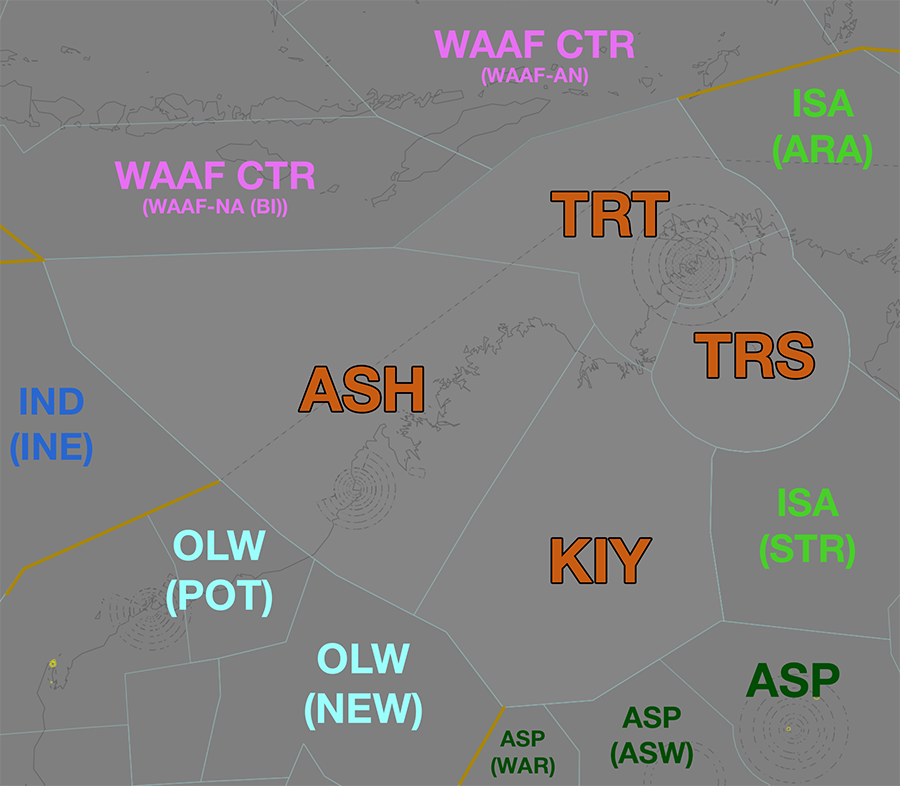
TRT is responsible for TRS, ASH, and KIY when they are offline.
Extending
Important
Due to the large geographical area covered by this sector and its neighbours, controllers are reminded of their obligations under the ATS Policy when extending. Ensure that you have sufficiently placed visibility points to cover your primary sector and any secondary, extended sectors in their entirety.
Reclassifications
When BRM ADC is offline, BRM CTR (Class D/E SFC to A055) reverts to Class G, and is administered by ASH. Alternatively, ASH may provide a top-down procedural service if they wish.
Tip
If choosing not to provide a top down service, consider publishing a pre-formatted ATIS Zulu for the aerodrome, to inform pilots about the airspace reclassification.
The restricted airspace around YCIN is classified as Class G by default, and is only reclassified as controlled airspace when CIA is online. When CIA is offline, the area remains Class G, and is administered by ASH.
When TN TCU is offline the TN MIL CTR and associated restricted airspace is deactivated, and the airspace is administered by TRS.
Tip
Consider publishing a pre-formatted ATIS Zulu for the aerodrome, to inform pilots about the airspace reclassification.
Departure and Arrival Procedures
YBRM
Sequencing
All sequencing is performed by ASH.
YCIN
WRA is responsibile for facilitating operations in and out of YCIN.
YPDN
STAR Assignment
The following subsectors are responsible for issuing STAR clearance.
| Subsector | STAR | Type | Notes |
|---|---|---|---|
| TRT | ANUPA WANGI |
All | |
| TRS | GATOR VEGPU |
All | Descent not below F200 until clear of TN TCU |
Sequencing
TRT is responsible for sequencing aircraft arriving from the north/west. TRS is responsible for sequencing aircraft arriving from the south/east. Coordination between TRT/TRS should be conducted to ensure that aircraft from each sector are sequenced appropriately with each other.
LAHSO
Important
Due to its operational complexity, LAHSO must be authorised by a senior VATPAC staff member or a nominated event coordinator.
In accordance with the authorisation requirements above, YPDN may utilise LAHSO during exceptionally busy events. Detailed procedures exist to ensure that controllers are aware of their responsibilities when performing LAHSO. See Controller Skills for more information.
YPTN
Sequencing
All sequencing is performed by TRS.
Local Procedures
Special Use Airspace
There are multiple volumes of SUA within TRT airspace associated with military operations in and out of YCIN, YPDN, and YPTN.
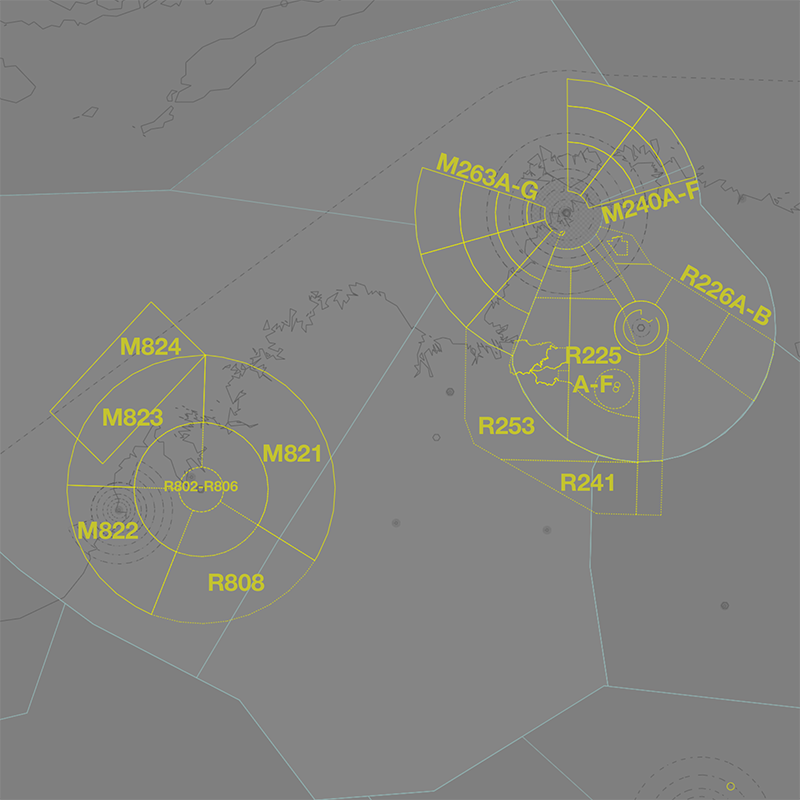
Each TCU must give heads up coordination with the relevant enroute controllers prior to any departures intending to operate in a currently inactive SUA.
Phraseology
TNA -> TRS: "On the groud YPTN, CLAS35, requests activation of R225D A095-F600, from 0300 until 0500.”
TRS -> TNA: "CLAS35, expect activation of R225D A095-F600 at 0300 until 0500."
TNA -> TRS: "CLAS35."
Non-participating aircraft intending to transit an activated SUA should be rerouted, where possible, subject to the VATSIM Code of Conduct.
Bradshaw Field Training Area SUA
The Bradshaw Field Training Area is contained within three volumes of SUA: R268 Koolendong, R269 Angalarri North, and R270 Angalarri South; all SFC-NOTAM. The area is used for extensive army training and operations based at Nackaroo Airfield (YNKR). R269 and R270 are wholly located in the TRS subsector, while R268 extends slightly into KIY.
When all three restricted areas are activated, they are referred to collectively as 'Bradshaw'. Aircraft intending to operate in adjoining SUA should be notified 'Bradshaw Active' with their clearance.
Delamere Air Weapons Range SUA
The Delamere Air Weapons Range is contained within three volumes of SUA:
- R211 Delamere (
SFC-A095) - R212 Delamere (
SFC-A095) - R232 Delamere (
SFC-NOTAM)
The range is used for a variety of bombing and live-firing training exercises, and is wholly located within the TRS subsector.
When all three restricted areas are activated, they are referred to collectively as 'Delamere'. Aircraft intending to operate in adjoining SUA should be notified 'Delamere Active' with their clearance.
M821-M824 Curtin
The M821-M824 Curtin MOAs are located over YCIN, F200-F600, located entirely in ASH airspace.
The MOAs directly adjoin the CIN TMA and when CIA is online aircraft will be transferred directly to/from the MOAs. When CIA is offline, aircraft will contact ASH for transit through the surrounding civilian airspace.
Aircraft will generally enter and exit the MOA via the appropriate military gate.
Affected Civil Operations
When activated, the restricted areas disrupt traffic on the busy A339, A576, T20, and T29 high altitude airways which are used by aircraft travelling between Australia and south-east Asia.
Activation also significantly disrupts traffic travelling in and out of YBRM. Aircraft may be given an additional requirement to climb above, or descend below the vertical limits of the activation, or rerouted manually to avoid the area.
M277A-H Darwin
The M277A-H Darwin MOAs are located southwest of YPDN, NOTAM-NOTAM. M277A and M277E are entirely within DN TCU airspace, while M277B-D and M277F-H are in TRT airspace.
Aircraft will generally enter and exit the MOA via the appropriate military gate.
Affected Civil Operations
Activation of the MOA disrupts traffic on the J151 high altitude airway, and aircraft departing via the HELLI SID. Aircraft may be given an additional requirement to climb above the vertical limits of the activation, or rerouted manually to avoid the area.
M278A-H Darwin
The M278A-H Darwin MOAs are located northeast of YPDN, NOTAM-NOTAM. M278A and M278E are entirely within DN TCU airspace, while M278B-D and M278F-H are in TRT and TRS airspace.
Aircraft will generally enter and exit the MOA via the appropriate military gate.
R225A-F and R250 Tindal
The R225A-F and R250 Tindal restricted areas form the western part of the Tindal Flying Training Area, and are located entirely within the TRS subsector. The areas are used for a variety of training purposes, including supersonic flight.
The restricted areas directly adjoin the TN TMA, and aircraft will generally enter and exit the areas via the appropriate military gate
Affected Civil Operations
When activated, the restricted areas disrupt traffic on the A461 high altitude airway which connects YPDN and YBAS. Aircraft may be given an additional requirement to climb above the vertical limits of the activation, or rerouted manually to avoid the area.
R226A-B Tindal
The R226A-B restricted areas are the easternmost segments of the Tindal Flying Training Area, entirely within the TRS subsector.
These areas are rarely activated, with nearly all operations being preferentially conducted in the western R225A-F and R250 Tindal restricted areas.
R276B-D Darwin
The R276B-D Darwin restricted areas are located southwest of YPDN, NOTAM-NOTAM, in TRT airspace
Aircraft will generally enter and exit the restricted areas via the appropriate military gate.
Affected Civil Operations
Activation of the restricted areas disrupts traffic on the J72 high altitude airway, and aircraft arriving via the WANGI STAR. Aircraft may be given an additional requirement to remain above the vertical limits of the activation, or rerouted manually to avoid the area.
Phraseology
QFA848 has been assigned the WANGI STAR for Runway 11 into YPDN, and is approaching their top of descent. The R276B-C restricted area has been activated SFC-F150.
TRT: "QFA848, descend via STAR to F160, cancel level restriction at KIGOS."
QFA848: "Descend via STAR to F160, cancel level restriction at KIGOS, QFA848."
Important
Before cancelling a STAR level restriction, coordinate with DN TCU to ensure no additional conflicts are inadvertently created.
STAR Clearance Expectation
Handoff
Aircraft being transferred to the following sectors shall be told to Expect STAR Clearance on handoff:
| Transferring Sector | Receiving Sector | ADES | Notes |
|---|---|---|---|
| ASH, KIY | TRT, TRS | YPDN |
Terminal Handover Frequencies
Aircraft being transferred from enroute to a TCU with multiple frequencies shall be given the frequency for the revelant TCU position.
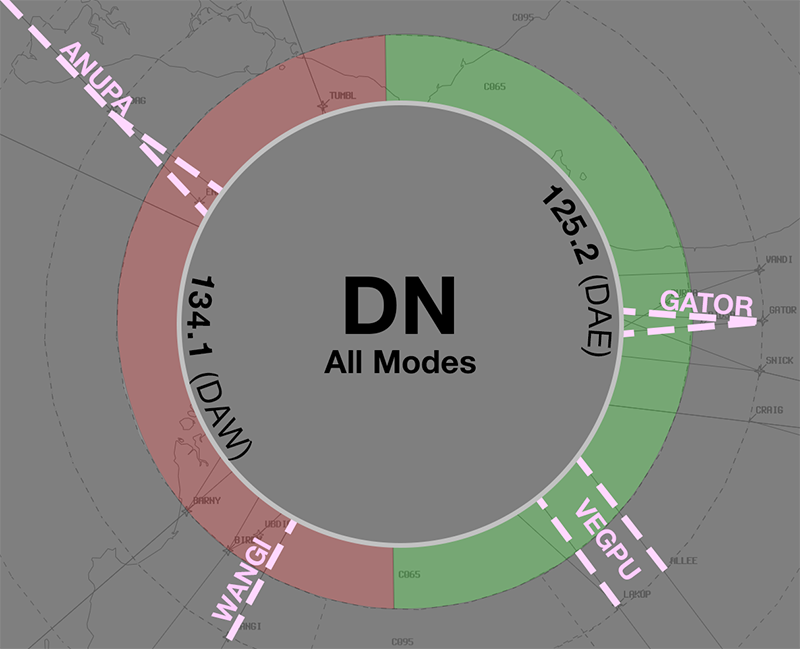
| STAR | Frequency (Controller) |
|---|---|
| ANUPA | 134.100 (DAW) |
| GATOR | 125.200 (DAE) |
| VEGPU | 125.200 (DAE) |
| WANGI | 134.100 (DAW) |
Tip
The quick reference tables above only include scenarios for which there is voiceless coordination. Refer to the diagram for the appropriate position/frequency for coordination and handoff for all other situations.
Coordination
Enroute
As per Standard coordination procedures, Voiceless, no changes to route or CFL within 50nm to boundary.
TRT Internal
As per Standard coordination procedures, Voiceless, no changes to route or CFL within 50nm to boundary.
DN TCU
Airspace
Airspace
DN TCU owns the Class C and G airspace within 40 DME DN from SFC to F180.
Arrivals/Overfliers
Voiceless for all aircraft:
- With ADES YPDN; and
- Assigned a STAR; and
- Assigned
F120
Note
When QNH falls below 980 hPa, DN TCU and TRT shall coordinate a suitable level as F120 is unavailable.
All other aircraft coming from TRT CTA must be Heads-up Coordinated to DN TCU prior to 20nm from the boundary.
Departures
Voiceless for all aircraft:
- Tracking via a Procedural SID terminus; and
- Assigned the lower of
F180or theRFL
All other aircraft going to TRT CTA will be Heads-up Coordinated by DN TCU.
BRM ADC
Airspace
BRM ADC is responsible for the Class D airspace SFC to A055, as well as the Class E airspace 1200ft AGL to A055, within the BRM CTR.
Departures
Next coordination is required from BRM ADC to TRT(ASH) for all aircraft entering TRT(ASH) CTA.
The standard assignable level from BRM ADC to TRT(ASH) is:
| Aircraft | Level |
|---|---|
| All | The lower of A050 and RFL |
Arrivals/Overfliers
YBRM arrivals and overfliers shall be heads-up coordinated to BRM ADC from TRT prior to 5 mins from the boundary.
Phraseology
TRT -> BRM ADC: "Via SAFIR, FD621”
BRM ADC -> TRT: "FD621"
The standard assignable level from TRT(ASH) to BRM ADC is A060, any other level must be prior coordinated.
CIN TCU
Airspace
The limits of the CIN TCU are SFC to F200 within 25 DME CIN. This may be amended by NOTAM.
Arrivals/Overfliers
The Standard assignable level from ASH to CIN TCU is F130, tracking via CIN VOR.
All other aircraft must be voice coordinated to CIN TCU prior to 20nm from the boundary.
Departures
The standard assignable level from CIN TCU to ASH is F190, and tracking via their planned route.
CIN ADC
When CIN TCU is offline, coordination is not required between ASH and CIN ADC. Aircraft entering CIN ADC airspace shall be handed off, and instructed to contact CIN ADC for onwards clearance.
CIN ADC owns the Class C airspace within the CIN MIL CTR from SFC to A015.
TN TCU
Airspace
Any airspace releases from the default setup must be coordinated and agreed upon with TRT(TRS). It is also good practice to remind them of any airspace releases that may be active due to NOTAMs.
Departures
Voiceless for all aircraft:
- Tracking via a Procedural SID terminus; and
- Assigned the lower of
F180or theRFL
All other aircraft going to TRS CTA must be Heads-up Coordinated by TN TCU prior to the boundary.
Phraseology
TN TCU -> TRS: "DRGN48, request DCT BEBEX"
TRS -> TN TCU: "DRGN48, concur DCT BEBEX"
Arrivals/Overfliers
Voiceless for all aircraft:
- Tracking via TN; and
- Assigned the lower of
F130or theRFL.
All other aircraft coming from TRS CTA will be Heads-up Coordinated to TN TCU.
Phraseology
TRS -> TN TCU: "via NOLEK, FD858"
TN TCU -> TRS: "FD858, F150"
IND(INE) (Oceanic)
As per Standard coordination procedures, Voiceless, no changes to route or CFL within 15 mins to boundary.
Aircraft must have their identification terminated and be instructed to make a position report on first contact with the next (procedural) sector.
Phraseology
ISA: "QFA121, identification terminated, report position to Brisbane Radio, 129.25"
International (WAAF)
As per Standard coordination procedures, Heads-up Coordination required for all aircraft prior to 30 mins from boundary.
Phraseology
TRT -> WAAF CTR: "Estimate, SIA236, KIKEM time 21, F320"
WAAF CTR -> TRT: "SIA236, F320"