Williamtown TCU
Positions
| Name | ID | Callsign | Frequency | Login ID |
|---|---|---|---|---|
| Williamtown Approach | WAL | Willy Approach | 135.700 | WLM_APP |
| Williamtown Approach (High) | WAH | Willy Approach | 133.300 | WLM-H_APP |
Non-Standard Positions
Non-standard positions may only be used in accordance with VATPAC Air Traffic Services Policy.
Approval must be sought from the bolded parent position prior to opening a Non-Standard Position, unless NOTAMs indicate otherwise (eg, for events).
Note
Williamtown TCU is a joint military/civil TCU and procedures can differ significantly to those in a civil TCU. Ensure you are familiar with the military controller skills necessary to provide a quality service.
Airspace
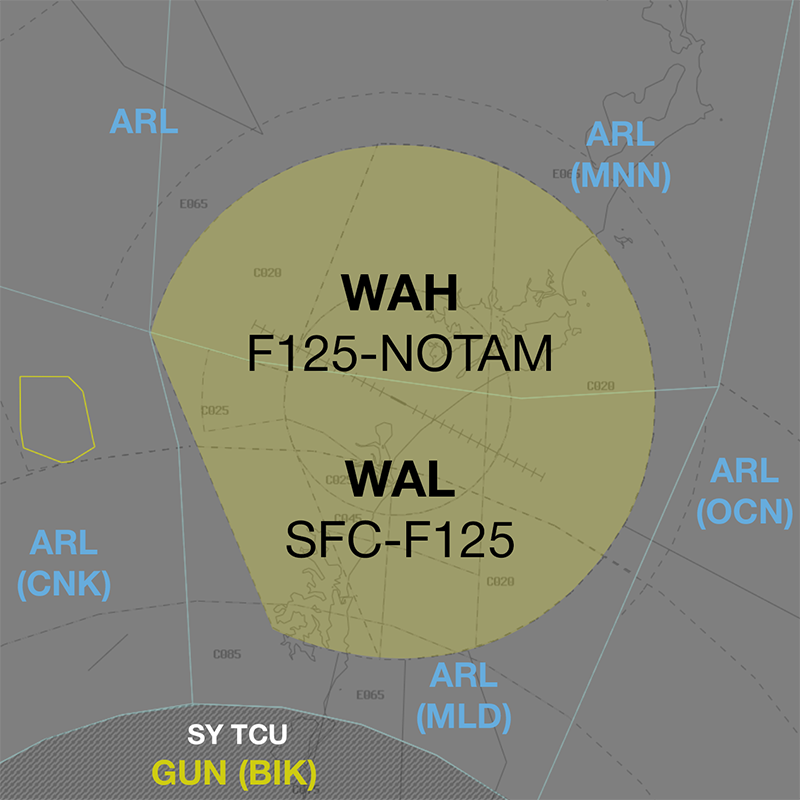
WLM TCU owns the airspace within the WLM MIL CTR SFC to F125.
WLM ADC
WLM ADC is responsible for the airspace within the WLM MIL CTR A from SFC to A015.
Airspace Division
WAL owns the WLM TCU airspace SFC to F125.
WAH owns any airspace above F125 activated by ad-hoc release with MNN or NOTAM.
Note
The upper limit of WAH must be coordinated with MNN prior to the position logging on.
Restricted Area Activations
There are no restricted areas or MOAs activated by default when WAL is online.
SUA in Enroute Airspace
Most military operations will take place in SUA nearby the TCU in enroute airspace, outside the jurisdiction of WLM TCU.
Upon receiving airways clearance coordination from ACD of an aircraft intending to operate in a currently inactive SUA, WLM TCU must give heads up coordination to relevant enroute controllers.
This gives the enroute controller sufficient time to assess the request, make necessary adjustments to any aircraft in the area currently, and activate the SUA; or alternately to refuse the activation request before the aircraft is in the air.
Phraseology
PTHR11 is requesting clearance to operate in the M581 restricted area.
WLM ACD -> WAL: "PTHR11 requests clearance to M581.”
WAL -> WLM ACD: "Standby, call you back."
WAL -> MNN: "On the groud YWLM, PTHR11, requests activation of M581 A085-F240, from 0300 until 0500.”
MNN -> WAL: "PTHR11, expect activation of M581 A085-F240 at 0300 until 0500."
WAL -> MNN: "PTHR11."
WAL -> WLM ACD: "PTHR11, clearance approved."
WLM ACD -> WAL: "Clearance approved, PTHR11"
Note
The requirement to coordinate activation of an SUA is in addition to existing coordination requirements. Heads-up coordination is still required for these aircraft if they do not meet the voiceless coordination criteria.
Local Procedures
Initial and Pitch
The initial points are aligned with Taxiway A at the following locations.
| RWY | Initial Point | Altitude |
|---|---|---|
| 12 | South-western tip of Grahamstown Dam | A025( A020 for PC21) |
| 30 | Intersection of the coast and extended Taxiway A centreline | A025( A020 for PC21) |
Military Gates
There are numerous military gates established throughout the WLM TCU to facilitate entry and exit to adjoining SUA.
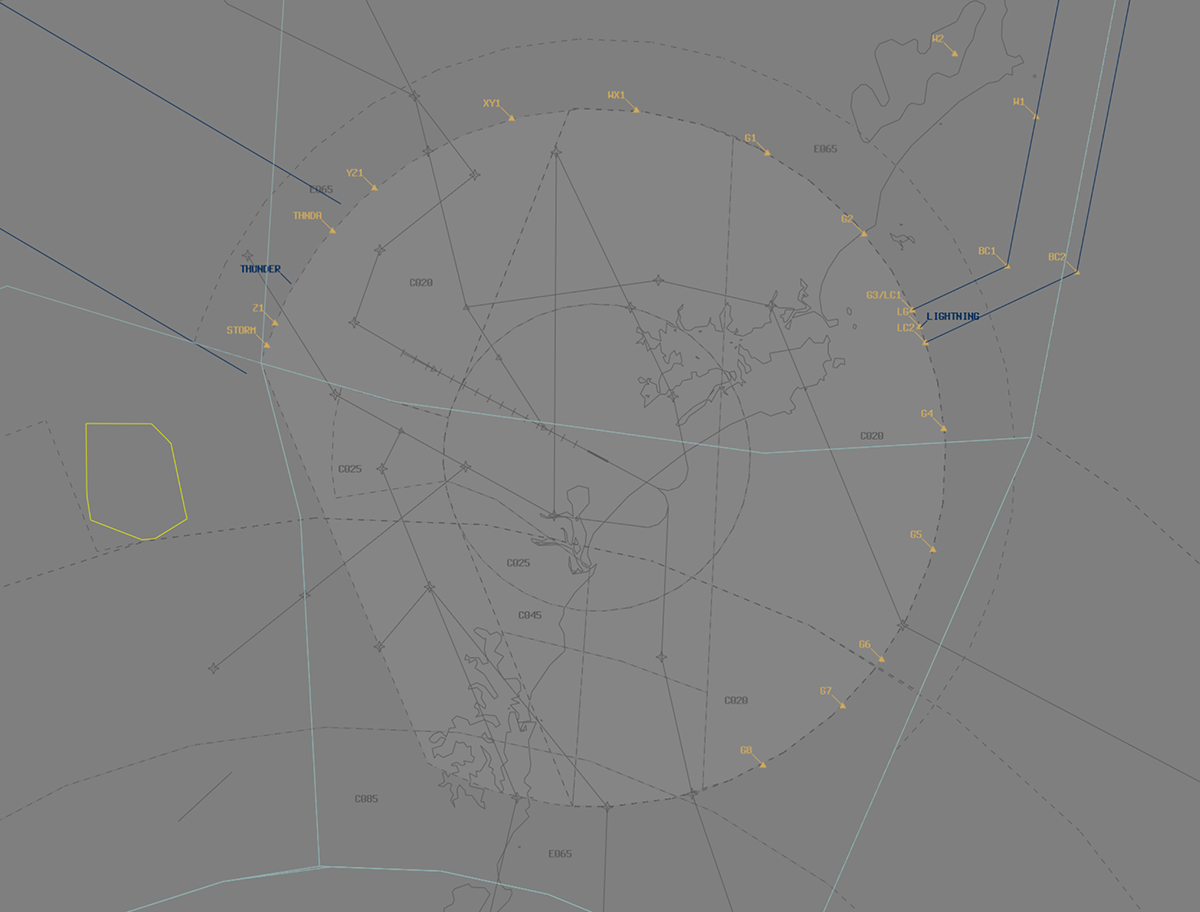
If the pilot does not nominate a gate, or nominates a gate that does not provide access to their intended SUA, WLM ACD should clear the aircraft to depart via the appropriate gate.
| Intended SUA | TCU Exit Gate |
|---|---|
| M581 | Gates 4-7 |
| M582 | Gate 6 |
| M583 | Lightning Gate (LG) |
| M584 | Lightning Gate (LG) |
| R585A | Gate 1 |
| R585B | Gate 9 |
| R585C | Gate 10 |
| R585D | Gate 11 |
| R586 | Gates 1-3 |
Tip
Coordination requirements exist between ACD and TCU when aircraft are requesting clearance to operate in an SUA that has not been activated. Controllers performing the role of ACD should ensure they coordinate with TCU before providing clearance
Military Corridors
There are two military corridors established around the WLM TCU to facilitate transit of military aircraft between the TCU and adjoining SUAs.
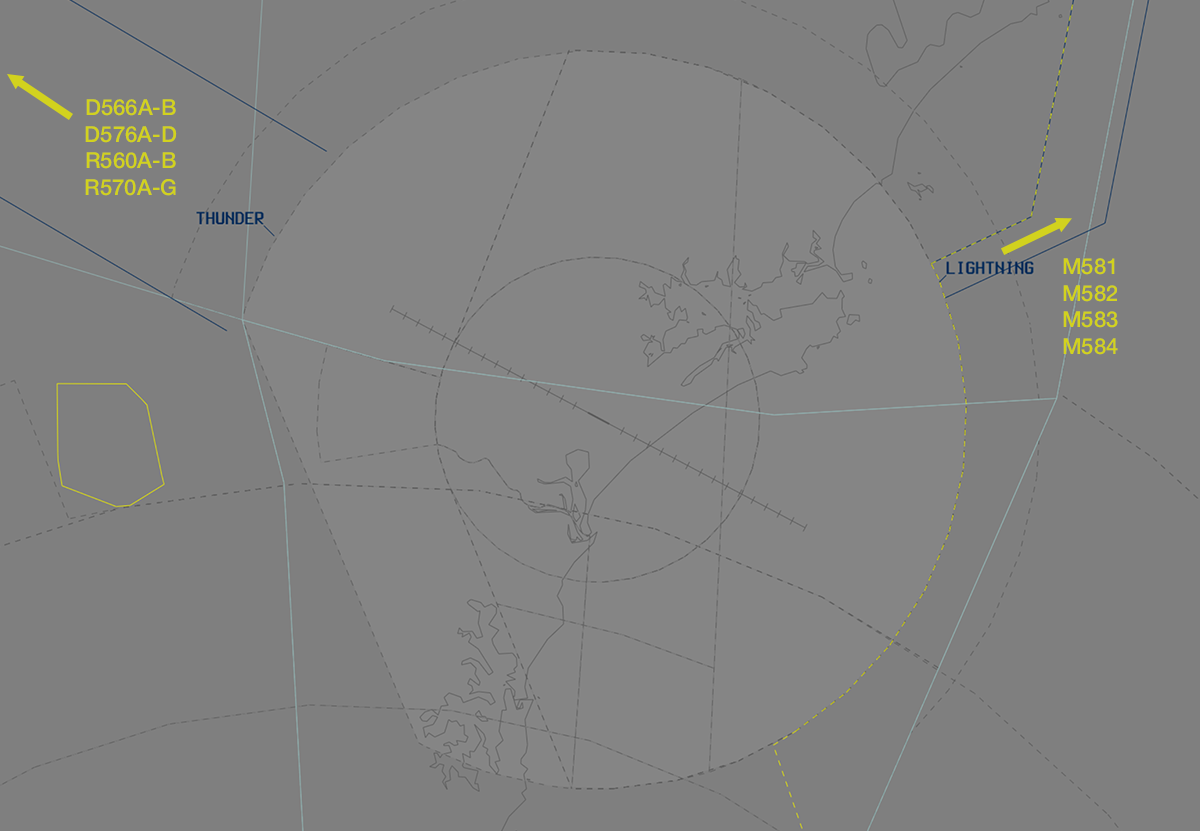
These corridors are located outside the jurisdiction of WLM TCU.
Thunder Corridor
The Thunder Corridor is used by aircraft to transit civilian enroute airspace between the WLM TCU and the R560 and R570 restricted areas.
Aircraft departing to the areas will be cleared the STORM 1 coded clearance by ACD, aircraft returning to the airport will be cleared the STORM 2 coded clearance by ARL.
Aircraft transiting the Thunder Corridor should be assigned the appropriate altitude to ensure separation with opposite direction traffic while transiting to their desired restricted area.
| Coded Clearance | Altitude |
|---|---|
| STORM 1 | F140 |
| STORM 2 | F130 |
Note
Aircraft tracking via the STORM coded clearance does not constitute a voiceless coordination route between WLM TCU and ARL. Aircraft should still be heads-up coordinated to ARL prior to 5 minutes to the boundary, unless coordinated otherwise.
Lightning Corridor
The Lightning Corridor is used by aircraft to transit between the WLM TCU and the M581-M584 restricted areas. Aircraft will access the corridor through the Lightning Gate (LG) and transit the corridor before reaching their desired operating area.
The corridor itself is located entirely within SUA, and aircraft entering the corridor from WLM TCU airspace do not need to be handed off to ARL if the restricted areas are active.
Phraseology
WAL: "WGTL45 at LG cleared operating, report ops normal time 30."
WGTL45: "At LG cleared operating, ops normal time 30, WGTL45."
Aircraft transiting the Thunder Corridor should be assigned the appropriate altitude to ensure separation with opposite direction traffic while transiting to their desired restricted area.
| Coded Clearance | Altitude | Notes |
|---|---|---|
| Outbound | A100-A140A200-A240 |
Aircraft will remain on local QNH above A100 |
| Inbound | A050-A090A150-A190 |
Aircraft will remain on local QNH above A100 |
Aircraft returning to base via the corridor will contact WLM TCU prior to leaving their training area. Once the aircraft has been identified by WLM TCU, they will then pass details of their intended return.
Phraseology
WGTL45: "Willy Approach, WGTL45."
WAL: "WGTL45, Willy Approach, identified."
WGTL45: "Willy Approach, WGTL45. A090 visual, for visual approach with information A."
M581-M584 MOA Subsets
The M581-M584 MOAs are themselves divided into eighteen different subareas that are used to confine different operations within the area. These areas are arranged in a grid pattern and are identified by a grid reference.
| MOA | Subareas |
|---|---|
| M581 | A1, B1, and C1 |
| M582 | A2, B2, B3, C2, and C3 |
| M583 | D1-D3, and E1-E3 |
| M584 | F1-F3, and G |
WLM TCU is not responsible for assigning subareas, or ensuring separation between aircraft operations between areas.
When an aircraft has declared an intention to operate within a subarea, WLM TCU may provide a traffic statement to help provide situational awareness to the departing aircraft.
Phraseology
WAL: "WGTL46 at LG cleared operating, number 2 in Bravo One and Charlie One, report ops normal time 30.
Special Use Airspace
Salt Ash SUA
The Salt Ash Air Weapons Range is located within the WLM MIL CTR, and is used for air-surface gunnery and bombing practice. It is entirely contained within the R596 restricted area.
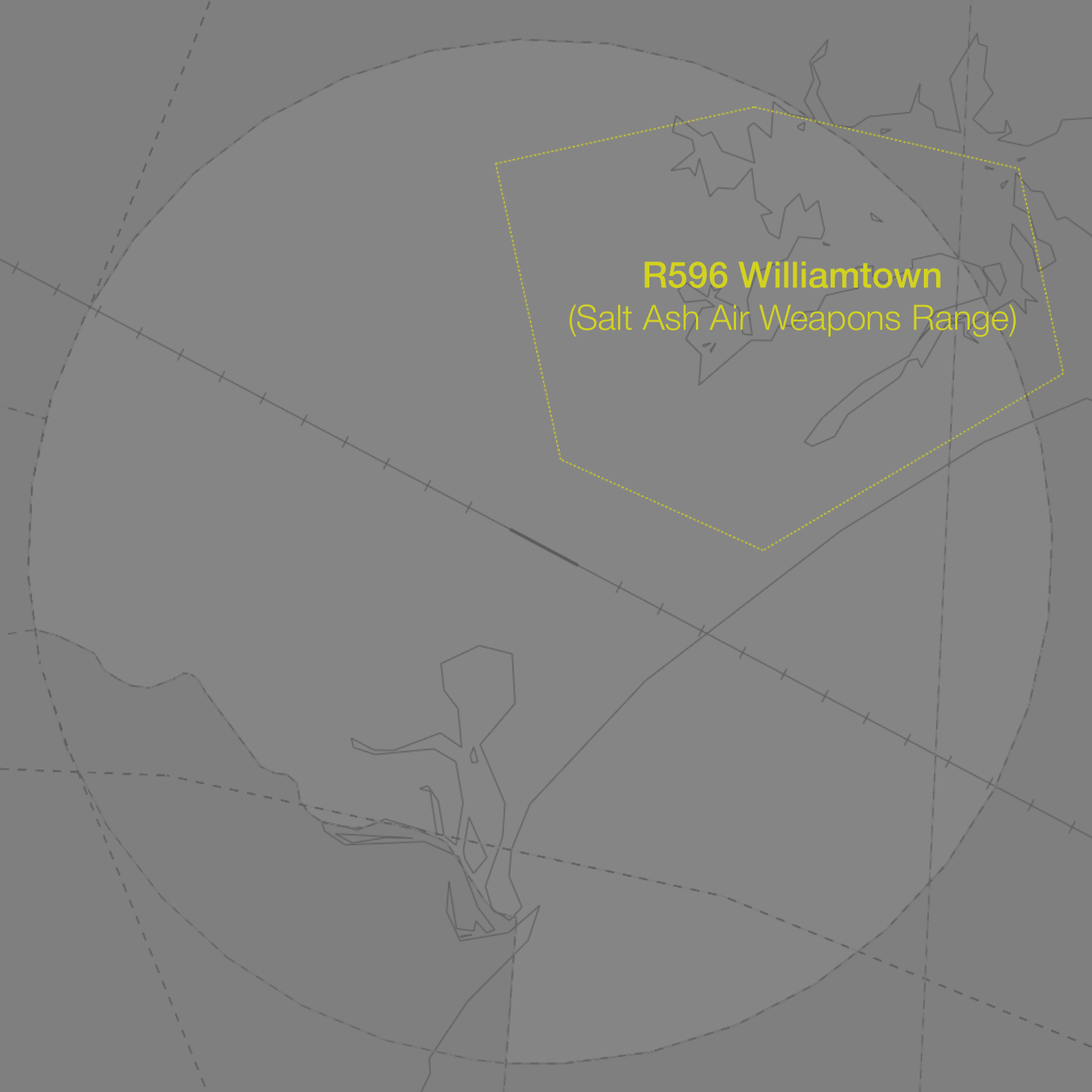
The restricted area can be activated in two configurations according to the requirements of the operation. Only VFR aircraft are permitted.
| Configuration Name | Vertical Limits | Notes |
|---|---|---|
| R596 High | SFC - A130 |
Aircraft will remain on local QNH above A100 |
| R596 Low | SFC - A050 |
When the R596 restricted area is active all airspace within the SUA is managed by WAL, and the ATIS should be updated to reflect the activation.
Stereo Approaches
In times of heavy military traffic, WLM TCU may choose to nominate stereo approaches as the preferred approach method. When stereo approaches have been nominated, the ATIS APCH EXP field must be updated accordingly.
Aircraft arriving from Gates 1-4 and 6 will join the stereo approach at the gate; other aircraft may start the approach from overhead WLM TAC.
Phraseology
WGTL45 is returning from M581 via Gate 6, and has already been identified. Runway 30 is in use.
WGTL45: "Willy Approach, WGTL45. F150 visual, for stereo approach with information A."
WAL: "MAPL45, Willy Approach, cleared stereo approach. At 11 TACAN WLM contact Tower, 118.3"
MAPL45: "Cleared stereo approach, tower at 11 TACAN WLM, WGTL45"
VFR Lanes of Entry
Coastal Route
A lane of entry is available along the coastline, allowing aircraft to transit the zone from north to south (or vice versa). A clearance is required from WLM TCU prior to entering the CTR.
| Direction | Routing | Altitude |
|---|---|---|
| Northbound | NBB ANA PSS BRI SUG | A005 |
| Southbound | SUG BRI PSS ANA NBB | Not above A020 until ANA, then A005 |
Aircraft are required to follow the coastline and remain over water at all times.
Phraseology
FWC: "Willy Approach, FWC, Cessna 172, 4nm south of NBB, A005, received Bravo, for the coastal route, request clearance"
WLM TCU: "FWC, squawk 0366, remain outside controlled airspace"
FWC: "Squawk 0366, remain outside controlled airspace, FWC"
WLM TCU: "FWC, identified, cleared coastal route northbound, maintain A005"
FWC: "Cleared coastal route northbound, maintain A005, FWC"
Details of the lane are available in the YWLM ERSA FAC and on the Williamtown VTC.
Important
Delays may be necessary due to arrivals to runway 30 or departures from runway 12. Clearance should be withheld from VFR aircraft wishing to track between NBB and ANA until the extended runway centreline is clear.
During periods of peak traffic, it may be beneficial to coordinate with ADC and have them maintain visual separation between aircraft on the VFR route and any other aircraft operating in the CTR.
Inland Lane
A lane of entry is available in the Class G airspace to the north of YWLM, allowing aircraft to transit the restricted airspace from north to south (or vice versa). No clearance is required to operate along the route provided aircraft remain at or below A025.
Flow
Local Knowledge
- Aircraft may be assigned the Romeo or Victor STAR to reduce track miles
- During VMC by day, aircraft may be instructed to track for a visual base to either runway
Flow Tables
The tables below give an estimated time in minutes from the Feeder Fix to the Threshold.
| STAR | RWY 12 | RWY 30 |
|---|---|---|
| ASUVA | 15 | 7^ |
| EKIPU | 12^ | 11^ |
| IVTAG R/V EKIPU transition OVLUX transition PUDUT transition |
- - - |
8^ 8^ 9^ |
| LAXUM A | 9^ | 15 |
| LAXUM B | 11^ | 18 |
| LAXUM R | 8^ | 11^ |
| LAXUM V | 8^ | 11^ |
| OVLUX | 11^ | 11^ |
| PUDUT | 9^ | 12^ |
| STAR | RWY 12 | RWY 30 |
|---|---|---|
| ASUVA | 17 | 8^ |
| EKIPU | 13^ | 12^ |
| IVTAG R/V EKIPU transition OVLUX transition PUDUT transition |
- - - |
9^ 9^ 10^ |
| LAXUM A | 10^ | 17 |
| LAXUM B | 12^ | 21 |
| LAXUM R | 9^ | 12^ |
| LAXUM V | 9^ | 13^ |
| OVLUX | 13^ | 13^ |
| PUDUT | 10^ | 13^ |
Corrections
| Situation | Correction |
|---|---|
| Assigned a reduced speed | +1 min, except ^ |
| Over 40kt of head/tailwind component | +1 min for headwind -1 min for tailwind |
Assumptions
- Nil wind
- The feeder fix for all STARs is the assigned STAR transition waypoint (if applicable), otherwise the waypoint coinciding with the STAR title
Calculator
The following calculator will generate a landing time from a feeder fix ETA, or the reverse.
Coordination
Enroute
Departures
Voiceless for all aircraft:
- Tracking via a Procedural SID terminus; and
- Assigned the lower of
F120or theRFL.
Note
Aircraft are not required to be tracking via the SID procedure, simply tracking via any of the terminus waypoints (regardless of departure airport or assigned SID) is sufficient to meet the criteria for voiceless coordination.
All other aircraft going to MNN CTA must be Heads-up coordinated by WLM TCU prior to the boundary.
Phraseology
WAH -> MLD: "QJE1597, request DCT OMGAB"
MLD -> WAH: "QJE1597, concur DCT OMGAB"
Arrivals/Overfliers
Voiceless for all aircraft:
- With ADES YWLM; and
- Assigned a STAR; and
- Assigned
A090
All other aircraft coming from MNN CTA will be Heads-up coordinated to WLM TCU.
WLM ADC
Airspace
WLM ADC owns the airspace within the WLM MIL CTR A (SFC-A015).
Departures
Next coordination is not required from WLM ADC to WLM TCU for aircraft that are:
- Departing from a runway nominated in the ATIS; and
- Assigned the standard assignable level; and
- Assigned a Procedural SID
All other aircraft require a 'Next' call to WLM TCU.
The standard assignable level from WLM ADC to WLM TCU is:
| Aircraft | Level |
|---|---|
| All | The lower of F120 and RFL |
ACD to WLM TCU
The controller assuming responsibility of ACD shall give heads-up coordination to WAL (or the enroute controller responsible for the WLM TCU) prior to the issue of a clearance to an aircraft intending to operate in an SUA that has not been activated.
Phraseology
WLM ACD -> WAL: "PTHR11 requests clearance to R570 via Thunder corridor.”
WAL -> WLM ACD: "PTHR11, clearance approved."
Most military operations will take place in SUA adjoining the TCU in enroute airspace. WLM TCU must coordinate the activation of these SUAs with the relevant enroute controllers prior to approving any clearances.
Charts
Reference
In addition to the civilian ERSA and AIP publications, the RAAF AIP website contains the necessary charts (available in the TERMA) and description of procedures (in each airports' FIHA).