Tasmania TCU
Positions
| Name | ID | Callsign | Frequency | Login ID |
|---|---|---|---|---|
| Hobart Approach | HBA | Hobart Approach | 125.550 | HB_APP |
| Launceston Approach | LTA | Launy Approach | 123.800 | LT_APP |
Airspace
The vertical limits of the Tasmanian TCUs are SFC to F245.
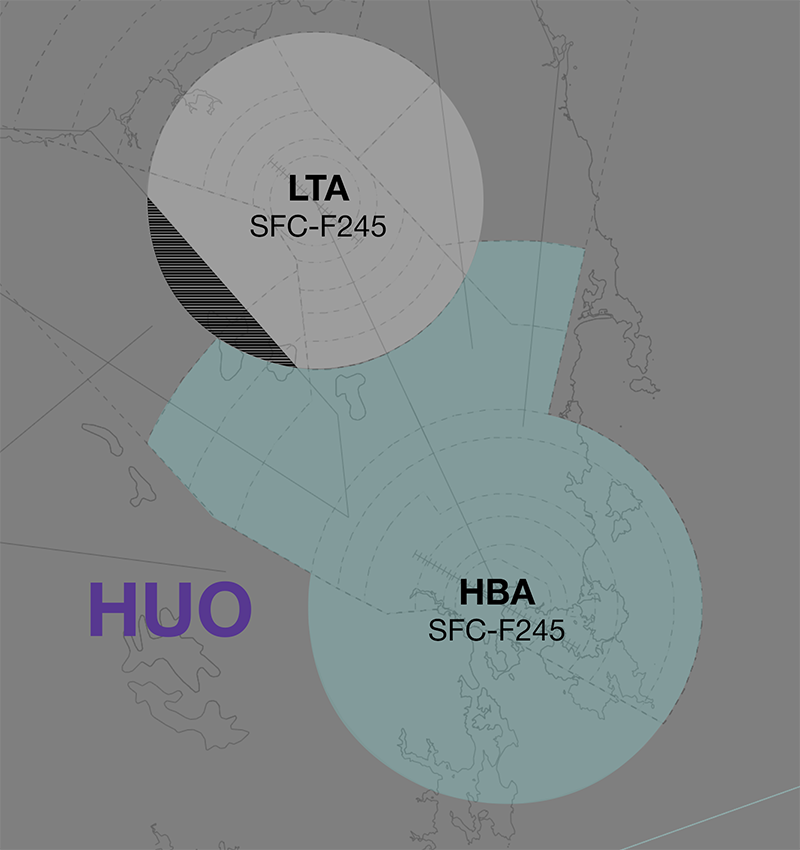
Airspace Division
LT TCU
LTA owns the airspace SFC to F245 within a 30nm radius of the LT VOR. LT ADC owns the Class D airspace within LT CTR SFC to A015 when open.
LTA Release to HUO
The Airspace on and west of the IRSOM-MORGO track F125-F245 (shaded in the diagram above) is permanently released from LTA to HUO, unless coordinated otherwise.
HB TCU
HBA owns the airspace SFC to F245 within the remainder of the Tasmania TMA (shown below). HB ADC owns the Class D airspace within HB CTR SFC to A015 (north of runway centreline) and A025 (south of runway centreline) when open.
Extending
HBA may extend to LTA and vice versa, callsigns remain the same. See Controller Skills for details.
Departure and Arrival Procedures
YMLT
Visual approaches are preferred into YMLT.
If instrument approaches are nominated on the ATIS, HUO will reroute inbound IFR aircraft via the following waypoints:
| Duty Runway | Tracking Via | Amended Routing |
|---|---|---|
| RWY 14R | IRSOM NUNPA |
LT2ND LT2NG |
| RWY 32L | IRSOM NUNPA |
NODAS LT2SC ELREL LT2SA |
These routes keep arrivals within CTA and away from the departure streams.
Tip
In some situations, it may be beneficial to process aircraft from the north via the DGA/visual approach for a circuit join to RWY 32L, as a form of track shortening. See Local Knowledge for more.
Likewise, it may be necessary to process aircraft via the RNP (and above routing) for sequencing/separation. Coordination with HUO must take place in either case.
YMHB
All aircraft should be kept on SIDs and STARs. If due to operational requirements or routing, an aircraft is unable to accept the SID or STAR, voice coordination with HUO will be required.
YCBG
Aircraft inbound to YCBG who will track via the HBA CTA should be issued an airways clearance by HBA, then passed to HB ADC when appropriate. HBA must coordinate any clearance limits issued to HB ADC.
Aircraft inbound to YCBG who will track directly from Class G airspace to the CTR should contact HB ADC for clearance.
Flow
Local Knowledge
- IFR aircraft inbound to YCBG must be flowed as if they were arriving at YMHB, unless they can accept a visual approach and remain clear of the inbound tracks to YMHB
- IFR aircraft inbound to YMLT from the north may be cleared via the DGA/visual approach for a circuit join onto RWY 32L as a form of track shortening
Important
Aircraft landing at YMHB will generally require a backtrack to vacate the runway. During busy periods, the following flow rates are recommended to prevent a large number of go arounds.
| Situation | Flow Rate |
|---|---|
| Many arrivals | 4 min between each arrival |
| Many arrivals and departures | 5 min between each arrival |
Flow Tables
YMHB
The tables below give an estimated time in minutes from the Feeder Fix to the Threshold.
| STAR | RWY 12 | RWY 30 |
|---|---|---|
| IPLET A | 12^ | 12^ |
| IPLET V | 10^ | 10^ |
| IPLET W | 10^ | 10^ |
| MORGO A | 12^ | 15 |
| MORGO V | - | 14 |
| MORGO W | - | 14 |
| STAR | RWY 12 | RWY 30 |
|---|---|---|
| IPLET A | 13^ | 13^ |
| IPLET V | 11^ | 11^ |
| IPLET W | 11^ | 12^ |
| MORGO A | 13^ | 17 |
| MORGO V | - | 16 |
| MORGO W | - | 16 |
YMLT
The tables below give an estimated time in minutes from the Feeder Fix to the Threshold.
| Tracking | RWY 14R | RWY 32L |
|---|---|---|
| IRSOM LT2NE | 11^ | - |
| IRSOM NODAS LT2SC | - | 16 |
| MIMIM LT2NG | 15 | - |
| MIMIM ELREL LT2SA | - | 19 |
| LATUM LT2ND | 15 | - |
| LATUM LT2SB | - | 11^ |
| Tracking | RWY 14R | RWY 32L |
|---|---|---|
| IRSOM LT2NE | 12^ | - |
| IRSOM NODAS LT2SC | - | 18 |
| MIMIM LT2NG | 17 | - |
| MIMIM ELREL LT2SA | - | 21 |
| LATUM LT2ND | 17 | - |
| LATUM LT2SB | - | 12^ |
Corrections
| Situation | Correction |
|---|---|
| Assigned a reduced speed | +1 min, except ^ |
| Over 40kt of head/tailwind component | +1 min for headwind -1 min for tailwind |
Assumptions
- Nil wind
- The feeder fix for all STARs is the waypoint coinciding with the title of the STAR
YMHB Calculator
The following calculator will generate a landing time from a feeder fix ETA, or the reverse.
YMLT Calculator
The following calculator will generate a landing time from a feeder fix ETA, or the reverse.
Coordination
Enroute
Departures
Voiceless for all aircraft:
- Assigned the lower of
F240or theRFL; and - Tracking via a Procedural SID terminus
All other aircraft going to HUO CTA must be Heads-up coordinated by TAS TCU prior to the boundary.
Phraseology
LTA -> HUO: "via IRSOM, QFA114, with your concurrence, will be assigned F150, for my separation with ZYX"
HUO -> LTA: "QFA114, concur F150"
Arrivals
Voiceless for all aircraft:
- With ADES YMLT
- Tracking from IRSOM or NUNPA in accordance with Departure and Arrival Procedures, or DCT LT; and
- Assigned
A090
- With ADES YMHB
- Assigned a STAR; and
- Assigned
F130
All other aircraft coming from HUO CTA will be Heads-up coordinated to TAS TCU.
HB ADC
Airspace
HB ADC owns the Class D airspace in the HB CTR SFC to A015 north of the runway centreline and A025 south of the runway centreline. HBA owns the Class D and C airspace above these levels.
Departures
Next coordination is not required to HBA for aircraft that are:
- Departing from a runway nominated on the ATIS; and
- Assigned the standard assignable level; and
- Assigned a SID; or
- Not entering HBA CTA
All other aircraft require a 'Next' call to HBA.
Note
All departures from YCBG who will enter the HBA CTA will be Next coordinated by ADC.
The standard assignable level from HB ADC to HBA is:
| Flight Rules | Level |
|---|---|
| IFR | A080 |
| VFR | The lower of A045 and RFL |
SMC to TCU
The controller assuming responsibility of SMC shall give heads-up coordination to HBA controller prior to the issue of the following clearances:
- VFR departures entering HBA CTA
- Aircraft using a runway not on the ATIS
Arrivals
HBA will coordinate all YMHB & YCBG arrivals to HB ADC prior to 5 mins from the boundary. This coordination shall be as per Standard Heads-up format, with the addition of:
- Runway, if other than duty runway
- Approach type, unless specifically nominated on the ATIS
- IFR circuit joining instructions, if not on straight-in instrument approach
Phraseology
HBA -> HB ADC: "via BUSKA, QJE1789, for the ILS"
HB ADC -> HBA: "QJE1789, ILS"
LT ADC
Airspace
LT ADC owns the Class D airspace in the LT CTR SFC to A015. LTA owns the Class D and C airspace above A015.
Departures
Next coordination is not required to LTA for aircraft that are:
- Departing from a runway nominated on the ATIS; and
- Assigned the standard assignable level; and
- Assigned a SID; or
- Not entering LTA CTA
All other aircraft require a 'Next' call to LTA.
The standard assignable level from LT ADC to LTA is:
| Flight Rules | Level |
|---|---|
| IFR | A080 |
| VFR | The lower of A045 and RFL |
LT ADC shall give heads-up coordination to LTA controller prior to the issue of the following clearances:
- VFR departures entering LTA CTA
- Aircraft using a runway not on the ATIS
Arrivals
LTA will coordinate all YMLT arrivals to LT ADC prior to 5 mins from the boundary. This coordination shall be as per Standard Heads-up format, with the addition of:
- Runway, if other than duty runway
- Approach type, unless specifically nominated on the ATIS
- IFR Circuit joining instructions, if not on Straight-in instrument approach
Phraseology
LTA -> LT ADC: "via IRSOM, JST416, for the DGA, will join left downwind 32L"
LT ADC -> LTA: "JST416"
LTA/HBA Internal
All aircraft transiting between internal TAS TCU boundaries must be heads-up coordinated.
Phraseology
HBA -> LTA: "via LATUM, AM773"
LTA -> HBA: "AM773, F130"