Inverell (INL)
Positions
| Name | ID | Callsign | Frequency | Login ID |
|---|---|---|---|---|
| Inverell | INL | Brisbane Centre | 134.200 | BN-INL_CTR |
| Burnett | BUR | Brisbane Centre | 123.000 | BN-BUR_CTR |
| Downs | DOS | Brisbane Centre | 135.600 | BN-DOS_CTR |
| Gold Coast | GOL | Brisbane Centre | 130.400 | BN-GOL_CTR |
| Noosa | NSA | Brisbane Centre | 124.100 | BN-NSA_CTR |
| Straddy | SDY | Brisbane Centre | 134.300 | BN-SDY_CTR |
Non-Standard Positions
Non-standard positions may only be used in accordance with VATPAC Air Traffic Services Policy.
Approval must be sought from the bolded parent position prior to opening a Non-Standard Position, unless NOTAMs indicate otherwise (eg, for events).
Airspace
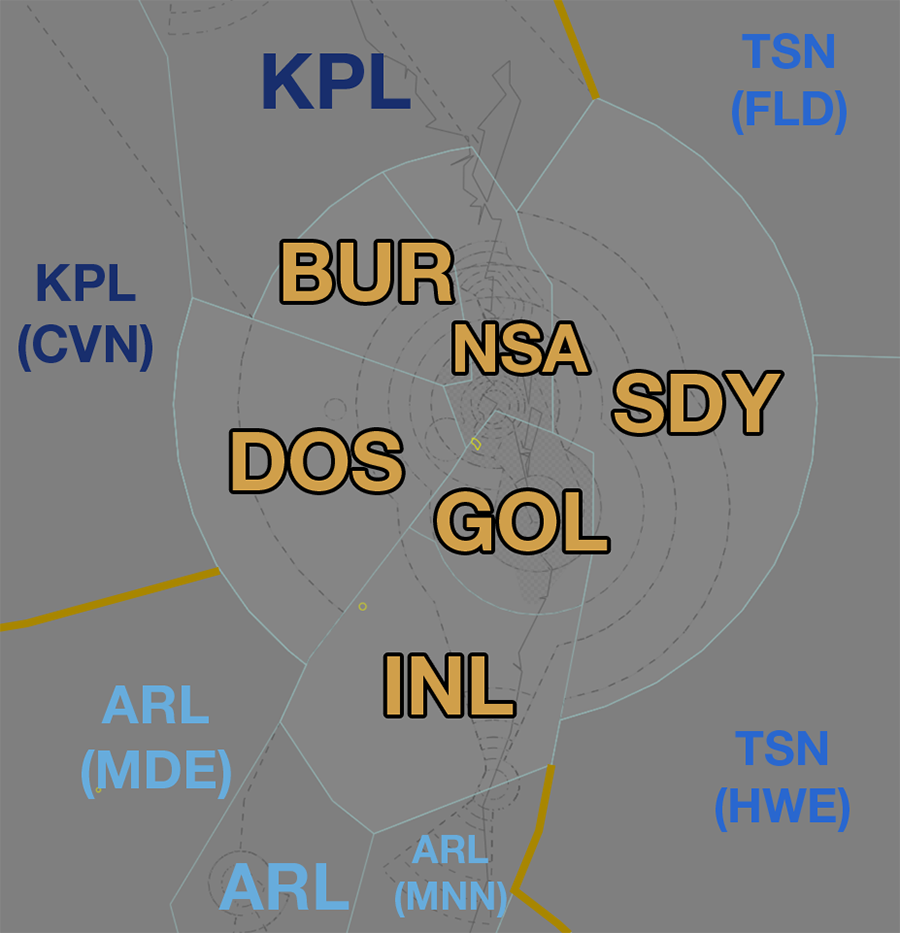
GOL is responsible for the BN TCU when BN TCU is offline.
INL is responsible for DOS, GOL, SDY, BUR, and NSA when they are offline.
Reclassifications
When AMA is offline, the AMB MIL CTR and associated restricted airspace is deactivated, and the airspace is administered by DOS.
When OKA is offline, the OK MIL CTR and associated restricted airspace is deactivated, and the airspace is administered by DOS.
Tip
When either AMA or OKA is offline, consider publishing a pre-formatted ATIS Zulu for their respective aerodromes, to inform pilots about the airspace reclassification.
When CFS ADC is offline, CFS CTR (Class D SFC to A045) reverts to Class G, and is administered by MNN and INL. Alternatively, INL may provide a top-down procedural service if they wish (not recommended), and this must be coordinated to MNN.
Due to the low ceiling of CTA, when CFS ADC is offline, INL shall instruct aircraft departing into CTA to report lined up on the runway and issue an airways clearance (traffic pending) at that time.
Tip
If choosing not to provide a top down service, consider publishing a pre-formatted ATIS Zulu for the aerodrome, to inform pilots about the airspace reclassification.
When CG ADC is offline, the CG CTR Class C airspace SFC to A035 reverts to Class G and is administered by GOL. Alternatively, GOL may provide a top-down approach service if they wish.
Tip
If choosing not to provide a top down service, consider publishing a pre-formatted ATIS Zulu for the aerodrome, to inform pilots about the airspace reclassification.
When SU ADC is offline, SU CTR (Class D SFC to A045) reverts to Class G, and is administered by NSA and BUR. Alternatively, NSA may provide a top-down procedural service if they wish (not recommended), and this must be coordinated to BUR.
Tip
If choosing not to provide a top down service, consider publishing a pre-formatted ATIS Zulu for the aerodrome, to inform pilots about the airspace reclassification.
Departure and Arrival Procedures
YAMB
Coded Clearances
Coded Clearances are available inbound and outbound from the AMB TMA, allowing an aircraft to transit civilian airspace via a military corridor to access offshore SUA.
Arrivals
Fast jet aircraft leaving offshore SUA or arriving to YAMB from the east shall be cleared via one of the following coded clearances.
| Sector | Arrival | Type | Notes |
|---|---|---|---|
| NSA | Northern 6 | Military | Descent not below F200 |
| SDY | Central 5 | Military | Descent not below F200 |
| GOL | Byron 2 | Military | Descent not below F200 |
Phraseology
CRNG21 plans to depart M649 and return to YAMB.
SDY: "CRNG21, cleared to YAMB via VIRGE thence CENTRAL 6, maintain F200"
Departures
High performance military jet aircraft with planned operations in offshore SUA, or intending to depart to the east, will be assigned a Coded Clearance departure.
Each coded clearance includes altitude restrictions which can be used to facilitate separation with civilian traffic.
| Departure | Initial Constraint | Secondary Constraint |
|---|---|---|
| Northern 5 | Cross BINUP at F190 |
Cross MURJO at F260 |
| Central 5 | Cross BINUP at F190 |
Cross MURJO at F260 |
| Byron 1 | Cross COWIE at F190 |
Cross KIWEE at F260 |
Note
Aircraft tracking via a coded clearance does not constitute a voiceless coordination route between AMB TCU and INL. Aircraft should still be heads-up coordinated to INL prior to 5 minutes to the boundary, unless coordinated otherwise.
YBBN
STAR Assignment
The following subsectors are responsible for issuing STAR clearance.
| Subsector | STAR | Type | Notes |
|---|---|---|---|
| BUR | SMOKA MORBI |
All | |
| DOS | ENLIP WOODY ISPON (SODPROPS) |
All | |
| INL | BLAKA GOMOL ISPON (SODPROPS) |
All | Descent not below F190 |
| SDY | TEBOT UGTUB |
All |
Arrivals from the south shall be given initial descent to not below F190. GOL will issue final descent.
Runway Assignment
When operating a PROPS Runway Mode, Aircraft shall be assigned the appropriate 'Alpha' STAR (or other STAR on pilot request), with the following runway selection:
| FF | Runway |
|---|---|
| BLAKA | 01R/19L |
| GOMOL | 01R/19L |
| UGTUG | 01R/19L |
| TEBOT | 01R/19R |
| MORBI | 01L/19R |
| SMOKA | 01L/19R |
| WOODY | 01L/19R |
| ENLIP | 01L/19L |
| Other aircraft: | |
| From the NORTH and WEST | 01L/19R |
| From the SOUTH and EAST | 01R/19L |
These standard runway assignments may be modified strategically by the BAS or BFL controller.
Example
During an event, the vast majority of traffic is coming from BLAKA and GOMOL feeder fixes. BAS/BFL may elect to assign 19L to BLAKA arrivals and 19R to GOMOL arrivals, to keep them strategically spearated in the TCU.
BFL -> INL: "All arrivals via GOMOL to be assigned 19R until further notice"
INL -> BFL: "Roger, Arrivals via GOMOL to be assigned 19R"
SODPROPS
When operating the SODPROPS Runway Mode, aircraft via ENLIP, BLAKA, GOMOL and UGTUG, shall be assigned the ISPON STAR with the appropriate transition. Aircraft via other feeder fixes may be assigned the standard STAR.
Sequencing
Sequencing arrivals into YBBN is a joint responsibility of the subsectors of INL. Initial sequencing actions should be performed by all sectors, with fine tuning and any holding required issued by GOL/BUR.
Adjacent Feeder Fixes
Aircraft assigned the same runway inbound via:
- BLAKA and GOMOL
- SMOKA and MORBI
Must be considered to be on the same STAR for sequencing purposes. That is, they must be at least 2 minutes apart at their respective Feeder fixes.
Predictable Sequencing Waypoints
There are nine Predictable Sequencing waypoints available for aircraft inbound YBBN via H66 and H252.
The table below contains the estimated time from the initial waypoint to the final waypoint via the CDO waypoint.
| Initial Waypoint | CDO Waypoint | Final Waypoint | Delay (in mins) |
|---|---|---|---|
| ADKEK | GUTBI | WHITI | 2 |
| ADKEK | ISDAG | WHITI | 3 |
| ADKEK | RULGU | WHITI | 5 |
| ADKEK | DOVIP | WHITI | 7 |
| ADKEK | URBAM | WHITI | 9 |
| ADKEK | ESMIS | WHITI | 11 |
| ADKEK | UBKEM | WHITI | 13 |
| Initial Waypoint | CDO Waypoint | Final Waypoint | Delay (in mins) |
|---|---|---|---|
| RULGU | DOVIP | OMKAK | 1 |
| RULGU | ISDAG | OMKAK | 2 |
| RULGU | URBAM | OMKAK | 3 |
| RULGU | GUTBI | OMKAK | 4 |
| RULGU | ESMIS | OMKAK | 5 |
| RULGU | UBKEM | OMKAK | 7 |
| RULGU | ADKEK | OMKAK | 8 |
| RULGU | OTBOL | OMKAK | 11 |
Holding Fixes
Refer to the vatSys Enroute Holds map for details of published holds on the airways inbound to YBBN. Where delays necessitate holding, aircraft should be instructed to hold at the following positions. The listed time should be subtracted from an aircraft's assigned feeder fix time to determine when they should leave the hold.
| Feeder Fix | Holding Fix | Time from Hold to Feeder Fix |
|---|---|---|
| TEBOT | ATROP | 2 min |
| UGTUG | SAVER | 2 min |
| Others | Feeder Fix | - |
Tip
Additional holding may be performed at upstream holding fixes to reduce controller workload. This is particularly useful when non-standard child sectors have been opened, allowing aircraft to absorb some of their delay in the previous sector.
YBCG
STAR Assignment
The following subsectors are responsible for issuing STAR clearance.
| Subsector | STAR | Type | Notes |
|---|---|---|---|
| BUR | No^ | Descent not below F190 |
|
| INL | BERNI | All | Initial descent not below F190VESOK/OVREX Transition (when applicable) |
| NSA | No^ | Descent not below F190 |
|
| SDY | LAMSI | All |
Arrivals from the north shall be given initial descent to not below F190. BN TCU will issue final descent.
Arrivals from other sectors should be issued with descent and tracking instructions appropriate for the runway configuration, following coordination.
Arrivals via BN
There is no STAR available to facilitate aircraft arriving from the north west. INL(BUR/NSA) will instruct these aircraft BN Y177 IDRIL NOPAS GOMOL prior to handoff to BN TCU, who will then facilitate further descent. Aircraft will then be given further instructions by BAC according to the runway in use.
BERNI Transitions
When the Evans Head Military Restricted Areas (R638) are activated, aircraft must be assigned the BERNI SID with either the OVREX (if tracking via Y54) or VESOK (if tracking via Y43) transition. These transitions will ensure the aircraft remains clear of the restricted area.
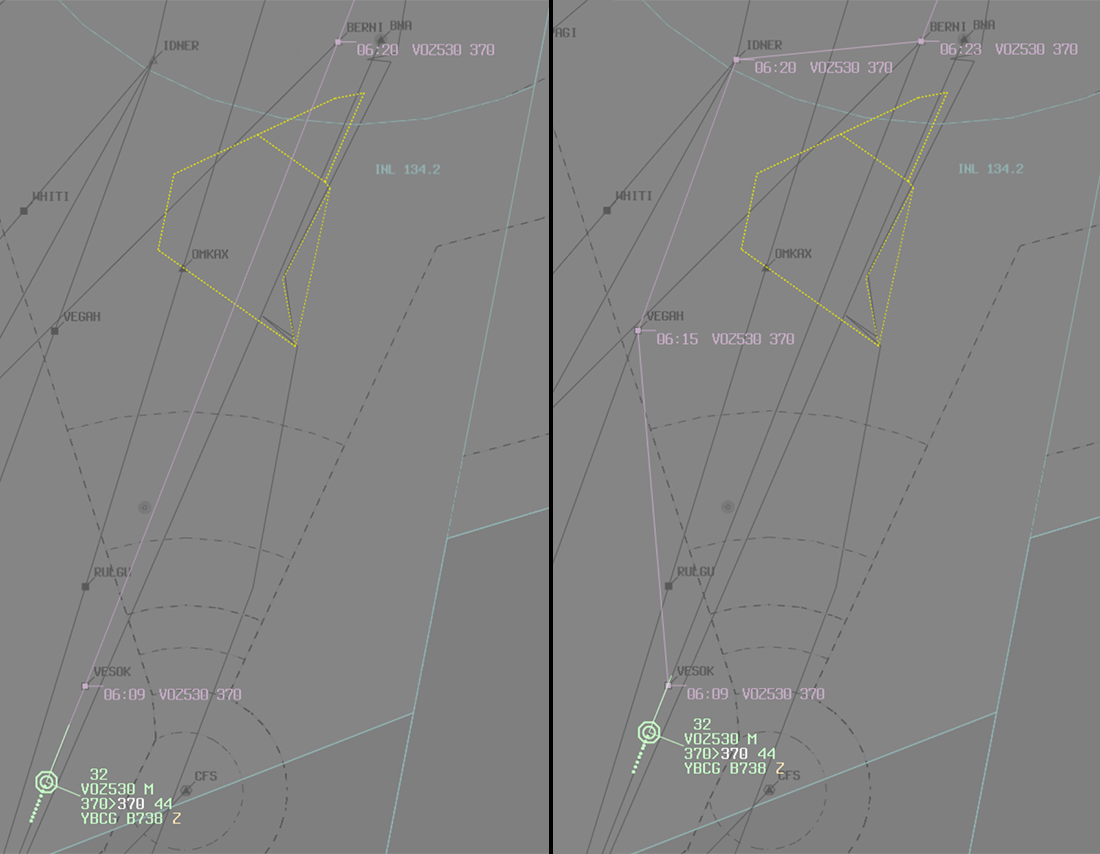
By default, vatSys will select the BERNI STAR with no transition. This can be manually overridden in the aircraft's flight plan.
Sequencing
Initial sequencing is performed by all sectors, with the final sequencing action performed by GOL.
YBNA
STAR Assignment
The following subsectors are responsible for issuing STAR clearance.
| Subsector | STAR | Type | Notes |
|---|---|---|---|
| INL | UPSEL | All |
Arrivals from other sectors should be issued with descent and tracking instructions appropriate for the runway configuration, following coordination.
Runway 06 Arrivals
When the R638 Evans Head restricted areas are activated, aircraft must be assigned the UPSEL XRAY or YANKEE STARs, rather than the ALPHA or BRAVO. These prcocedures will ensure the aircraft remains clear of the restricted area.
Sequencing
INL is responsible for initial sequencing for aircraft arriving from the south. NSA, SDY and GOL are responsible for initial sequencing for aircraft arriving from the north/east, with final sequencing actions are performed by GOL.
YBSU
STAR Assignment
The following subsectors are responsible for issuing STAR clearance.
| Subsector | STAR | Type | Notes |
|---|---|---|---|
| BUR | SEBVA | All | |
| GOL | ITIDE | All | Descent not below F130 |
| SDY | ITIDE | All |
Arrivals from other sectors should be issued with descent and tracking instructions appropriate for the runway configuration, following coordination.
Arrivals from the south shall be given initial descent to not below F130. NSA will issue final descent.
Sequencing
BUR, GOL and SDY are responsible for initial sequencing for aircraft arriving from the east, west, and south. KPL is responsible for initial sequencing for aircraft arriving from the north/east. Final sequencing actions are performed by NSA.
Coordination with KPL should be conducted to ensure that aircraft from each sector are sequenced appropriately with each other.
YCFS
Coffs Harbour (YCFS) lies under the INL/MNN boundary. INL is responsible for issuing descent to aircraft arriving into YCFS from the north.
Sequencing
INL and MNN share a joint responsibility to build the final sequence of arrivals into YCFS when the tower is open. Coordination with MNN should be conducted to ensure that aircraft from each sector are sequenced appropriately with each other.
Local Procedures
Military Corridors
There are three military corridors established around the AMB/OK TCU and BN TCU to facilitate transit of military aircraft between the TCU and adjoining SUAs.
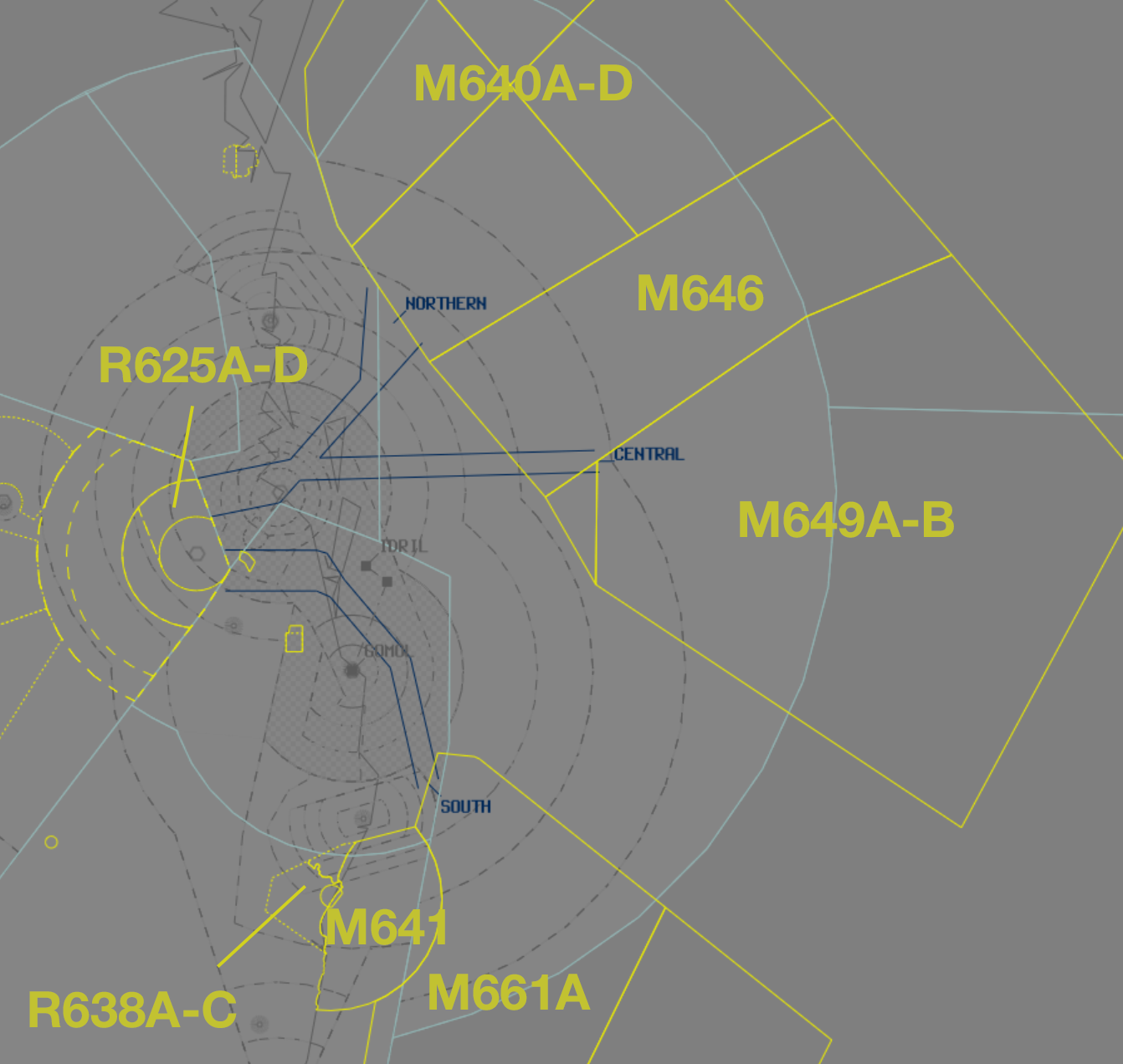
These corridors are located outside the jurisdiction of the AMB TCU.
Aircraft departing to the AMB TCU will be cleared the relevant coded clearance by AMB ACD. Aircraft returning to the airport will be cleared the relevant coded clearance by INL.
Aircraft transiting the Thunder Corridor should be assigned the appropriate altitude to ensure separation with opposite direction traffic while transiting to their desired restricted area.
Special Use Airspace
There are multiple volumes of SUA within INL airspace, mostly associated with military operations in and out of YAMB and YBOK.
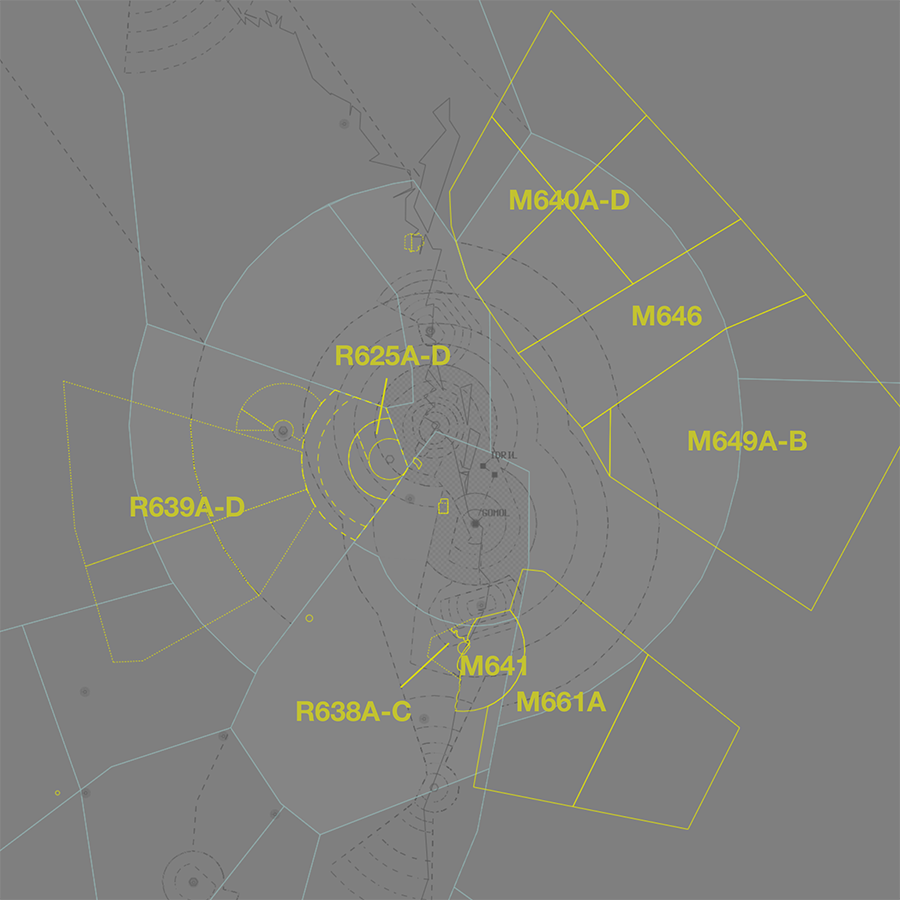
AMB and OK TCU must give heads up coordination with the relevant enroute controllers prior to any departures intending to operate in a currently inactive SUA.
Phraseology
AMA -> INL: "On the groud YAMB, DRGN31, requests activation of M640A-D A050-F240, from 0300 until 0500.”
INL -> AMA: "DRGN31, expect activation of M640A-D A050-F240 at 0300 until 0500."
AMA -> INL: "DRGN31."
Non-participating aircraft intending to transit an activated SUA should be rerouted, where possible, subject to the VATSIM Code of Conduct.
M640A-D Amberley
The M640A-D Amberley MOAs are located offshore within the SDY, KPL, and TSN(FLD) subsectors. The restricted areas are connected to the AMB TCU by the Northern Corridor.
Aircraft departing the AMB TCU will be cleared the NORTHERN 5 coded clearance. Aircraft returning to the TCU will be cleared the NORTHERN 6 coded clearance by INL.
Affected Civil Operations
When activated, these MOAs disrupt traffic on the A598 and H224 high altitude airways, which connects YBBN to the Solomon Islands.
| Planned Airway | ERSA Recommended Rerouting |
|---|---|
| A598 | ... Q67 GUDSO Q24 TERUV PUGEL |
Note
Aircraft tracking via a recommended rerouting must still be separated from the SUA laterally and vertically. After amending flight plans for the purposes of rerouting around SUA, controllers should ensure the route is displayed visually and the BRL is used to measure for >2.5nm clearance with all parts of the SUA.
M646 & M649A-B Amberley
The M646 and M649A-B Amberley MOAs are located offshore within the SDY, MNN and TSN(FLD, HWE) subsectors. The restricted areas are connected to the AMB TCU by the Central Corridor.
Aircraft departing the AMB TCU will be cleared the CENTRAL 4 coded clearance. Aircraft returning to the TCU will be cleared the CENTRAL 5 coded clearance by SDY.
M661A-B, M641, and R638A-C Evans Head
The M661A-B, M641, and R638A-C Evans Head SUAs are located south of YBNA within the GOL, INL, SDY and TSN(HWE) subsectors. The restricted areas are connected to the AMB TCU by the South Corridor.
Aircraft departing the AMB TCU will be cleared the BYRON 1 coded clearance. Aircraft returning to the TCU will be cleared the BYRON 2 coded clearance by SDY.
Affected Civil Operations
When activated, the restricted areas distrupt traffic within BAA airspace, aircraft arriving YBCG via BERNI, and aircraft on the T53 and P880 high altitude airways, which connect the BN TMA to New Zealand.
| Planned Airway | ERSA Recommended Rerouting |
|---|---|
| T53 (eastbound) | GOMOL LAMSI N584 SAKBI ... |
| P880 (westbound) | ... SIFRA N584 LAMSI |
Note
Aircraft tracking via a recommended rerouting must still be separated from the SUA laterally and vertically. After amending flight plans for the purposes of rerouting around SUA, controllers should ensure the route is displayed visually and the BRL is used to measure for >2.5nm clearance with all parts of the SUA.
STAR Clearance Expectation
Handoff
Aircraft being transferred to the following sectors shall be told to Expect STAR Clearance on handoff:
| Transferring Sector | Receiving Sector | ADES | Notes |
|---|---|---|---|
| INL | ARL | YSSY | |
| INL | GAH | YSWS | |
| INL | GOL | YBSU | |
| NSA, BUR | KPL | YBMK, YBRK |
Terminal Handover Frequencies
Aircraft being transferred from enroute to a TCU with multiple frequencies shall be given the frequency for the revelant TCU position.
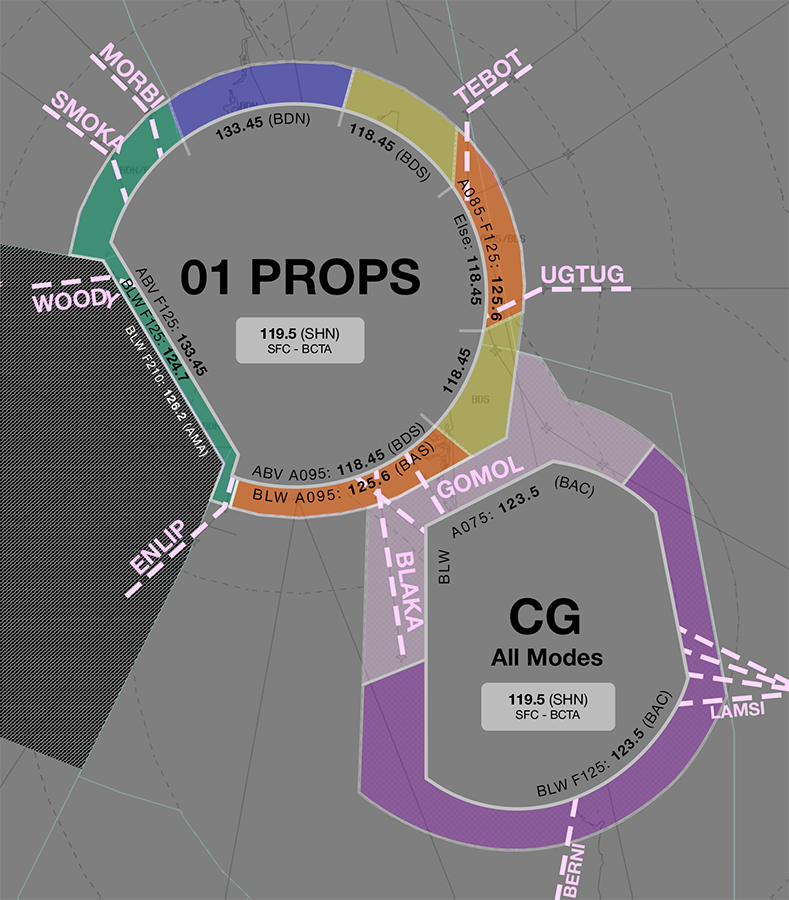
| ADES | STAR | Frequency (Controller) |
|---|---|---|
| YBBN | BLAKA | 125.600 (BAS) |
| YBBN | ENLIP | 124.700 (BAN) |
| YBBN | GOMOL | 125.600 (BAS) |
| YBBN | MORBI | 124.700 (BAN) |
| YBBN | SMOKA | 124.700 (BAN) |
| YBBN | TEBOT | 125.600 (BAS) |
| YBBN | UGTUG | 125.600 (BAS) |
| YBBN | WOODY | 124.700 (BAN) |
| YBCG | All | 123.500 (BAC) |
| YBNA | All | 118.350 (BAA) |
Tip
The quick reference tables above only include scenarios for which there is voiceless coordination. Refer to the diagram for the appropriate position/frequency for coordination and handoff for all other situations.
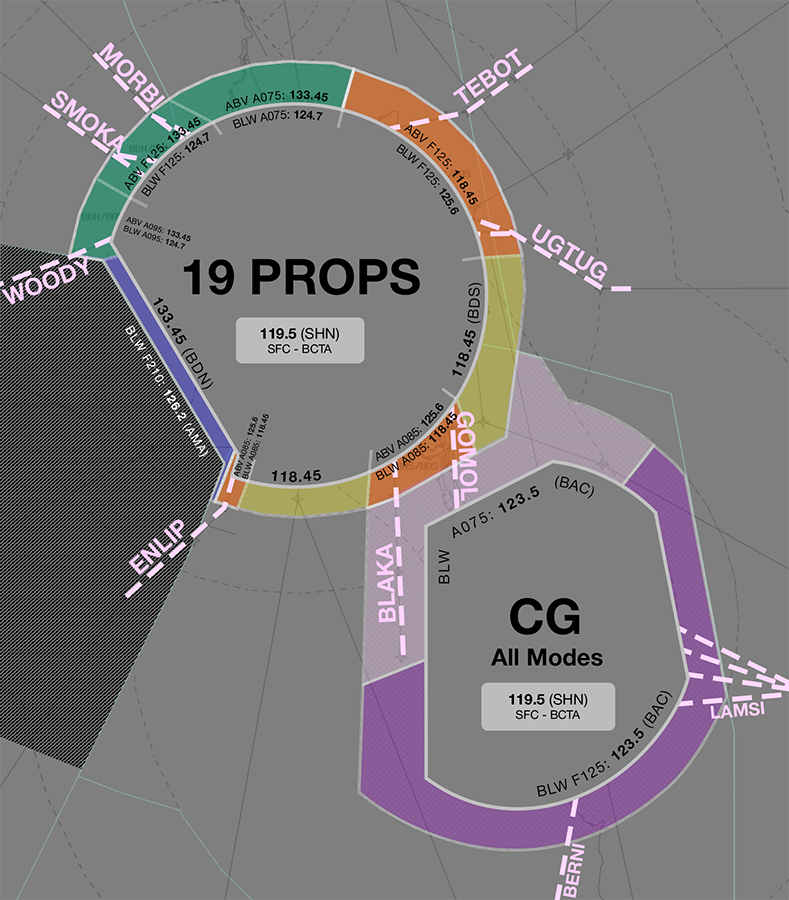
| ADES | STAR | Frequency (Controller) |
|---|---|---|
| YBBN | BLAKA | 125.600 (BAS) |
| YBBN | ENLIP | 125.600 (BAS) |
| YBBN | GOMOL | 125.600 (BAS) |
| YBBN | MORBI | 124.700 (BAN) |
| YBBN | SMOKA | 124.700 (BAN) |
| YBBN | TEBOT | 125.600 (BAS) |
| YBBN | UGTUG | 125.600 (BAS) |
| YBBN | WOODY | 124.700 (BAN) |
| YBCG | All | 123.500 (BAC) |
| YBNA | All | 118.350 (BAA) |
Tip
The quick reference tables above only include scenarios for which there is voiceless coordination. Refer to the diagram for the appropriate position/frequency for coordination and handoff for all other situations.
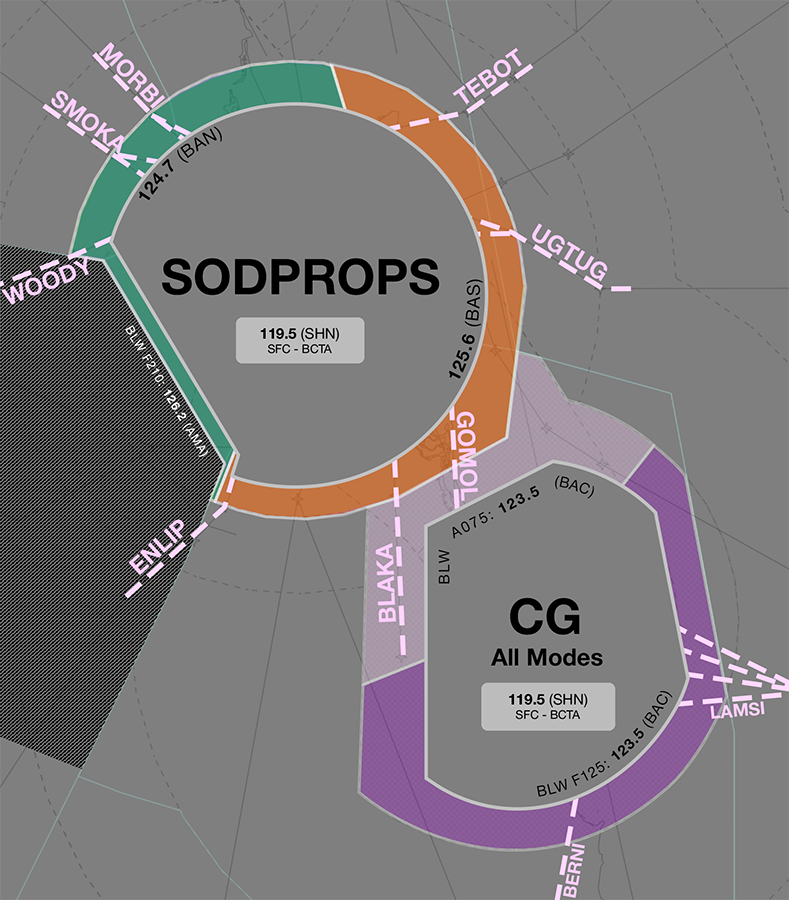
| ADES | STAR | Frequency (Controller) |
|---|---|---|
| YBBN | BLAKA | 125.600 (BAS) |
| YBBN | ENLIP | 125.600 (BAS) |
| YBBN | GOMOL | 125.600 (BAS) |
| YBBN | MORBI | 124.700 (BAN) |
| YBBN | SMOKA | 124.700 (BAN) |
| YBBN | TEBOT | 125.600 (BAS) |
| YBBN | UGTUG | 125.600 (BAS) |
| YBBN | WOODY | 124.700 (BAN) |
| YBCG | All | 123.500 (BAC) |
| YBNA | All | 118.350 (BAA) |
Tip
The quick reference tables above only include scenarios for which there is voiceless coordination. Refer to the diagram for the appropriate position/frequency for coordination and handoff for all other situations.
Coordination
BN TCU/BAC/BAA
Airspace
The Vertical limits of the BN TCU are SFC to F180, except in BAA airspace, where it is SFC to F125, and in BAC airspace, where it is SFC to A075 in the northwest, and SFC to F125 in the southeast.
Refer to Brisbane TCU Airspace Division for information on airspace divisions when BAS, BDN and/or BDS are online.
Arrivals/Overfliers
Voiceless for all aircraft:
- With ADES YBBN:
- Assigned a STAR; and
- Assigned
A090.
- With ADES YBCG:
- Assigned a STAR, and assigned
F130; or - Tracking via
BN Y177 IDRIL NOPAS GOMOL, and assignedF190.
- Assigned a STAR, and assigned
- With ADES YBNA:
- Assigned a STAR; and
- Assigned
F120
Additionally, voiceless coordination exists between INL and BN TCU for YBCG arrivals tracking via BN and assigned F190.
All other aircraft coming from INL CTA must be Heads-up Coordinated to BN TCU/BAC prior to 20nm from the boundary.
Departures
Voiceless for aircraft:
- With ADEP YBBN
- Tracking via a Procedural SID terminus^; and
- Assigned the lower of
F180or theRFL
- With ADEP YBCG
- Tracking via APAGI and assigned the lower of
F120or theRFL; or - Tracking via BN and assigned the lower of
F180or theRFL
- Tracking via APAGI and assigned the lower of
- With ADEP YBNA
- Tracking via IDNER or BUVAM; an
- Assigned the lower of
F120of theRFL
- With ADES YBSU
- Assigned the ITIDE STAR; and
- Assigned
F130
Note
^Aircraft are not required to be tracking via the SID procedure, simply tracking via any of the terminus waypoints (regardless of assigned SID) is sufficient to meet the criteria for voiceless coordination
All other aircraft going to INL CTA will be Heads-up Coordinated by BN TCU/BAC/BAA.
Enroute
As per Standard coordination procedures, Voiceless, no changes to route or CFL within 50nm to boundary.
INL Internal
As per Standard coordination procedures, Voiceless, no changes to route or CFL within 20nm (reduced from 50nm) to boundary.
That being said, it is advised that INL(All) give Heads-up Coordination to the relevant sector prior to 20nm from the boundary in the following scenarios:
- INL to DOS for all aircraft
- DOS to BUR, NSA, GOL and INL for all aircraft
- SDY to NSA, GOL and INL for all aircraft
CFS ADC
Airspace
CFS ADC is responsible for the Class D airspace in the CFS CTR SFC to A045.
Refer to Reclassifications for operations when CFS ADC is offline.
Departures
Next coordination is required from CFS ADC to INL for all aircraft entering INL CTA.
The standard assignable level from CFS ADC to INL is:
| Aircraft | Level |
|---|---|
| All | The lower of A070 and RFL |
Where possible (and no possible conflict exists), a higher level shall be assigned by for high performance aircraft during next coordination.
Arrivals/Overfliers
YCFS arrivals and overfliers shall be coordinated to CFS ADC from INL prior to 5 mins from the boundary.
Phraseology
INL -> CFS ADC: "via IDNER, VET"
CFS ADC -> INL: "VET"
The standard assignable level from INL to CFS ADC is A080, any other level must be prior coordinated.
SU ADC
Airspace
SU ADC is responsible for the Class D airspace in the SU CTR SFC to A045.
Refer to Reclassifications for operations when SU ADC is offline.
Departures
Next coordination is required from SU ADC to NSA/BUR for all aircraft entering NSA/BUR CTA.
The standard assignable level from SU ADC to NSA/BUR is:
| Aircraft | Level |
|---|---|
| All | The lower of A040 and RFL |
Where possible (and no possible conflict exists), a higher level shall be assigned by NSA/BUR for high performance aircraft during next coordination.
Arrivals/Overfliers
NSA must ensure all YBSU arrivals have been assigned a STAR, unless the pilot is unable to accept one.
YBSU arrivals and overfliers shall be coordinated to SU ADC from NSA prior to 5 mins from the boundary.
Phraseology
NSA -> SU ADC: "via ITIDE2W Arrival, JST731"
SU ADC -> NSA: "JST731"
The standard assignable level from NSA to SU ADC is A060, any other level must be prior coordinated.
OK TCU / AMB TCU
Airspace
By default, OK TCU owns the airspace within the R654A-D restricted areas from SFC to F125, and AMB TCU owns the airspace within the R625A-D restricted areas from SFC to F210.
Departures
All aircraft from AMB/OK TCU to INL(All) require Heads-up coordination prior to the boundary. Expect this coordination to be completed a short time after the aircraft becomes airborne (pending controller workload).
Phraseology
AMA -> NSA: "via COWIE, BUCK03."
NSA -> AMA: "BUCK03, F190"
Arrivals/Overfliers
All aircraft transiting from INL(All) to OK TCU and AMB TCU must be heads-up coordinated prior to 20nm from the boundary. Operations within OK TCU and AMB TCU are fairly ad-hoc, so there are no standard assignable levels. ENR and TCU controllers should coordinate to determine the most suitable level.
Phraseology
GOL -> AMA: "via HUUGO, STAL13, what level can I assign?"
AMA -> GOL: "STAL13, A090"
GOL -> AMA: "A090, STAL13"
TSN(HWE/FLD) (Oceanic)
As per Standard coordination procedures, Voiceless, no changes to route or CFL within 15 mins to boundary.
Aircraft must have their identification terminated and be instructed to make a position report on first contact with the next (procedural) sector.
Phraseology
INL: "QFA121, identification terminated, report position to Brisbane Radio, 126.45"